Showing posts with label strategy. Show all posts

Friday, August 1, 2025

Moral Clarity on the Anniversary of the Atomic Bombings


Reposted yearly as a much needed part of the conversation. 

        August 6th marks the dubious day in 1945 where America became the only power to use a nuclear bomb. This continues to spark controversy. From 1945 to 2005 American approval of the bombings has dropped from 85 to 57 percent. And a record low number of Americans are proud of their country. This is somewhat understandable as societal attitudes change and there is a great deal to critique over the decision. But it might also be what the editors at the National Review recently pointed out is part of the crisis of self-doubt gaining traction in America and what Wilfred McClay called a deeply unserious country that doesn’t believe in itself. Yet a proper study of the history surrounding the decision to drop the bombs and an examination of ethics finds the bombing was both justified and necessary.

        During the war both sides held a great deal of racial animus towards one another, which suggests the bomb might have been more willingly used because of racism.[1] Though, the bomb wasn’t ready in time to end the war against Germany so that is hard to gauge. Using an area effect weapon that didn’t distinguish between civilians and military targets invites condemnation.[2] The lack of military targets in Hiroshima and the dubious effectiveness of the bomb makes some people say this was terrorism.[3] After all, the Strategic Bombing survey revealed that the trains ran normally a mere two days later and this was often considered a way to stun the Japanese into surrendering and impress the Russians with the viability of the program.[4] (Though it should be noted that both cities had important military components. Both cities house important military garrisons as well as critical war industries, and Nagasaki was a foremost military shipping depot, and thus remained valid military targets.) Plus, there were supposedly peace feelers from the Japanese that made this completely unnecessary.

        As I will show below, these are all extremely flawed arguments that don’t accurately reflect the historical context and seem like excuses to blame American and undermine moral confidence today, instead of understanding the tragic but justified decisions of the past. Most importantly, every moral argument against the bombing fails because every blood soaked alternative was worse! 

        The strongest criticism regards peace overtures from Japanese officials. Who doesn’t want the war to end early? This theory argues that the Japanese were ready for peace and only block headed, blood thirsty, and maybe even racist generals kept the war going. These were detailed by a revisionist historian, Gar Alperovitz and thus come long after the fact when it became more fashionable to search and promulgate these theories.[5] More importantly, this theory cherry picks some information and leave out much more important events that shows these peace feelers were completely impotent and U.S. officials were correct when they disregarded them.

        The best evidence against this theory comes after the Japanese emperor’s decision to surrender. After America dropped the bombs and the emperor wanted peace army leaders challenged and almost reversed the decision through a military coup. Up until the dropping of the second bomb Japanese officials thought a defense of Japan could produce favorable peace terms that at times included conditional surrender, voluntary reduction (but not elimination) of their military, and protections from war crimes tribunals.[6] The peace overtures before the dropping of the bomb were impotent, and dropping the required of unconditional surrender ignores the many other conditions that Japanese officials favored until the second atomic bombing.

        Let me stress, even AFTER America dropped atomic bombs significant factions in Japanese leadership wanted to keep fighting. Peace was not possible before the bombs were dropped. The idea is an ahistorical fantasy used by modern pundits to attack America. Moreover, American willingness to negotiate before the bombs dropped would have emboldened the Japanese and aggressive army generals to think that more fighting would have secured more concessions.

        Other critics quote leaders who sound authoritative but really aren’t because these quotes also ignore historical context. One example comes from Eisenhower who said: [I believe] that Japan was already defeated and that dropping the bomb was completely unnecessary…[7]

        With all due respect to Eisenhower and other leaders cherry picked for opposing nuclear weapons, he was thousands of miles and away and was not privy to the intelligence and decision-making councils that led to it. It would be like Admiral Nimitz second guessing Eisenhower’s decision to stop at the Elbe. Eisenhower is a particularly odd choice for opposing nuclear weapons since his New Look military relied so heavily on nukes and spooks.[8] Those that blanche at the use of nuclear weapons and hate the national security state should probably avoid quoting a general that as president, threatened to use nuclear weapons in the Taiwan Strait crises, and unleashed CIA sponsored coups on democratically elected governments in Iran and Guatemala that still reverberate today.

        Other military critics were vocal against nuclear weapons not because of moral principles, but because of parochial rivalries. The bombs were delivered by bombers, and this helped Curtis LeMay argue for the creation of an independent Airforce. In turn, this would take resources and prestige away from the Navy and Army chiefs, who were incredibly territorial, had differing strategies and demands, and wanted the air corps assets divided between them.[9] Thus it isn’t surprising to find that admirals would elevate the role of commerce raiding in the defeat of Japan and minimize the “barbaric” “toy” dropped by the budding air corps. Their opposition had little to do with the moral concerns of the time and are especially dissimilar from modern antiwar sentiments. In fact, the admirals and generals used as props against nuclear weapons respectively preferred a blockade of the Japan that would have slowly killed millions, or an invasion that would have also killed millions (see below.)

        The sad truth is that the Japanese would not surrender without the atomic bomb dropping or millions (of Americans, Japanese, and Chinese) dying from an invasion. The East Asian victims of Japanese aggression are often forgotten in Western centric debates over the war. But the Japanese launched the Ichigo offensive in late 1944 which was comparable in size and scope to the German invasion of the Soviet Union.[10] Nationalist Chinese leader Kiang Chai Shek had seen a great deal of bloodshed but called this period the worst of his entire life. By 1945, an estimated 200,000 Chinese a month were dying. Many more on both sides would have died in fighting on the Japanese homeland. 
        
        The various estimates are disputed, often based on ideological preference, but General Marshall estimated 300,000 to 1,000,000 casualties (later updated to 1.2 million). Secretary of War Stimson estimated that 400,000 to 800,000 Americans would have died, (including 100,000 prisoners of war that were set to be executed upon invasion), and 5 to 10 million Japanese would have died from an invasion.[11] If the war only lasted another six months to a year that, the heavy combat and conventional strategic bombing campaign would have resulted in 1.2-2.4 million Chinese deaths. The estimated deaths for all combatants (American, Chinese, Japanese) without dropping the bombs would have been between 6.5 million and 13.4 million. But somehow shallow sermonizers against the bomb would have us believe that was the better choice. 

        The U.S. could have blockaded the country. The admirals at the time and later scholars argued that the U.S. had already destroyed much of Japanese shipping and merchant marine by August 1945,[12] and this may have been what Eisenhower meant by already defeating Japan, but then America would have to wait for the country to starve to death. That would have caused more deaths and in a slower manner, arguably worse than two nuclear bombings. Its effects would have been unevenly felt across the population. With the elites that caused the war suffering far less than the population that fought it. It also would have given the Japanese army in China more time in their genocidal war against China and again, it would have been more deadly for all sides than the two atomic bombs. 

        Even then, any peace offering from the emperor would have likely faced a coup just like the surrender after the atomic bombings. Moreover, starving the population as a tactic is a war crime. The admirals who argued for this arguably unjust and criminal course didn't object to the morality of using the bomb, their objection was simply the result of petty inter service rivalries. Yet they are drafted, out of context, into modern, post hoc debates regarding the morality of using atomic weapons. 

        The quick end to the war had the felicitous effect of forestalling a Soviet invasion. The first atomic bomb was dropped literally the day after Stalin finalized plans to invade Japan and Stalin invaded a day after the second bombing. The Soviets treated Eastern Europeans to show trials, mass deportations to the gulags, and they stood by while free Poles died in the Battle of Warsaw. (Stalin was so petty he didn't even let allies use his airspace to drop supplies.) It was obviously a benefit to end the war quickly and prevent the negative effects of Communist rule seen in East Germany and Eastern Europe even today. 

        After looking at the other options and strategic context in late 1945, the decision to drop the bomb was moral and justified. In fact, ending the war for mere hundreds of thousands of lives lost compared to the abject blood bath and tens of millions of deaths is why the allied leaders considered this weapon a godsend. Even though Michael Walzer opposed nuclear weapons, he also said that ending a war swiftly with a minimum of causalities is the greatest kindness a leader could offer.[13] Secretary of State Henry Stimson exemplified the latter idea when he said: My chief purpose was to end the war in victory with the least possible cost in the lives of the men in the armies which I had helped to raise. In the light of the alternatives which, on a fair estimate, were open to us I believe that no man, in our position and subject to our responsibilities, holding in his hands a weapon of such possibilities for accomplishing this purpose and saving those lives, could have failed to use it and afterwards looked his countrymen in the face.[14]

        In short, every other option was worse than using atomic weapons! Taken in a vacuum, of course nuclear weapons are horrific. It sounds authoritative to declare their use immoral and it makes a nice bumper sticker to sarcastically assert that Jesus would nuke people. But that weapon wasn’t used in a vacuum. It was used against a horribly aggressive regime and it prevented other options that would have killed millions more. The argument about a regrettable use of a shocking weapon to quickly end the war doesn't make a convenient bumper sticker, but its correct and morally superior to the alternatives. 

        It is both unfair and shallow to blame America for their barbaric use of atomic weapons while ignoring the context of that fierce war which compelled and justified their use. I bet that many of the pacifists today are descendants of servicemen and women that came home and had babies instead of dying because the atomic bombs prevented so much needless bloodshed. Many of the Japanese and Chinese people today are descendants of those that didn't die because of the millions of deaths the bombs obviated. And all of those people have lived, loved, laughed, hugged, and created beautiful works of art because the war ended without a horrific bloodbath. 

        Americans and members of the church must rightly hope to avoid the tragedy of ever having any conflict. But Vladimir Putin’s invasion of Ukraine and the genocidal campaign of Hamas sadly remind us that the specter of war can never be vanquished with hopeful thoughts. Americans can recognize that war, particularly defending life against the most genocidal regimes of the 20th century, was necessary, and the atomic bombings were a necessary and justified choice in World War II. Every American should strive to have the knowledge and tools to properly judge the morality of the past, which in turn provides the moral confidence to justly proceed in the present.

Thanks for reading. If you found value in this work please consider donating using the paypal button below or buy one of my books linked in the top left. If you're attacking me somewhere online about this post, please use the code word: war plan orange, to let me know you've actually read my argument.

*****
[1] For a good overview, see John Lynn, Battle: A History of Combat and Culture, (New York: Basic Books, 2009), chapter 7.
[2] Micheal Walzer, Just and Unjust Wars, (New York, Basic Books, 2015), 250-260.
[3] Howard Zinn, “Breaking the Silence.” ND. (https://web.archive.org/web/20071201172331/http://polymer.bu.edu/~amaral/Personal/zinn.html Accessed August 6th, 2021.)
[4] The United States Strategic Bombing Survey: Summary Report: 24. The United States Strategic Bombing Survey: The Effect of the Atomic Bombs on Hiroshima and Nagasaki, 6. https://docs.rwu.edu/cgi/viewcontent.cgi?article=1000&context=rwu_ebooks
[5] Gar Alperovitz, The Decision to Use the Atomic Bomb, (Vintage Books: 2010). https://mises.org/library/hiroshima-myth
[6] Richard Frank. Downfall: The End of the Japanese Empire, (Random House, 2001), 97.
[7] Julian Borger, “Hiroshima at 75: Bitter Row Persists Over US Decision to Drop the Bomb, The Guardian, August 5th, 2020, (https://www.theguardian.com/world/2020/aug/04/hiroshima-atomic-bomb-us-japan-history (Accessed August 6th 2021.)
[8] Gordon H. Change, He Di, “Eisenhower’s Reckless Nuclear Gamble over the Taiwan Strait,” American Historical Review 98 (December 1993), 1502-1523.
[9] Keith McFarland, "The 1949 Revolt of the Admirals" Parameters: Journal of the US Army War College Quarterly. XI (2): 53–63.
[10] Morgan Deane, Decisive Battles in Chinese History, (Westholme Press, 2017), chapter 12.
[11] Frank, Downfall, 340.
[12] Strategic Bombing Survey: Summary Report, 11.
[13] Michael Walzer, Just Wars, quoting Moltke the Elder, 47.
[14] Henry L. Stimson, as quoted in The Great Decision: The Secret History of the Atomic Bomb (1959) by Michael Amrine, p. 197

Thursday, June 5, 2025

Where will it lead? Dallin Oaks Supports Preemptive War


        Not too long ago the current member of the first presidency, Dallin H Oaks, gave a talk entitled, Where will this lead? He discussed the importance of basing current decisions on future events.

The setting was a beautiful college campus. A crowd of young students was seated on the grass…[T]hey were watching a handsome tree squirrel with a large, bushy tail playing around the base of a beautiful hardwood tree. Sometimes it was on the ground, sometimes up and down and around the trunk…

Stretched out prone on the grass nearby was an Irish setter. He was the object of the students’ interest, and the squirrel was the object of his. Each time the squirrel was momentarily out of sight circling the tree, the setter would quietly creep forward a few inches and then resume his apparently indifferent posture. This was what held the students’ interest. Silent and immobile, their eyes were riveted on the event whose outcome was increasingly obvious.

Finally, the setter was close enough to bound at the squirrel and catch it in his mouth. A gasp of horror arose, and the crowd of students surged forward and wrested the little animal away from the dog, but it was too late. The squirrel was dead.

        Personally, I would have let nature take its course. Any squirrel that wasn’t savvy enough to dodge a dog would probably ruin the gene pool anyway. But President Oaks then discussed the point of this true-life parable, not too different from the parable I offered:  

Anyone in that crowd could have warned the squirrel at any time by waving his or her arms or crying out, but none did. They just watched while the inevitable outcome got closer and closer. No one asked, “Where will this lead?” When the predictable occurred, all rushed to prevent the outcome, but it was too late. Tearful regret was all they could offer…

[This] applies to things we see in our own lives and in the lives and circumstances around us. As we see threats creeping up on persons or things we love, we have the choice of speaking or acting or remaining silent. It is well to ask ourselves, “Where will this lead?” Where the consequences are immediate and serious, we cannot afford to do nothing. We must sound appropriate warnings or support appropriate preventive efforts while there is still time.

        What astounded me about this story is how closely it parallels the arguments that I’ve been making for years. The late 17th century theorist Samuel Puffendorf described the principle as a right to defend yourself from a “charging assailant with sword in hand.” The Book of Mormon implies this principle when it says Nephites were taught “never to raise the sword” except to preserve their lives (Alma 48:14). This is commonly assumed to mean defense. But there is a time between raising a sword and swinging the sword. As well as a time before swinging a sword and striking someone with a sword. Thus, defense doesn’t begin when the sword hits you or hits you three times as some inappropriately apply Doctrine and Covenants 98, but defense begins when the sword is raised but hasn't yet struck. Or as summarized by Grotius: when the attack is commenced but not carried out.

        The basic principle was best explained by the early modern scholar, and founder of international law, Hugo Grotius. He described the principles of intent, means and imminency. This applies personally and intentionally. A short time ago Israel saw thousands of Hezbollah rockets pointed at them. They had an avowed enemy with an expressed intent to exterminate Israel. The means consisted of thousands of rockets pointed at Israel. Those rockets were ready to launch, and Israel had solid intelligence that the launch was imminent. So, Israel exercised their God given right to defend themselves from a raised sword.

        Personally, this is just as applicable. A crazed men enters the subway. He yells about his intent that he wants to stab people and doesn’t care if he goes to jail. He waves around the knife in his hand. And he is so deranged an attack seems imminent. I’m not making any of this up, this was the Neely subway attack. Thankfully, a brave Good Samaritan that deserves a medal put the man in a choke hold and prevented an attack. He and other subway passengers didn’t stand around and say to themselves, “this is really dangerous, lets see where he’s going with this.” They didn’t wait until the attack was carried out, in which they or others would have already been hurt. They acted preemptively.

        Even comedians understand this principle! A young mother was at a sketchy motel in the movie, Manos: The Hands of Fate. When the strange motel employee, Torgo, started palming her hair the RiffTrax comedian jokingly added her line, “This is super creepy but I’ll just stand right here and see where he’s going with this.”

        And now, I found that one of the leaders of the church understands the principle as well. “Where the consequences are immediate and serious, we cannot afford to do nothing. We must sound appropriate warnings or support appropriate preventive efforts while there is still time.

        This, dear readers, is the essence of justified preemptive war. I’ve been accused of being a warmongering, insane, deranged anti-Christ and war criminal with a stench of death for espousing these views.  All I want is for people to be safe and exercise their God given rights to defense. Now I find this view espoused by President Oaks.

        This principle has one more ironic note. Dallin H. Oaks is often quoted by peace advocates for his story about stopping a mugging by expressing tenderly, fatherly care.[1] The lesson gathered is somewhat misplaced, since an approaching bus distracted the mugger and seemed to have at least as much dissuasive power as Oak’s expressions of “assertive love.” On top of that, it’s rather condescending of pacifists to take one story and make it a general rule that should apply to everyone. Moreover, Dallin Oaks himself recognizes the need for preemptive action or else he wouldn’t have shared the parable of the squirrel years later.

        There is a great deal more evidence for preemptive war than many people realize. It has a strong theoretical basis based on solid reasons. The concept has implied scriptural support through Alma 48:14 and numerous other scriptures or stories. This includes Mosiah 9:1, the events after Alma 26:25, Helaman 1, Helaman 2, and even a careful reading of supposedly disqualifying verses like 3rd Nephi 3:21 or Mormon 4:4 support the practice. It works in the practical world ranging from the subway to missiles and it’s been practiced by everyone from Epaminondas to Moroni. Finally, its fundamental truth is explained by a supportive Dallin Oaks. We must ask where something will lead. When the cost of inaction is too dangerous, we are not only allowed, but commanded to take appropriate preemptive action.

Thanks for reading! If you found value in this work please consider donating using the paypal button at the bottom of the page. Or you maybe purchase one of my books in the top left. 
**********

[1] Patrick Mason and David Pulsipher, Proclaim Peace: The Restoration’s Answer to an Age of Conflict, Maxwell Institute, Deseret Book, 2021) 109-113.

Monday, February 3, 2025

Grotius and the Book of Mormon


 Over at Mormon Dialog and Discussion Board there is a detailed discussion about methodology and if the 17th century philosopher, Hugo Grotius, wrote the Book of Mormon. As someone with a book on the subject and significant knowledge of Grotius I got tagged and felt obligated to respond. I also rarely get a chance to discuss the 17th century thinker Grotius and topics like preemptive war and my book so this was a good opportunity. This is copy and pasted from the board so I apologize for any weird formatting. 

        I appreciate being tagged on this. My newest book on just war in the Book of Mormon discusses Grotius a great deal. Its been well reviewed thus far and you can read those reviews and find a link to the book here: https://mormonwar.blogspot.com/2024/12/reviews-of-my-new-book.html

        I've been working a great deal so I can't go into extensive detail but I've got a few points worth mentioning about the topic.

        The major thrust of my book doesn't simply show congruency. As Ben has explained (many, many times) I think people tend to see what they want to see so the comparisons aren't very useful. What I did was use the keen insights of Grotius to better explain under studied elements in the Book of Mormon, and then in turn use those extra insights from the Book of Mormon to comment on matters of just war. Its a conversation among great thinkers more than finding comparisons. 

        To cite one specific topic with two examples we might look at the concept of preemptive war. I know most people think the Book of Mormon dismisses the concept out of hand. But the most frequently cited verse in Mormon 4, actually condemns the heart that makes the strategy not the strategy. The Nephites lost a great deal on the defensive too. I found 9 other verses that discuss the concept and show its use. I don't want to get too off in the weeds but if you want you can read more about it here: https://squaretwo.org/Sq2ArticleDeaneKishkumenDagger.html

        Probably the most important scriptures for this discussion are Alma 46:30 when Moroni justifies his capture attempted capture of Amalickiah, and Helaman's servant in Helaman 2 that preemptively kills the assassin before he kills Helaman. 

        These are important for how they interact with Grotius. Most justifications for preemptive war, outside of some more extreme views like Vattel, Gentili, or the Chinese Shizi, focus on the present. According to these theorists, if a nation focused on the past to justify preemptive war leaders would claim that they are reacting to the nefarious nature of the opposing regimes that are warlike and bloodthirsty and thus must be attacked first before they attack again (see Epaminondas for example). A focus on the future would be similar to the Thucydides trap, where Athens, WW1 Britain, WW2 Germany are respectively worried about a rising Sparta, Germany, and Russia. They have to attack now to prevent some greater calamity in the future. But the present is the more accepted position. You can read this from Walzer or in the Caroline Standard, but Grotius' criteria is still the most useful when he said that an enemy must have intent, means  and the defending nation must face an imminent attack. Hugo Grotius, On the Law of War and Peace, Stephen Neff trans., (Cambridge University Press, 2012), 83-84.

        This is where both examples from the Book of Mormon matter. If you read Alma 46:30, you see that all of Moroni's concern's are in the future. Amalickiah has been defeated and is running away, there is no imminent attack, only future problems:

        Now Moroni thought it was not expedient that the Lamanites should have any more strength; therefore he thought to cut off the people of Amalickiah, or to take them and bring them back, and put Amalickiah to death; yea, for he knew that he would stir up the Lamanites to anger against them, and cause them to come to battle against them; and this he knew that Amalickiah would do that he might obtain his purposes.

        This might seem like really obscure theory, but if Grotius wrote the Book of Mormon he wouldn't include details and narratives that contradicted his ideas of imminency. In fact,  many people dissented from the Lamanite king and then seized the "place of arms" (Alma 47:2; 5). So you could argue Amalickiah didn't have means either and many Lamanites didn't have the intent. So Grotius wrote a narrative that contradicts his theory of preemption, and then provided narrative details where Amalickiah fulfilled every worry that Moroni had, thus undermining his own theories even more.      

        The second verse regards Helaman's servant who preemptively killed Kishkumen during his assassination attempt on Helaman. This one is even more clear because Grotius wrote about robbers as a reason for law enforcement and not deadly preemption: if the conspirators “formed a plot, prepar[ed] an ambuscade, poisoning, or readied a false accusation [the planner] cannot lawfully be killed either if the danger can in any other way be avoided, or if [the ruler] thought delays could afford remedies.” (Ibid.) In other words, if the plot can be neutralized by the defenders using other remedies, then they likely haven't gathered the means, shown intent, and attack it isn't imminent enough to warrant deadly force. 

        Yet the servant of Helaman didn't take any other remedies. He was "out by night" and seemingly had plenty of advanced notice (Helaman 2:6). Kishkumen let his guard down and there was time as they "were going forth" to the judgement seat (2:9). A chapter before Nephite leaders seized incipient rebels like Paanchi  and killed them (Helaman 1:8; notice the preemption of the Nephites leaders as they seized him when he was "about" to flatter). Yet the narrative says Helaman's servant killed Kishkumen. We don't exactly know why he didn't call for the guards instead of killing them. But if Grotius wrote the narrative, we would assume that he would clearly articulate his previously stated beliefs that there was enough time to "use other remedies." Some might argue that the narrative doesn't clearly endorse this story as righteous so why bother. But a recent Interpreter article suggests that Moroni's dramatic use of omission about Helaman's servant, while simultaneously detailing the nefarious Gadianton plot, highlights the righteousness of Helaman's servant: https://interpreterfoundation.org/nameless-mormons-dramatic-use-of-omission-in-helaman-2/ 

        Here are a couple examples where extremely specific details from Grotius are entirely contradicted by the Book of Mormon text. I don't like simply showing congruency, or authorship based on poorly thought out similarities. As you can see just from two small examples, a careful study of scriptures, and using those scriptures to have a conversation with the best philosophers, brings new insights and deepens faith. I know I'm biased, but given the positive reactions to my book, and how I've independently published or presented 7 different times based on material from the book, I think its incredibly fruitful. 

Thanks for reading. I work as a free lance author. If you found value in my work please consider donating using the paypal button at the bottom of the page. Or consider buying one of my books linked in the top left. 

Wednesday, May 1, 2024

The Bloodthirsty Commander and King Benjamin's Preemptive War


        Part of an ongoing series about preemptive war in the Book of Mormon. See part onepart twopart threepart fourpart fivepart sixpart sevenpart eight.

        Twice in recent years writers have used Zeniff’s description of his “blood thirsty and austere” commander as evidence that diminishes or casts doubt on the morality of the preemptive attack listed in Mosiah 9:1.

        The first mention comes from a piece which discusses the potential wordplay on “good.” The authors mentioned the preemptive war in Mosiah 9:1, but then focus on the term bloodthirsty. As far as I know, they seem to be the only other authors to recognize the preemptive war in that verse. They only mention it in passing, but they seem to connect the strategy with the description of Zeniff’s bloodthirsty commander.

        The second attempt is from Mark Henshaw who claims the commander's "bloodthirsty" nature undermines the righteousness of the attack. Henshaw’s opposition in this case is especially frustrating because earlier in the same piece he said there is no “unequivocal case of righteous preemptive military action,” as though the Book of Mormon is supposed to be an exhaustive guide to strategy instead of a religious text that testifies of Jesus Christ and his mission. But he also questions the lack of Mormon’s editorial dissent as evidence that favors preemptive war. In other words, the silence of Mormon in not explicitly endorsing preemptive war is enough evidence for Henshaw when dismissing the concept, but Mormon’s lack of explicit dissent is not enough when supporting the concept. It certainly seems like a standard about explicit details that changes based on the side he wants to favor.

        Regardless of his shifting standards regarding details, those we do have in the text do not suggest that the bloodthirsty commander makes this attack unrighteous because the Book of Mormon outlines the importance of the heart, the unreliability of Zeniff’s narrative, and implications of Omni’s narrative that suggests King Benjamin at least allowed this attack.

The Heart:

        As I’ve written about often, the heart remains the most important part of the just warrior. The bloody accounts at the end of the Nephite nation seem like an odd place to make that argument, but they represent the best example of how readers have missed the heart of the matter. A careful reading of the account in Mormon chapter 3 and 4 shows that Mormon is not objecting to offensive warfare but objecting to the wicked state of their hearts.

        In describing the behavior that led to his refusal to lead the Nephites, Mormon wrote (Mormon 39-10):

And now, because of this great thing which my people, the Nephites, had done, they began to boast in their own strength, and began to swear before the heavens that they would avenge themselves of the blood of their brethren who had been slain by their enemies.

And they did swear by the heavens, and also by the throne of God, that they would go up to battle against their enemies, and would cut them off from the face of the land. 

        It was the boasting and swearing that Mormon rejected, and the strategy has been thrown out with the wicked bathwater. As I remind people often, the Nephites lost and were annihilated on the defensive as well. But we blame their hearts for their wickedness and defeat, not the strategy. Once the pattern is recognized that a person can renounce war in their heart while wielding the sword, it becomes clear that it permeates the Book of Mormon, and they can even launch righteous preemptive wars. The importance of the heart includes many scriptures that weren’t considered pertinent to warfare. For instance, in the next chapter of Mormon, “it is the wicked that stir up the hearts of the children of men unto bloodshed” (Mormon 4:5). And in verse 11: “every heart was hardened, so that they delighted in the shedding of blood continually.”

       I could go on for thousands of words, as this subject makes up significant parts of the first and eleventh chapter of my book, as well as multiple blog posts and presentations. But the point is that strategy is assessed independently of the heart. And thus the bloodthirsty commander of the expedition doesn’t necessarily negate the potential reasons for the attack, and the hearts that launched the attack.

The Narrator:

        We don’t even know this commander is bloodthirsty because we depend on an unreliable narrator that admits to seeing what he wants to see in others and being overzealous to the detriment of his own people (Mosiah 9:3). He saw the good in the Lamanites while later admitting he was deceived by cunning (Mosiah 10:18). Despite seeing what was good in them a chapter before, Zeniff then tells us the Lamanites are “wild and bloodthirsty” (Mosiah 10:12).

        If he was so mistaken about the Lamanites, going from good to bloodthirsty and cunning in his description of them, he could be just as mistaken when discussing his “bloodthirsty” commander. In fact, careful reading suggests Zeniff was the aggressor that caused the conflict. (Since Zeniff is giving a primary account, we should accept his narrative more than the secondhand Omni narrative that suggests the commander caused the fight.)

        In Mosiah 9:2 Zeniff “contended” with his brethren and leader to make a treaty with them. Zeniff was the one disobeying orders or the intent of the mission. He argued his point so much that apparently, he was bound and set for execution because he had to be “rescued” by those who agreed with him. As far as I know, this is the only example of munity among Nephite armies. And Zeniff was the culprit. Mormon argued his people were “without order” (Moroni 9:18), and Moroni threatened to “stir up insurrections” (Alma 60:27), but this is the only actual recorded civil war.

        In contrast, the austere and bloodthirsty leader that Zeniff defied was simply following orders or the intent of the mission in the face of intransigence. Zeniff’s disobedience is reinforced when he recounts that in their second attempt Zeniff admits the Lord smote he and his people because they were slow to remember their God (Mosiah 9:3).

        Zeniff is the narrator and sees some good in the Lamanites. But in a mere three verses he is mistaken about the Lamanites, instigated a fight with his commander, mutinous to the point of treason, seems to cause a civil war, and the Lord smote him and his followers for their unrighteousness. A chapter later his people are snared by cunning and unprepared in their defenses. (He had to “invent weapons” in [9:16], and despite being a scout he didn’t set guards until [10:2]). In later chapters they are often wicked (9:17; 11:2-14), and the Lamanites eventually enslaved his people. Zeniff’s account admits in so many ways that he is horribly misguided and that should include the bloodthirsty commander.

The Omni Narrative:

        We should think further about the very start of Zeniff’s account. Zeniff’s account makes it sound like a military expedition. But Omni’s account makes this an armed expedition to settle the land (Omni 27). The Book of Mormon doesn’t record free-lance Nephite attacks from armies. The army is raised (Alma 16:3) and gathered (Helaman 1:19). It is then led by a captain or chief captain appointed by the government or the people. The Book of Mormon does include the free movement of settlers such as Hagoth (Alma 63:-5-6) and Alma the Elder escaping the Lamanite king. But the Anti Nephi Lehi’s had to receive permission to enter Nephite lands (Alma 27:15). And an expedition that was aimed to expel the Lamanites by force of arms in a preemptive attack could be considered an act of war. And a similar expedition by Morianton to “possess” the land of Bountiful made Moroni fearful enough to intercept him (Alma 50:29, 33.)

        If King Benjamin opposed this, it beggars’ imagination to believe that he would have allowed it to continue. There is a chance he didn’t know about it. But the last writer of the Small Plates of Nephi had a brother that joined the attack (Omni 30). And that same writer delivered the plates to King Benjamin (25). In fact, it seems that the loss of that brother ended the direct descendants of Nephi and record keepers, which necessitated the transfer to King Benjamin. All of which suggests a close community which undermines the idea that Zeniff’s party was a secret, free lance attack.

        This means that King Benjamin, “a just man,” who “fought in the strength of the Lord,” the heart that fights righteous wars, actively equipped, supplied, and launched this attack or at the very least, allowed the expedition (Omni 25, Words of Mormon 1:14)! He looked at their swords, heard their intentions to possess the land by preemptively attacking the people there, and didn’t stop it.

       The more passive allowance seems more likely for two reasons. First, the only account of war in this period, Words of Mormon 1:14, says the Nephites “drove the Lamanites out of all the land of their inheritance.” Unless “lands of inheritance” include the aborted attack on the Land of Nephi King Benjamin did not actively launch the attack. In allowing the expedition to leave King Benjamin could have removed some troublesome Nephites (Words of Mormon 1:15-16). These people were so troublesome that upon arrival they immediately descended into civil war where they killed their own kin (Mosiah 9:2).

        Given the separation of the settlers and the Nephites, and the difficulty of the settlers to even find the Nephites decades later (Mosiah 8:8), this seems more like King Benjamin letting separatist settlers leave than some sort of state policy of King Benjamin. All the same, King Benjamin still allowed a preemptive attack and there is no recorded displeasure or “thus we see” sermon from Mormon.

        I’m glad more scholars are studying Mosiah 9:1 and noticing its implications for preemptive war. Unfortunately they are reading too much into the description of the bloodthirsty commander, and not enough about the ample context found throughout Zeniff’s narrative and the Book of Mormon. That context tells us that the heart of the person making the strategy is the most important factor in determining its righteousness. Zeniff is a narrator that consistently shows flaws like his own wickedness, poor decisions, and misreading of the people around him. And there is evidence that the righteous King Benjamin, at least allowed this expedition and could have launched it. For all of these reasons, the description of the bloodthirsty commander by Zeniff does not condemn the use of preemptive war.

 Thanks for reading. If you found value in this work please considering donating to get more of it. You can use the paypal button at the bottom of the page or buy one of books linked in the top left. 

Friday, August 5, 2022

Moral Clarity on the Anniversary of the Atomic Bombings


[Originally posted at Real Clear Defense]

    August 6th marks the dubious day in 1945 where America became the only power to use a nuclear bomb. This continues to spark controversy. From 1945 to 2005 American approval of the bombings has dropped from 85 to 57 percent. And a record low number of Americans are proud of their country. This is somewhat understandable as societal attitudes change and there is a great deal to critique over the decision. But it might also be what the editors at the National Review recently pointed out is part of the crisis of self-doubt gaining traction in America and what Wilfred McClay called a deeply unserious country that doesn’t believe in itself. Yet a proper study of the history surrounding the decision to drop the bombs and an examination of ethics finds the bombing was both justified and necessary.

    During the war both sides held a great deal of racial animus towards one another, which suggests the bomb might have been more willingly used because of racism.[1] Though, the bomb wasn’t ready in time to end the war against Germany so that is hard to gauge. Using an area effect weapon that didn’t distinguish between civilians and military targets invites condemnation.[2] The lack of military targets in Hiroshima and the dubious effectiveness of the bomb makes some people say this was terrorism.[3] After all, the Strategic Bombing survey revealed that the trains ran normally a mere two days later and this was often considered a way to stun the Japanese into surrendering and impress the Russians with the viability of the program.[4] (Though it should be noted that both cities had important military components. Nagasaki for example, was home to one of the most important military garrisons and was a foremost military shipping depot, and thus remained a valid military target.) Plus, there were supposedly peace feelers from the Japanese that made this completely unnecessary.

    As I will show below, these are all extremely flawed arguments that don’t accurately reflect the historical context and seem like excuses to blame American and undermine moral confidence today, instead of understanding the tragic but justified decisions of the past.

    The strongest criticism seems to be the peace overtures. Who doesn’t want the war to end early? This theory argues that the Japanese were ready for peace and only block headed, blood thirsty, and maybe even racist generals kept the war going. These were detailed by a revisionist historian, Gar Alperovitz and thus come long after the fact when it became more fashionable to search and promulgate these theories.[5] More importantly, this theory cherry picks some information and leave out much more important events that shows these peace feelers were completely impotent and U.S. officials were correct when they disregarded them.

    The best evidence against this theory comes after the Japanese emperor’s decision to surrender. After the bombs dropped and the emperor wanted peace army leaders challenged and almost reversed the decision through a military coup. It’s incredibly unlikely that minor officials would have produced peace when the atomically convinced emperor almost didn’t. Let me stress, even AFTER the atomic bombs were dropped there were significant factions in Japan that wanted to keep fighting. Peace was not possible before the bombs were dropped. Plus, American willingness to negotiate before the bombs dropped would have emboldened the Japanese and aggressive army generals to think that more fighting would have gotten them more concessions.

    Other critics quote leaders who sound authoritative but really aren’t. Many of these quotes also ignore historical context. One example comes from Eisenhower who said: [I believe] that Japan was already defeated and that dropping the bomb was completely unnecessary…[6]

    With all due respect to Eisenhower and other generals cherry picked for opposing nuclear weapons, he was thousands of miles and away and was not privy to the intelligence and decision-making councils that led to it. It would be like Admiral Nimitz second guessing Eisenhower’s decision to stop at the Elbe. Eisenhower is a particularly odd choice for opposing nuclear weapons since his New Look military relied so heavily on nukes and spooks.[7] Those that blanche at the use of nuclear weapons and hate the national security state should probably avoid quoting a general that as president, threatened to use nuclear weapons in the Taiwan Strait crises, and unleashed CIA sponsored coups on democratically elected governments in Iran and Guatemala that still reverberate today.

    Other military critics were vocal against nuclear weapons not because of moral principles, but because of parochial rivalries. The bombs were delivered by bombers, and this helped Curtis LeMay argue for the creation of an independent Airforce. In turn, this would take resources and prestige away from the Navy and Army chiefs, who were incredibly territorial, had differing strategies and demands, and wanted the air corps assets divided between them.[8] Thus it isn’t surprising to find that admirals would elevate the role of commerce raiding in the defeat of Japan and minimize the “barbaric” “toy” dropped by the budding air corps. Their opposition had little to do with the moral concerns of the time and are especially dissimilar from modern antiwar sentiments. In fact, the admirals preferred a blockade of the Japan that would have slowly killed millions, and the army preferred an invasion that would have also killed millions (see below.)

    The sad truth is that the Japanese would not surrender without the atomic bomb dropping or millions (of Americans, Japanese, and Chinese) dying from an invasion. The East Asian victims of Japanese aggression are often forgotten in Western centric debates over the war. But the Japanese launched the Ichigo offensive in late 1944 which was comparable in size and scope to the German invasion of the Soviet Union.[9] Nationalist Chinese leader Kiang Chai Shek had seen a great deal of bloodshed, but called this period the worst of his entire life. An estimated two hundred thousand Chinese a month were dying at this point in the war. An invasion by American forces on the Japanese homeland would have skyrocketed those figures. Secretary of War Stimson estimated that 400,000 to 800,000 Americans would have died, (including 100,000 prisoners of war that were set to be executed upon invasion), and 5 to 10 million Japanese would have died from an invasion.[10]

    There was the option not to fight which would have left China and much of Asia in the hands of a regime as bad as Hitler’s. Yet one has to wonder how long the imperial Japanese would have felt comfortable with the U.S. in Hawaii so they would probably have attacked America again anyway. The U.S. could have continued to bomb them. The firebombing of Tokyo and conventional attacks actually caused more deaths than the nuclear bombs so that couldn’t have been a better option.

    The U.S. could have blockaded the country. The admirals at the time and later scholars argued that the U.S. had already destroyed much of Japanese shipping and merchant marine by August 1945,[11] and this may have been what Eisenhower meant by already defeating Japan, but then America would have to wait for the country to starve to death. That would have caused more deaths and in a slow manner arguably worse than two nuclear bombings. Its effects would have been unevenly felt across the population. With the elites that caused the war suffering far less than the population that fought it. It also would have given the Japanese army in China more time in their genocidal war against China. So between deaths from famine and deaths from the Greater East Asian War that option would have killed millions more than the bombings. Even then, any peace offering from the emperor would have likely faced a coup just like the surrender after the atomic bombings. Keep in mind that the admirals who argued for this possibly unjust and criminal course are the same admirals being quoted out of context today for entirely different reasons than the military leaders originally intended.  

    Dropping the atomic bomb quickly ended the war which prevented the Soviets from invading as well. The first atomic bomb was dropped literally the day after Stalin finalized plans to invade Japan and he invaded a day after the second bombing. The Soviets treated Eastern Europeans to show trials, mass deportations to the gulags, the Soviet army’s refusal to help the free Poles in the Battle of Warsaw etc., so it was a good option to end the war quickly and prevent the negative effects of Communist rule seen in East Germany and Eastern Europe even today. You can easily argue that the Japanese Constitution and rebuilding under MacArthur was far preferable to Soviet occupation.

    After looking at the other options and strategic context in late 1945, the decision to drop the bomb was moral and justified. In fact, ending the war for mere hundreds of thousands compared to the abject blood bath and millions of deaths that awaited all sides is the reason why the allied leaders considered this weapon a godsend. Even though Michael Walzer opposed nuclear weapons, he also said that ending a war swiftly with a minimum of causalities is the greatest kindness a leader could offer.[12]  Secretary of War Henry Stimson exemplified the latter idea when he said: My chief purpose was to end the war in victory with the least possible cost in the lives of the men in the armies which I had helped to raise. In the light of the alternatives which, on a fair estimate, were open to us I believe that no man, in our position and subject to our responsibilities, holding in his hands a weapon of such possibilities for accomplishing this purpose and saving those lives, could have failed to use it and afterwards looked his countrymen in the face.[13]

    In short, every other option than using nuclear weapons was worse. Taken in vacuum nuclear weapons are horrific, but that weapon wasn’t used in a vacuum and its incredibly unfair to blame America for being barbarians while ignoring the context that justified and compelled their use. This is probably because few have studied military ethics in depth, they simply think that some things are “bad.” But again, considering every option and the context of their war the dropping of atomic weapons was justified and necessary. The war was ended more quickly, saving lives, including millions of Asian lives.

    Americans and members of the church must rightly hope to avoid the tragedy of any having any conflict. But Vladimir Putin’s invasion of Ukraine sadly reminds us that the specter of war can never be vanquished with hopeful thoughts. Americans can recognize that war, particularly defending life against the most genocidal regimes of the 20th century, was necessary, and the atomic bombings were a necessary and justified choice in World War II.  And every American should strive to have the knowledge and tools to properly judge the morality of the past, which in turn provides the moral confidence to justly proceed in the present.

I work as a freelance author. If you found value in this high quality, ad free research please consider donating using the paypal button below. Or buy one of my books linked in the top left. Thanks! 

**********

[1] For a good overview, see John Lynn, Battle: A History of Combat and Culture, (New York: Basic Books, 2009), chapter 7.

[2] Micheal Walzer, Just and Unjust Wars, (New York, Basic Books, 2015), 250-260.

[3] Howard Zinn, “Breaking the Silence.” ND. (https://web.archive.org/web/20071201172331/http://polymer.bu.edu/~amaral/Personal/zinn.html Accessed August 6th, 2021.)

[4] The United States Strategic Bombing Survey: Summary Report: 24.  The United States Strategic Bombing Survey: The Effect of the Atomic Bombs on Hiroshima and Nagasaki, 6.  https://docs.rwu.edu/cgi/viewcontent.cgi?article=1000&context=rwu_ebooks

[5] Gar Alperovitz, The Decision to Use the Atomic Bomb, (Vintage Books: 2010). https://mises.org/library/hiroshima-myth

[6] Julian Borger, “Hiroshima at 75: Bitter Row Persists Over US Decision to Drop the Bomb, The Guardian, August 5th, 2020, (https://www.theguardian.com/world/2020/aug/04/hiroshima-atomic-bomb-us-japan-history (Accessed August 6th 2021.)

[7] Gordon H. Change, He Di, “Eisenhower’s Reckless Nuclear Gamble over the Taiwan Strait,” American Historical Review 98 (December 1993), 1502-1523.

[8] Keith McFarland, "The 1949 Revolt of the Admirals" Parameters: Journal of the US Army War College Quarterly. XI (2): 53–63.

[9] Morgan Deane, Decisive Battles in Chinese History, (Westholme Press, 2017), chapter 12.  

[10] Frank, Richard B. (1999). Downfall: The End of the Imperial Japanese Empire. New York: Random House, 340.

[11] Strategic Bombing Survey: Summary Report, 11.  

[12] Michael Walzer, Just Wars, quoting Moltke the Elder, 47.  

[13] Henry L. Stimson, as quoted in The Great Decision: The Secret History of the Atomic Bomb (1959) by Michael Amrine, p. 197


Monday, February 14, 2022

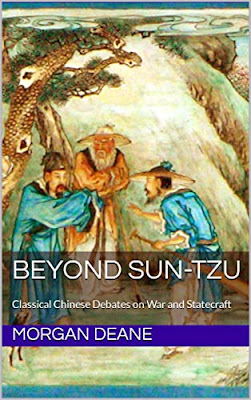
Now Available! Beyond Sun-Tzu: Classical Chinese Debates on War and Statecraft


    I'm proud to announce my newest book, Beyond Sun-Tzu: Classical Chinese Debates on War and Statecraft is now available for order. Here is the book blurb and I'm still looking for reviewers if you're interested: 

    Sun-Tzu (Sunzi) is one of the most popular and widely known military writers in all of history. His ideas have influenced statesmen, generals, and businessmen for hundreds of years in the West and thousands of years in China. But Sun-Tzu was only one of many competing voices in Warring States China, and many Chinese philosophers and leaders, as well as a few modern Western military historians have questioned the privileged status of his theories. Beyond Sun-Tzu: Classical Chinese Debates on War and Statecraft, is the first book to systematically examine the chaotic debates among philosophers in the pivotal Warring States Period.

    Military historian Morgan Deane examines scores of texts from the philosophers of Legalism, Confucianism, Daoism, the Seven Military Classics, and many others to find the truly dominant ideas of Chinese thinkers, areas of disagreement, surprising points of agreement, and a sophisticated synthesis. The result forces us to fundamentally reexamine Chinese military theory and gives us the tools to understand contemporary matters. This "broad knowledge" of Chinese military theory becomes an invaluable tool to help readers better assess the strength of Communist China, the relative unimportance of super weapons, the primacy of winning the allegiance of the people to your government, the importance of timeless counter insurgency methods, and so much more.

Tuesday, December 14, 2021

New Book! Beyond Sun-Tzu: Classical Chinese Debates on War and Statecraft


    I'm proud to announce my new book, Beyond Sun-Tzu: Classical Chinese Debates on War and Statecraft is available for preorder. My research into Chinese military history supplies many of the great ideas found for free on this blog. I have unique insights into the nature of warfare, insurgency, military theory, just warfare and so much more. If you find value in this blog, please make sure and check out the book. I keep the prices low so it is a great stocking stuffer for you and your loved ones.

Here is the blurb:

Sun-Tzu (Sunzi) is one of the most popular and widely known military writers in all of history. His ideas have influenced statesmen, generals, and businessmen for hundreds of years in the West and thousands of years in China. But Sun-Tzu was only one of many competing voices in Warring States China, and many Chinese philosophers and leaders, as well as a few modern Western military historians have questioned the privileged status of his theories. Beyond Sun-Tzu: Classical Chinese Debates on War and Statecraft, is the first book to systematically examine the chaotic debates among philosophers in the pivotal Warring States Period.
Military historian Morgan Deane examines scores of texts from the philosophers of Legalism, Confucianism, Daoism, the Seven Military Classics, and many others to find the truly dominant ideas of Chinese thinkers, areas of disagreement, surprising points of agreement, and a sophisticated synthesis. The result forces us to fundamentally reexamine Chinese military theory and gives us the tools to understand contemporary matters. This "broad knowledge" of Chinese military theory becomes an invaluable tool to help readers better assess the strength of Communist China, the relative unimportance of super weapons, the primacy of winning the allegiance of the people to your government, the importance of timeless counter insurgency methods, and so much more.
    I'm looking for reviews so if you'd like a free copy and have a blog or significant social media following feel free to drop me a line. Thanks!

    I work as a freelance author. If you found value in this work please consider donating using the paypal button below, or you can buy one of my books.