Showing posts with label terrorism. Show all posts

Tuesday, September 3, 2024

Book Review: How to Read the Bible and Still Be a Christian


        Domonic Crossan is the expert on the “historical Jesus” but wrote a book that was severely flawed. Dominic Crosson’s book relies on several false dichotomies (types of justice, radical nonviolent God verses normal civilized God), dubious historical reconstructions, lops off large segments of scripture and fails to truly study the character of God. Instead, like pacifist LDS writers he uses his own ideology to create a God in his own image.

The Historical Jesus

        The foundation of his argument is the nonviolent teachings of the historical Jesus. But his interpretation rests on a house of cards. He points to a general historical trend in the first two centuries AD that he calls “the matrix,” or general cultural and societal attitudes within Jewish society. Yet these attitudes are selectively chosen and amplified. For example, he points to the attempt of Caligula to install a pagan statue in the temple (146-148). In response, a crowd of Jews not carrying weapons gathered in the square to oppose the action. This is supposedly an example of nonviolent resistance but doesn’t account for how militant they seemed simply using the power of an angry crowd. These Jewish people weren’t calmly nonviolent resisters proudly bandied about by modern pacifists. They were militant agitators, that even without weapons were on the verge of a violent and deadly riot. The unarmed Lamanite prisoners, for example, were so violent the Nephites were forced to slay 2,000 of them (Alma 57:13-14). Yet Crossan massages the incident to make readers assume the example supports a nonviolent ideology. (For someone who builds their case on the “historical” Jesus this sloppy understanding of history is especially egregious.)

        His use of the Q source is even more dubious. This is the name of the anonymous source that may have inspired Matthew, Mark, and Luke. Because Matthew and Luke both contain polished expansions of Markan material using the same wording, many scholars conclude that Matthew and Luke relied on the Gospel of Mark and a second, unknown, or Q source (Matthew 6:24 = Luke 16:13; Matthew 7:7–8 = Luke 11:9-10). Yet some scholars argue that maybe Q didn’t exist at all. Others think that perhaps Mark was first to write his gospel but relied on some of Jesus’ unpolished sayings written in Aramaic, that may have been from an earlier Q source and polished by Matthew and Luke. Others think Mark was a later and abbreviated “summary” gospel. There is so much disagreement among scholars concerning which source inspired what and when each was written that it usually needs a chart to explain it. See the chart on this page for example.

        It’s all as plain as the sun in the sky!! Crossan takes this ~settled~ debate and looks at Jesus’ militant statements recorded by Matthew and Luke deriving from Q. Combined with the idea that Matthew and Luke use Q to “update” the original Jesus of Mark with militant statements he concludes that Q had the unsanitized version of the radical nonviolence of Jesus that was changed to the normalcy of violent civilization by Matthew and Luke (see 174-179 for example). The previous sentence sure is a mouthful, but simply stated without Crossan’s buzz words, he claims the historical Jesus was corrupted with bad theology derived from cultural attitudes of later writers. Crosson’s over reliance on Q to try and separate a pure Jesus from a corrupted one within the gospels is unsatisfying from an evidentiary standpoint.

Selective Theology

        It is even weaker from a theological standpoint. His weak arguments that reconstruct the so called, “historical Jesus” are used an excuse to lop off entire segments of the Bible. He somewhat admits this problem when he contends that Christians follow Jesus, not the Bible. Yet outside of living prophets that add living eye witness testimonies, the holy texts that describes God’s dealing with His people are the only information we have about God. So Crosson claims to follow Jesus, while he picks and chooses among the texts that authoritatively describe Jesus.

        For example, he talks a great deal about distributive justice. He doesn’t account for the injustice that derives from nonviolent impulses. If people stand idly by because of their vision of the historical, nonviolent, redistributive Jesus, then their innocent “wives and…children should be massacred by the barbarous cruelty of those who were once their brethren” (Alma 48:24). Moreover, it’s immoral to have a personal choice by individuals impose unjust and immoral consequences on others. For example, Patrick Mason and David Pulispher used the example of Dallin Oaks talking down a mugger holding a gun as evidence that people should adopt their non violent proposals. This is a heartwarming story and I’m glad Elder Oaks didn’t need to use violence. Having someone hold a gun on innocent family members and relying on a speech to save them from gunfire is not a reasonable or safe standard for families. But pacifists expect their passive standards from a selective reading of scripture to guide other’s foreign policy and personal safety with innocent victims at stake.

        Instead of acknowledging that different parts of the Bible reflect different attributes of the same God, Crosson refers to “parallel tracks” of a “bipolar” and “schizophrenic” God (71). At one disgusting point he calls the God of the flood a “terrorist” (71).[1] He claims that God was “sucked into” the escalatory violence of the world (71-72), as though God isn’t in charge, he is simply led around by the nose and provoked by His creations.

How Weak a Foundation

        Unfortunately, Crosson’s attitude that judges God based on his concept of nonviolence reminds me of LDS scripture and pacifists. They are so interested in seeing a “God made in their own image” that they minimize and misunderstand God (D&C 1:16). One LDS writer, David Pulsipher, complained that God and His prophets lacked the “moral imagination” that the writer and his favorite pacifists had.[2] It is our job to understand the divine, not try to limit or diminish God because he doesn’t have our “imagination.” (Also, see Helaman 16:22.)

        In another instance, Pulispher and Patrick Mason suggest that we use modern scholarship to dispute the historical accuracy of the Bible, thus “eroding any moral authority that might be gleaned from scriptures that endorse human violence.”[3] Unsurprisingly, just a few pages earlier the same authors cited Dominic Crosson,[4] who not only undermines any moral authority for violence but doubts the character of God to such a degree that he calls him a genocidal terrorist. That is putting the cart before the horse. It uses modern tools of scholarship, themselves a reflection of cultural concerns, to dispute God, who commands us to put aside small-minded cultural attitudes and follow Him.

        Of course, the Bible isn’t a clear manual about God and mankind’s concept of deity is often misunderstood and used to commit awful acts of violence. Still though, Latter Day Saints should be especially wary of a methodology that diminishes God’s character that reduces him to a figure head for an ideology. And an ideology that forbids the use of force actually perpetuates injustice. Rather than showing a schizophrenic God, the Book of Mormon’s account of the destruction immediately preceding His ministry and Christ’s teaching reveal a consistently loving God that recognizes the need to use force. Right before Jesus’s personal ministry among the Nephites he violently destroyed many cities (3 Nephi 9:3-12). Then he lamented that His people didn’t listen to him (3 Nephi 9:13), and he offered a tender example of how he would gather them as a hen gathered her chickens before offering the Sermon on the Mount and turn the other cheek (3 Nephi 10:4-6; 3 Nephi 12:39). Then he finished by reminding his audience of Isaiah's violent prophecies of a militant God executing his “vengeance” (3 Nephi 21:14-21).

        One version of God shouldn’t be believed over the other. Both versions ARE GOD and worthy of study. We are reading about different aspects of his personality, that is just, merciful and loving while God recognizes the need to use violence, often as punishment that compels men to be humble (Alma 32:13), and lead them to repentance and redemption (3 Nephi 9:17).

        Dominic Crosson’s book relies on several false dichotomies, dubious historical reconstructions, lops off large segments of scripture and fails to truly study the character of God. Instead, like pacifist LDS writers he uses his own ideology to create a God in his own image. I can’t recommend his book unless you want to see the “playbook” that LDS pacifists attempt to run on scripture.

**********
Thanks for reading. If you found value in this work please consider donating using the paypal link below or by purchasing one of my books linked in the top left. My latest, is a book length treatment of the above ideas. 

[1] I was seriously tempted to stop reading at that point. Terrorist is an overwrought, emotional term and directed towards God it revealed a great deal of Crosson’s character. I no longer wondered why he was a disgraced ex priest.

[2] Pulsipher, J. David (2021) "Defend Your Families and Love Your Enemies: A New Look at the Book of Mormon’s Patterns of Protection," BYU Studies Quarterly: Vol. 60: Iss. 2, Article 6. (179-182)

[3] Patrick Mason, David Pulsipher, Proclaim Peace: The Restoration’s Ancer to an Age of Conflict, (Deseret Book, 2021), 167-168.

[4] Ibid., 150 fn 7.

Monday, July 1, 2024

Newest Book on Just War Released, Ten Year Anniversary of my First Book!


    I’m excited to announce that my new book, To Stop a Slaughter: Just War in the Book of Mormon is published and available on Amazon! Those of you that read this blog already have a good sense of the material that is in it. You might remember posts about the importance ofthe heart, preemptive war, and the Nephite wars at the end of their nation. Here is the back cover blurb:

    In a world filled with what seems like "one continual round of bloodshed and murder" (Mormon 8:8) the debates in how to stop that slaughter are filled with partisan talking points, competing vociferous voices, unexamined assumptions about the use of force, fearful hot takes, and self-serving politicians and media narratives that only serve to increase the tension.

    In this the war of words and tumult of opinions (JS History 1:10) acclaimed military historian Morgan Deane applies a Hugh Nibley like command of numerous Christian and Chinese philosophers to engage the rich, intellectual debates from history, and apply them to the ethics of war and peace within the Book of Mormon. The result shows that Book of Mormon offers robust comments on such pertinent topics as the paramount importance of the heart, when and how a nation should use force, the limits of the word and the sword, the intent of people making war, preemptive war, insurgency, and a resolution between, instead of cross talk and proof text citations of oft cited pacifist and isolationist verses and those that support the use of force. This book amplifies the clarion call of the Book of Mormon to love your neighbor enough to be like the Nephites, reluctantly compelled to use arms to stop their slaughter (Alma 48:21-23).

    I’ve sent the book out for reviews, and if you’re interested in a review copy feel free to send me a message. 

    My first book, Bleached Bones and Wicked Serpents: Ancient Warfare in the Book of Mormon has reached its ten year anniversary! I just received a message the other day about how it has helped strengthen testimonies. As I wait for new reviews to come in, here are some more over the years:

    Deane’s work is well-written and thought provoking, required reading for those interested in warfare in the Book of Mormon as warfare, rather than just spiritual analogy. David Spencer, author of Captain Moroni’s Command.

    Hugh Nibley’s understudy. …an absolute must for anyone studying the Book of Mormon... [ties] wide ranging examples from the ancient world in remarkable efficiency. Deane's personal experience also gives a strong eye to military aspects so often neglected... This is a book that will be talked about for years to come by any serious student of the Book of Mormon...” David West, award winning author of Heroes of the Fallen

    Deane is an excellent scholar with fresh ideas and is always worth reading. Matthew Roper, Scripture Central.

    [Deane helps provide analysis] equal of any rabbinical quarrel or Jesuitical casuistry…[and] a fitting springboard for robust and lively debates.” Robert Wood, Chester M. Nimitz Chair Emeritus, U.S. Naval War College.

    The book successfully uses the battles as a means to understand the evolution of Chinese military culture, doctrine, and tactics. The battle maps are well drawn and helpful for those who are not familiar with China’s geography and history. The author has designed the book for general readers, including high school seniors and college freshman, so they can quickly grasp the complex security concerns and strategic calculations often underlying China’s decision-making process. Li Xiaobing, Journal of Chinese Military History

    China’s increased presence on the global stage has attracted greater interest in its long military history. With five millennia behind it, East Asia’s dominant power is certainly no stranger to armed conflict. While that immense scope may seem daunting, author Morgan Deane offers a highly accessible survey with Decisive Battles in Chinese History. Army History

    This astute history clearly reveals the development of China’s military and martial spirit. Military Officer

    I look forward to reading more positive reviews of my latest book and I’ll share them as they come in.

Thursday, April 4, 2024

The Silver Bullet: Afghanistan and Blowback


        When discussing American intervention inevitably someone will cry Afghanistan as a warning. In the 1980s the United States supplied arms to various militant groups. The goal was to resist the Soviet invasion in the hopes that it would weaken a US rival at  a relatively minimal cost. Some of these groups then became the ruling Taliban that won their post-Soviet civil war. The ruling Taliban allowed Al Qaeda to train and then launch the 9/11 attacks. Thus creating “Afghanistan” as a single, silver bullet to any American intervention.[1] In fact, “blowback” is such a lazy catch phrase that even in commenting on the Israel Hamas war Connor Boyack,  a supposedly serious libertarian, conflated cycle of violence and blowback into cycle of blowback. (He also added some antisemitism as well.) But this argument fails as a simplistic retelling of history, offers a presentist argument that discounts the contemporary threat of the Soviet Union, and continues to offer a reactive and weak vision of foreign policy.

        History doesn’t move in a straight line. It’s true that some militant groups received arms. At the same time though that action doesn’t lead in a straight line to the 9/11. The various militant groups fought against each other almost as much as they fought the Soviet Union. In fact, the fragmentary leadership and society led to a civil war in Afghanistan for much of the 90s. Only half a decade after that civil war Al Qaeda launched the 9/11 attacks. There were all sorts of moments that could have changed that outcome, and the US wasn’t closely involved in them for a decade.

        The Soviets could have continued their occupation. Another power like the Northern alliance and the Lion of Panjshir, could have won the civil war. Ironically enough, after the withdraw of Soviet forces that lion complained the US wasn’t more involved. From the linked interview he said: “[The US] forgot Afghanistan and they left Afghanistan alone.” This reminds me of a poor book where the author argued the US was imperialistic for “meddling” in foreign countries, while he also blamed the US for “losing” China to the Communists. In other words, he blamed the US for not meddling. But when your isolationist agenda comes first, and you rely on a simplistic understanding of history, intellectual rigor and honesty take a back seat.

        Returning to other historical paths not taken, Bill Clinton could have seized Osama Bin Laden when he had the chances. (BillClinton actually had nine chances according to the 9/11 commission.) Any of these variables alone, and definitely all of them together cut the thread of American aid to the mujahadeen leading to 9/11 implied in the blowback arguments. There were so many variables that meandered throughout the decade plus interval between the two that the blowback argument becomes simplistically ahistorical.

        More importantly, this is a presentist argument. Presentism is normally a fallacy from those that complain individuals in the past are racist, sexist, and otherwise fail to conform to current standards. In this case presentism takes the terror attack from a decade later to ignore the threats at the time that made America arm the mujahadeen. It would be much like looking at Soviet strength early in the Cold War and complaining that it was blowback for America’s defeat of Hitler.[2] That thinking ignores the threat the Nazis posed and the need to intervene against that threat.

        In that Cold War America faced an evil empire that repressed its own citizens, ruthlessly crushed dissidents abroad, aggressively expanded along its borders and threatened nuclear war. Arming Afghani fighters was a relatively low-cost way to sap the strength of an existential threat. Those using their only bullet ignore the historical context of that threat. They might argue that the US had no moral right or national interest to resist the Soviet Union, but I’m assuming that my readers don’t lack moral confidence in America or show downright hatred for their country that many show today. Because ignoring the Soviet Union of the 1980s for fear of the Taliban assisted terror attack of 9/11, is like saying America shouldn’t fight Hitler because the Soviet Union will be stronger.

        The US should balance the consequences with their goals but can’t be paralyzed by fear which leads to my final point that our foreign policy can’t be paralyzed by fear of what could happen. Its true that actions have consequences, but so does inaction.

        The best example of blowback from inaction that ends up being worse than any blowback from action is in Syria. Back in 2011 the typical crowd wanted to avoid any military action to remove the Syrian dictator and protect civilians. They did so using a false dichotomy between a massive invasion and nothing, when America could have achieved good results with limited invested and danger through a no fly zone. But afraid of a small potential of war through a no-fly zone or missile strikes, we did nothing.

        The result was that America looked weak because our leaders declared red lines that they didn’t enforce, and made bellicose statements that the dictator’s days were “numbered” that became irrelevant. Almost 300,000 civilians have died, 12 million internally displaced, and 5 million people became refugees. Russia made Syria their proxy and tested their combat tactics that were used in Crimea and Ukraine a short time later. The terrorist group ISIS went from jayvee to pro and stormed across much of the region. European nations still grapple with that refugee crisis, including Sweden that had to mobilize the army to fight gangs of immigrant youth. In the US we had rabid debates about what to do with all of those migrants. (Though I think we should have loved them enough to make sure their homes weren’t destroyed in the first place.) 

        Looking at all that, do the isolationist libertarians that use this silver bullet consider all the consequences of inaction? Nope, they scream blowback about the current shiny thing in the news. Ironically enough, it was blowback that started the war in Ukraine, and probably Israel. Putin started marshaling his forces for invasion mere weeks after the botched Afghanistan withdraw. 

        Clearly the United States should carefully consider its actions which include blowback to military intervention and nonintervention. But using the aid to Afghanistan in the 1980s as a direct cause of 9/11 is over simplistic reasoning in support of consistent, knee jerk isolationism. (Or as I discovered researching my next book, their beliefs are called contingent pacifism because they recognize a theoretical right to just war in scripture but don’t find any examples in the world that meet those conditions.) The Afghani silver bullet ignores the historical context of the decisions in the 1980s to argue for isolationism today. Most importantly, that silver bullet shows an inherently weak foreign policy by ignoring the expensive cost of inaction for often vague and exaggerated costs of action.

Thanks for reading. If you found value in this work please consider getting more of it by donating using the paypal button below or by purchasing one of my books linked in the top left. 

[1] This is more rhetorical flourish than clinically accurate. Isolationists libertarians sometimes refer to the CIA coups against Guatemalan and Iranian governments in the 1950s.

[2] Personally, that’s why I preferred Winston Churchill’s Mediterranean strategy where Western allies invaded Eastern Europe from Italy. Despite its higher difficulty level that strategy would have spared millions from Soviet domination. 

Friday, March 1, 2024

Parable of the Bad Neighbor: What would you do?


    For the longest time I wish I could locate one of the worst examples I had ever read about pre-emptive war. It turns out I had looked in the right spot, but the website for a long time was defunct. (It’s still a bit funky to be honest.) The parable was vague, and a poorly written attack on me, but it did make me think. And after a brief foreword, I’ll provide my own parable that should be much better.

    As a preamble, I have to point out a few ways this parable is limited regarding international relations. That’s because those that live in a state have a series of criminal and civil remedies. If one neighbor is noisy, nosey, threatening, or violent in any way the other neighbors can do anything from filing a restraining order to calling the police. Even threats of violence, or “making terroristic threats,” can result in arrest so there is no need for preemptive self-help violence.

    The state doesn’t have most of those recourses in international relations. There are some limited remedies ranging from the World Court, Interpol, diplomats, and some international organizations, but it is the military that delivers protection and justice for its people. When the citizens of one nation find themselves threatened by another, the leaders of the state are the ones responsible for protecting the rights of their citizens. Unlike the parable of the neighborhood dispute, there are no police to call or restraining orders to file. I assume my interlocuter chose the example of neighbors because it seemed especially ridiculous to preemptively shoot one.

    Without further ado, let’s assume that this neighborhood doesn’t have legal and civil remedies. This is apocalyptic Australia, there are no police and Mad Max is chasing down a biker gang a continent away.

    A new guy moves into the neighborhood and despite your best efforts your relationship sours. But this isn’t what you see on Judge Judgy about barking dogs or a loud party. The new neighbor, Fred, believes the property line is misaligned, or maybe he thinks he was legitimately wronged in having a valuable fruit tree just over the line. For whatever reason, he is openly antagonistic towards you.

    After some time Fred finally says, “I will kill you.” The aggressive neighbor gives a speech that their problem will soon be solved.[1] You see Amazon truck after Amazon truck drop off giant boxes from the gun store.[2] He tracks you in the sights of his machine gun every time you leave the house. He repeatedly crosses the property line to see how quickly you react.

    Despite your best efforts to diffuse the situation, after some time his friends pull up in pickup trucks and armed with machine guns they surround your house. They step forward with their weapons loaded and racked with a round in the chamber but haven’t fired yet. They take aim, and they fire. Your house is Swiss cheese from all the bullets, but this is still the first attack (D&C 98:23-26). They reload, and attack two more times for a total of three attacks.

    The question becomes, at what point would the good follower of Jesus Christ attack?

    Remarkably, there are some people who would wait until the end of the parable to attack. They mistakenly apply Doctrine and Covenants 98 to assume that it is a guide to foreign policy. They believe that Mormons must patiently bear three trespasses (usually interpreted as attacks) and lift a standard of peace before attacking. This group of people sound strong when they quote the scripture to “renounce war and proclaim peace” (v.16). But their position falls apart with the first bullet as you think about what it truly means to bear three attacks such as the massed fire in the parable, three nuclear strikes, or three sword thrusts. Its completely ridiculous to think that Jesus requires suffering three Pearl Harbors or 9/11 attacks before defending yourself.

    The most likely answer is that you are justified in defending yourself after the first attack. This is a reasonable position to take in response to a clear attack. But there are problems with this position. Returning fire under these circumstances places the defender at a severe disadvantage. Remaining on the pure defensive allows the attacker to choose the time and place of the attack. The attacker could choose to strike when the defender is asleep or gone to the store or before the defender supplied his own guns and reinforcements. Once the attack commenced, the defender would have to return fire in the face of incoming gunfire. Ceding the initiative places you at in a reactionary and weaker position, much like the Nephites after the Lamanite attack in Alma 16. There is a significant chance that your defense at this point will not be enough to save your life. So again, waiting to receive the attack seems as strong as it is simplistic. But it can be a poor and dangerous standard. It’s the equivalent of having a deranged homeless man brandishing a knife on your subway train, but waiting to see what he does with it next (See below).

    If you want to have a much better defense, you should fire before they do! This option would preemptively attack between the point when the neighbors gather around your house and when they first fire at you. It might be when they first pull up, or when they aim their guns, but the defending neighbor knows when an attack is happening (or commenced) and he doesn’t have to wait for it to be carried out.

    And this gets to the crux of preemptive war. Preemptive war is the right to attack between the point when the attack is commenced but not carried out. Or as the Book of Mormon implies, when the sword is raised, but hasn’t yet struck (Alma 48:14). The key is the phrase “raise a sword,” which compares to the theoretical standard of preemptively striking a charging assailant with sword in hand.[3]

    But there are arguments that you could launch a just attack even earlier. What if your neighbor wasn’t importing more rifles, but instead was importing tactical nukes? Just the transfer of nuclear weapons to a place where an avowed enemy could quickly strike the continental US was enough to justify the blockade of Cuba. If your neighbor has vowed to strike and has the weapons, then there are other theorists that suggest the attack doesn’t have to be imminent.[4]  For example, if the US waited until the 9/11 strikes were commenced but not carried out, they still would destroy four airplanes filled with innocent Americans. These are variations that don’t change the right to preemptive war, only the application of that right regarding difficult issues like striking terrorists.

    So what does the parable of the Bad Neighbor teach us? Well the parable as originally given is too vague to be of much use except as a strawman perception of preemptive war. The specifics matter. The real-life application of the preemptive right is clearly seen in the New York Subway incident. An aggressive and disturbed person comes on board a train waving around a knife and screaming that he doesn’t care if he goes to jail. No rational person would say to themselves, “This is creepy, but let’s see where it’s going.” “The restored gospel is clearly superior to and excludes preemptive just war theory.” “The gospel says renounce war and proclaim peace.” Or maybe “we should wait until he tries to stab someone because after all, we only believe in defensive war.” Daniel Penny clearly and correctly anticipated an attack, so he subdued the dangerous would-be assailant.

     When these ideas are presented in a specific scenario, like a brandished gun about to be fired, or drawn knife in a closed subway, the Parable of the Bad Neighbor shows that most people intuitively agree with the concept of preemptive war. That strong intuition is a sense of your natural rights. When the neighbor has shown intent (they announce their intent to kill you), means (they have imported a devastating number of weapons), and the attack is imminent (they’ve surrounded your house and march towards it with raised weapons),[5] the sword is raised, and the attack is commenced but not carried out. As a result, the defending neighbor has a God given right to defend themselves preemptively.

    Exactly when that point is reached is often disputed. In fact it’s common in debates around the justified use of preemptive war to manipulate and rearrange details to make an attack seem less or more likely and hence more or less justified. In the parable that would be like an analyst claiming that the aimed weapons of Fred and his friends were really just target practice or warning shots, so the defending neighbor was overreacting. You'll see that both in the original parable below as I’m supposedly cool with randomly killing someone and Mark Henshaw tried to rearrange the details of Kishkumen’s attack as a rebuttal to my use of the story. Preemptive war can also be abused by Putin or Bush, but that doesn’t diminish the right. Again, these individuals are often invoked as stop think boogeymen.

    For kicks and giggles I've included  the original example. You’ll notice its far vaguer than my parable and filled with loaded language (panic, paranoid, snooping). I really hate the phony use of the word friend. It builds a straw man big enough to blaze at Burning Man and is included here as an illustration of the limited thought on the matter. At least it helped me to crystalize the key ideas behind the right to preemptive war:

How would our friend Morgan respond to the following situation? A new guy moves into the neighborhood, and after a few months of snooping and spying you determine that Fred…has an arsenal of weapons. You have a meeting with all your neighbors and decide that he might use them against you. You have no proof of this, yet the neighborhood is in a panic and everyone is paranoid that it might be them first. You collectively decide to use force to apprehend Fred’s arsenal, and when he politely refuses the situation escalates and a fellow neighbor shoots Fred with a 30-06 from 300 yards. Problem solved. No judge, no jury, just an executioner. Everyone is safe right? But was it moral? Did you not kill Fred before he had done anything wrong? Obviously this scenario is absurd, but what is the difference when nations do the same thing in the name of patriotism and nationalism?

Asked and decisively answered. Thanks for reading. For a more official and in depth version of scriptures, theory, and preemptive war see my article in Square Two, Kishkumen’s Dagger.

Producing ad free, high quality research is time consuming. If you found value in this work please consider donating using the paypal button below or by purchasing one of my books linked in the top left. 
***********

[1] The Communists clearly indicated they wanted to take islands in the Taiwan Strait Crisis which led to preemptive US intervention. https://en.wikipedia.org/wiki/Cross-Strait_relations#Military_stalemate_to_diplomatic_war_

[2] The transfer of nuclear weapons to Cuba was enough for President Kennedy to consider a first strike. He said, “we no longer live in a world where only the actual firing of weapons represents a sufficient challenge to a nation’s security to constitute maximum peril. Nuclear weapons are so destructive and ballistic missiles are so swift, that any substantially increased possibility of their use or any sudden change in deployment may well be regarded as a threat to peace.” Mark Totten, First Strike: America, Terrorism, and Moral Tradition, (New Haven: Yale University Press, 2010),71.

[3] Mark Totten, First Strike: America, Terrorism, and Moral Tradition, (New Haven: Yale University Press, 2010), 129-146.

[4] Totten, First Strike, 136. 

[5] These are the expanded criteria given by Grotius. Hugo Grotius, On the Law of War and Peace, Stephen Neff trans., (Cambridge University Press, 2012), 84.

Friday, August 6, 2021

The Atomic Bombing Was Necessary and Justified


    August 6th marks the dubious day in 1945 when America became the only power to use a nuclear bomb. This continues to spark controversy. There was a great deal of racial animus during the war with both sides holding disdainful views of the other.[1] Using an area effect weapon that didn’t distinguish between civilians and military targets invites condemnation.[2] The lack of military targets in Hiroshima and the dubious effectiveness of the bomb makes some people say this was terrorism.[3] After all, the Strategic Bombing survey revealing that the trains ran normally a mere two days later and this was often considered a way to stun the Japanese into surrendering and impress the Russians with the viability of the program.[4] Plus, there were supposedly peace feelers from the Japanese that made this completely unnecessary. These are all extremely flawed arguments that don’t accurately reflect the historical context, and seem like excuses to blame instead of understand.  

    The strongest attacks seem to be the peace overtures. This theory argues that the Japanese were ready for peace and only block headed generals kept the war going.  These were detailed by a revisionist historian, Gar Alperowitz and thus come long after the fact when it became more fashionable to search and promulgate these theories.[5] More importantly, they cherry pick some information and leave out much more important events that shows these peace feelers were completely impotent and the U.S. was correct when they disregarded them.

    The best evidence against this theory comes after the Japanese emperor’s decision to surrender. After the bombs dropped and the emperor wanted peace the military challenged and almost reversed the decision through a military coup. It’s incredibly unlikely that minor officials would have produced peace when the atomically convinced emperor almost couldn’t. Let me stress, even AFTER the atomic bomb dropped there were significant factions in Japan that wanted to keep fighting. Peace was not possible before the bombs were dropped. Plus, American willingness to negotiate before the bombs would have emboldened the Japanese and aggressive army generals to think that more fighting would have gotten them more concessions.

    Other critics quote leaders who sound authoritative but really aren’t. One example comes from Eisenhower who said: [I believe] that Japan was already defeated and that dropping the bomb was completely unnecessary…[6]

    But with all due respect to Eisenhower and other generals cherry picked for opposing nuclear weapons, he was thousands of miles and away and was not privy to the intelligence and decision-making councils that led to it. It would be like Admiral Nimitz second guessing Eisenhower’s decision to stop at the Elbe. Eisenhower is a particularly odd choice for opposing nuclear weapons since his New Look military relied so heavily on nukes and spooks.[7] 

    Other critics were more vocal against nuclear weapons because they were delivered by bombers and this helped Curtis LeMay argue for the creation of an independent Airforce. In turn, this would take resources and prestige away from the Navy and Army chiefs, who were incredibly territorial and wanted the air corps assets divided between them.[8] Their opposition had little to do with the qualms of modern pacifists and posting quotes from them ignores the historical context from which they were produced.

    The sad truth is that the Japanese would not surrender without the atomic bomb dropping or millions (of Americans, Japanese, and Chinese) dying from an invasion. An estimated two hundred thousand Chinese a month were dying at this point in the war. The Japanese launched the Ichigo offensive in late 1944 which was comparable in size and scope to the German invasion of the Soviet Union.[9] An invasion by American forces on the Japanese homeland would have skyrocketed those figures.

    There was the option not to fight which would have left China and much of Asia in the hands of a regime as bad as Hitler’s. You also have to wonder how long they would have felt comfortable with the U.S. in Hawaii so they would probably have attacked America again anyway. The U.S. could have continued to bomb them. The firebombing of Tokyo and conventional attacks actually caused more deaths than the nuclear bombs so that couldn’t have been a better option.

    The U.S. could have blockaded the country. Scholars argue that the U.S. had already destroyed much of Japanese shipping and merchant marine by August 1945,[10] and this may have been what Eisenhower meant by already defeating Japan, but then America would have to wait for the country to starve to death. That would have caused more deaths and in a slow manner arguably worse than two nuclear bombings. It also would have given the Japanese time to kill more Chinese soldiers and civilians. So between deaths from famine and deaths from the Greater East Asian War that option would have killed millions more. Even then, any peace offering from the Emperor would have likely faced a coup just like the surrender after the atomic bombings.

    Dropping the atomic bomb quickly ended the war which prevented the Soviets from invading as well. The first atomic bomb was dropped literally the day after Stalin finalized plans to invade Japan and he invaded a a day after the second bombing. We saw how well Eastern Europeans were treated show trials, mass deportations to the gulags, the Soviet army’s refusal to help the free Poles in the Battle of Warsaw etc., so that wasn’t a good option. You can easily argue that the Japanese Constitution and rebuilding under MacArthur was far preferable to Soviet occupation.

    After looking at the other options and strategic context in late 1945, the decision to drop the bomb was moral and justified. In fact, ending the war at about 170,000 deaths compared to the abject blood bath that awaited all sides is the reason why the allied leaders considered this weapon a godsend. The same prominent ethicist that condemned the bomb also said that ending the war swiftly with a minimum of causalities is the greatest kindness a leader could offer.[11]  Secretary of State Henry Stimson exemplified this idea when he said: My chief purpose was to end the war in victory with the least possible cost in the lives of the men in the armies which I had helped to raise. In the light of the alternatives which, on a fair estimate, were open to us I believe that no man, in our position and subject to our responsibilities, holding in his hands a weapon of such possibilities for accomplishing this purpose and saving those lives, could have failed to use it and afterwards looked his countrymen in the face.[12]

    Thus, every other alternative was far worse, but you have your pacifist, blame America, soldiers are barbaric Nazis storyline. THAT is the made up history. Again, considering every option and the context of their war the dropping of atomic weapons was justified and necessary. I hope you can use this as a resource the next time someone attacks America for this eminently defensible action.

I work as a freelance writer. If you found value in this work please consider donating using the paypal button below, or purchase one of my books using the link to your top left. 

**********

[1] For a good overview, see John Lynn, Battle: A History of Combat and Culture, (New York: Basic Books, 2009), chapter 7.

[2] Micheal Walzer, Just and Unjust Wars, (New York, Basic Books, 2015), 250-260.

[3] Howard Zinn, “Breaking the Silence.” ND. (https://web.archive.org/web/20071201172331/http://polymer.bu.edu/~amaral/Personal/zinn.html Accessed August 6th, 2021.)

[4] The United States Strategic Bombing Survey: Summary Report: 24.  Though it should be noted that Nagasaki was home to one of the most important military garrisons and was a foremost military shipping depot, and thus remained a valid military target. The United States Strategic Bombing Survey: The Effect of the Atomic Bombs on Hiroshima and Nagasaki, 6.  https://docs.rwu.edu/cgi/viewcontent.cgi?article=1000&context=rwu_ebooks

[5] Gar Alperovitz, The Decision to Use the Atomic Bomb, (Vintage Books: 2010). https://mises.org/library/hiroshima-myth

[6] Julian Borger, “Hiroshima at 75: Bitter Row Persists Over US Decision to Drop the Bomb, The Guardian, August 5th, 2020, (https://www.theguardian.com/world/2020/aug/04/hiroshima-atomic-bomb-us-japan-history (Accessed August 6th 2021.)

[7] Gordon H. Change, He Di, “Eisenhower’s Reckless Nuclear Gamble over the Taiwan Strait,” American Historical Review 98 (December 1993), 1502-1523.

[8] Keith McFarland, "The 1949 Revolt of the Admirals" Parameters: Journal of the US Army War College Quarterly. XI (2): 53–63.

[9] Morgan Deane, Decisive Battles in Chinese History, (Westholme Press, 2017), chapter 12.  

[10] Strategic Bombing Survey: Summary Report, 11.  

[11] Michael Walzer, Just Wars, quoting Moltke the Elder, 47.  

[12] Henry L. Stimson, as quoted in The Great Decision: The Secret History of the Atomic Bomb (1959) by Michael Amrine, p. 197


Friday, January 5, 2018

Ma$ter$ of War or Non Cent$?

Ron Madson is a popular peace advocate and writes at the Mormon Worker. We’ve bumped into each other at conferences and each have dueling chapters in the same book. At the Mormon Worker he wrote a piece called Ma$ter$ of War. My eye was attracted to it because, and I swear, my first hope was  this was some random post about the latest expansion to Lords of Water Deep, a cool ability in the Big Trouble in Little China table top game, or forgotten classic by Avalon Hill.  Instead, it was a long argument against warfare.  I invite you to clink the link on the Mormon Worker and read for yourself as I won’t quote much. But I will respond to the major arguments he made about the financial waste of war, and what seems like, upon initial inspection, a convincing moral case against war.

Problems in the Numbers Game
American Spending

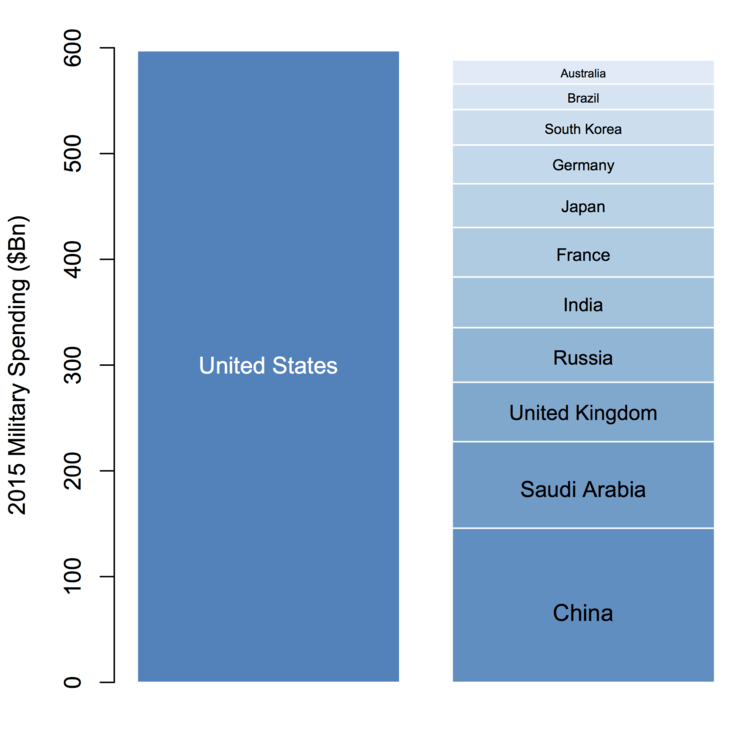
The first major flaw concerns defense spending. Madson offers an infographic that shows a giant bar graph of American defense spending, followed by the next 7 to 11 countries combined (depending on which chart is used.) Yet the problem is that many countries likely misreport their spending.  Just with China there is considerable evidence of cooking the books. Sinologist June Teufel Dryer for example estimates that Chinese spending is much higher based on several factors.[1] She points to complaints of province leaders feeding and housing soldiers to argue that the Chinese don’t report many of their personnel costs, such as housing and food. She argues that the cost of their nuclear weapons program, which is rather large, and the cost of their weapons acquisition programs are not included either.

The low range of the reconfigured Chinese budget is 30-40% higher than what the Chinese report. The high range of estimates would place their budget as much as ten times higher. The median derived by most analysts suggests a military budget three to four times their disclosed amount. Using the amount China admits to (144 billion in military spending in 2015) and then multiplying by 4 (the amount that most analysts suggest) would place China roughly equal with the US in spending. And considering the low cost of living, that money can sustain a much larger military than it can in the United States.

The Problem with Spending

More importantly, Madson’s arguments assume that threats are simply a function of math. As though there is some sort of theme park cut out with his hand out that says, your spending must be this high in order to be safe. If that were the case then mathematicians and accountants would be the generals. More important than just the amount of money spent, is how the money is spent, the way soldiers and systems are deployed, and then the way they are led in combat.

Military analysts contend that America doesn’t need more spending that what it does not to meet its threats. They simply have to better use what they currently have and spend. For example, since we already mentioned China, America regularly conducts Freedom of Navigation patrols in the South China Sea. These stress the importance of international law which is needed to counter the use of brute force to seize disputed territory.  American forces have upgraded their anti-missile defense by doing such things as upgrading the radar on Aegis ships, and networking the advanced sensors on the F35 with anti-missile firing platforms. Yet to meet the threats from China the air and naval bases needs more built in resiliency. This means they need repair kits, bomb shelters and redundant communication systems.  The ships need better close in defenses such as rail guns. (Not to mention they could probably use some remedial courses in how to steer.)

Both of these are necessary to counter a Chinese strategy that relies on hundreds and even thousands of missiles, some of which that can hit Guam. In the event of war China is expected to launch these missiles at key elements of U.S. expeditionary forces such as airfields, ports, logistics hubs, and carrier strike groups.  Without the built in resiliency the US forces could be paralyzed and denied access to Taiwan, the South China Sea, or disputed islands around Japan.  China would then have a free hand in seizing key territory in what they call the “first island chain.” If successful, by the time American forces recover from the missile barrage, China would have seized the territory they wanted, and could present the world with a fait accompli similar to Russia’s annexation of Crimea.
Speaking of Russia, the geography of the Baltic members of NATO places the US in a similar problem of seizing key territory before America can properly respond. In extensive war games RAND concluded that Russia could field as many as 25 battalions within 10 days of the start of hostilities, compared to 17 for NATO. That doesn’t sound like an insurmountable difference, especially with NATO’s advantage in airpower. Using Madson’s logic then, we are wastefully spending more money than we need to. Except that current NATO forces are overwhelmingly light and would be overwhelmed by concentrated Russian artillery, missiles, and armored units. In the same war games analysts concluded that the Russians would capture Riga, the capital of Latvia, within 48-60 hours after invading.

To counter this, analysts have suggested pre supplied and forward deployed heavy battalions in the region. The armored brigades don’t represent many more soldiers than are already deployed in the region, but they will provide the key elements that force Russian heavy units to slow their advance, get off roads, and concentrate for battle, and essentially make them better targets for NATO air power. I asked over a year ago if the current NATO brigades in the Baltics are just a speed bump, and without critical adjustments that largely don’t involve money, but just a repositioning of forces and systems already in the area, they will remain that way.

This is getting a bit detailed, but I wanted to show the reader that matters of budget, strategy, and force structure matter just as much, if not more than simple screeds against spending money. The US faces real threats from a resurgent and aggressive China and Russia. Both of whom often cook the books to distort their massive military spending, and which have upgraded key forces such as missile technology that can stun the US into inaction through a massive surprise attack.

Problems with Morality

So far, I’ve shown how numbers are not a simple measure of threat. Countries like China cook the books and allies cut their military budgets to spend on social programs, which both distort the relative amount of spending. But spending money takes away from valuable social programs that help lives when the military just take lives. According to Madsen, we’ve been terrorists nonstop since 9/11.  There is significant debate about the efficacy of social programs and their solvency, and perhaps I’ll address that in another post, but here I want to discuss the misuse of the word terrorist, and offer a brief word concerning morality in warfare.
Manson

I discussed this in far more detail back during the Bundy fiasco.  But the short version is that terrorism is used far more for its pejorative and emotional value than its clinical description. Its very popular to repeat the cliché that one man’s terrorist is another man’s freedom fighter. In the sense that words themselves are weapons, this is entirely true.  Various revolutionary groups, terrorists, and the governments that oppose them can use the terms to either bolster their position or undermine their opponents.

Yet, despite the manipulation of words, and despite some of the disputes over the definition of terrorism, it’s still entirely possible to tell the difference between a freedom fighter and a terrorist.  Items such as the donning of uniforms, discrimination between military and nonmilitary targets, discernment against or deliberate targeting of civilians, and declarations of war from recognized heads of state, makes it very easy to distinguish between George Washington and Abu Al Baghdadi. There is some overlap between insurgents and terrorism, but its not nearly so indistinguishable as the purveyors of the cliché would lead you to believe.

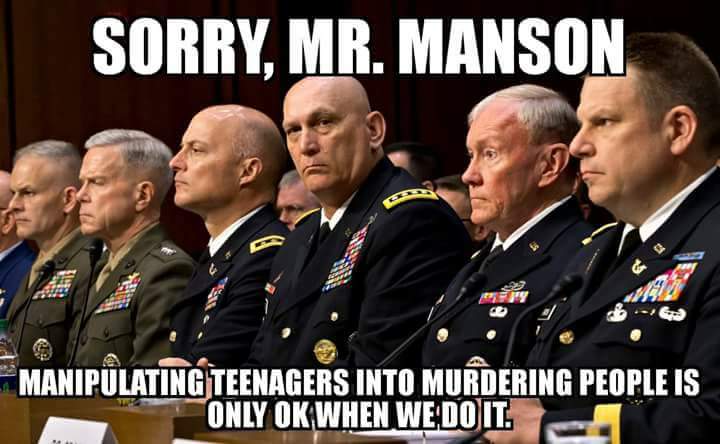
Manson had a cult of personality that viciously and randomly stabbed people, including a pregnant women, while walking on the street. A soldier, wearing a uniform, in a constitutionally declared war is ordered into combat against other soldiers. This makes the morality of killing far different between the two.  Even saying that, America rains death from above which is still horrible right? Yet killing a civilian by accident is different than deliberately targeting him or her. If they happen in the course of legitimate acts of war and the direct intention is a morally acceptable military target, then unintentionally killing civilians is within the realm of just war. That is still tragic and a horrible loss of life, but not a war crime or terrorism.[2] The public could reasonably ask if the military should have been more cautious, and used better judgement (not to mention aim) during the situation. But the military already works hard to have precision weapons that only hit their intended target, they assess targets and before they bomb in built up urban areas (such as the recent Battle for Mosul) they assess potential civilian loss. Even after all of these precautions, civilian lives are lost which doesn’t make it terrorism.

To make matters even more difficult, ISIS and other groups deliberately cloud the situation by militarizing nonmilitary targets such as hospitals and schools, and then trying to shield military targets with civilians. (The deaths of civilians in the latter case would be a war crime on the part of those using the human shields.)[3]  This complication makes it more than “the US is evil for killing civilians or bombing a hospital,” because bad actors deliberately muddle the distinctions between acceptable and unacceptable targets. Moreover, like the hands up, don’t shoot narrative, (which was the lie of the year,) the supposed victims of these air strikes wale to the nearest reporter with an often tendentious narrative, which is then tabulated by anti-American NGOs and repeated by people like Madson.

In short, the context of fighting a war makes American actions legal, civilian losses are strenuously avoided, but often accidentally happen; despite being unintentional consequences of just warfare they are often exaggerated by American enemies to anti-American sources by the very people who criminally muddled the distinction between military and nonmilitary targets and put civilians in harm in the first place.  Madson magnifies rare American misdemeanors and ignores the frequent felonies from bad actors.

Conclusion

I’ve provided a sober assessment of the American budget, disposition of forces, and morality of warfare (as well as my pet peeve when people misuse terrorism.) I did go into a bit of detail and couldn’t cover many other items.  But I hoped that I showed that these are complex issues that deserve more than shrill moral condemnation.

China and others cooks the books to make American military spending look overwhelming. Even if it was, money spent is not the entire sum of threats faced, but based on particular circumstances and the US faces real challenges. American forces fight justly within recognized rules of war and seek to avoid civilian casualties against a barbaric enemy that deliberately kills, rapes, and uses civilians as shields in pursuit of their savage world view.   Instead of Master’s of War, his post is more like some $hoveling Non-cents.

[Thanks for reading. I work as a freelance writer so if you found value in this work please consider donating using the pay pal button at the bottom of the page.] 
********
[1] June Teufel Dryer, Recent Developments in the Chinese Military,” A Military History of China, David Graff, Robin Higham eds, (New York: Westview Press, 2002), 285-302.
[2] Michael Walzer, Just and Unjust Wars, 153-155.
[3] Gary Solis, The Law of Armed Conflict: International Humanitarian Law in War, 320. “If civilian casualties result from an illegal attempt to shield a legitimate military objective with a human shield, those casualties are the responsibility of the side using the human shield.”