Posts
Posts




Through 25 years of writing and thinking about war, I keep
running into the same mistakes. People either treat war as always immoral, or
they toss the term ‘war crime’ around as a catchall. This post explains the
common misconceptions about just war, show how medieval and modern theorists
actually enlarged moral protections for civilians, and argue that force, in
narrowly defined circumstances, can be a needed last resort to prevent
slaughter.
War is clearly wrong
Who watches the destruction and heart ache on the evening
news and believes that God wants that? Yet just as quickly one might
remember the abject slaughter of the helpless and we must ask, what happens
when the absence of force results in even greater evil than war? Yazidi
sex slaves, kidnapped Ukrainian children, cartels sex trafficking immigrants,
to the slaughtered innocents on October 7th, and those still
tortured and starved by Hamas in captivity all show us the evil that men do. If the Good Samaritan happened upon the beaten traveler in the middle of the attack and not after, he would lift the sword to protect his neighbor. Like the Good
Samaritan, we should love our brothers enough to raise the sword in their
defense. The need for force and God given desire to “deliver the poor and
needy” (Psalms 82:4) then becomes a good thing, because it stops or prevents
abject slaughter.
While no one wants war, because you need to stop a slaughter, many
people recognize the tragic need for war on an intuitive level.
Anything I don’t like is a war crime
People believe, like Paul Ramsey described, that civilians
are roped off from harm like the ladies at a medieval tournament.[1]
So, any time civilians are killed, churches struck, or some other tragedy
occurs it must be a war crime.
But real war crimes require actual laws of war. Augustine,
the first just war theorist, talked about right intention including a desire to
restore a just and peaceful order.[2]
The medieval thinker, Gratian in the Decretum named protected groups like pilgrims,
clerics, women, and unarmed peasants.[3]
Salamanca school scholar Francisco De Vitoria wrote that indigenous people can’t be
slaughtered simply for not being Christian. He said: “War is no argument for the truth
of the Christian faith.”[4]
Civilian deaths are tragic, but not every tragedy is a war
crime. Intent, environment, and proximity to combatants all matter. Terrorists
like Hamas exploit this by hiding behind civilians. The laws of war are clear:
using civilians as shields is a violation; unintended strikes, even on churches
or those that kill children, are not. That tragedy remains awful, but Hamas chose it when they launched terror attacks and then hid beneath hospitals, schools, and churches.
Some use every tragedy to reject force altogether, but that simply
guarantees victims will be slaughtered. Pacifism often implies it is better to
let atrocities continue than to risk civilian harm. Outrage over an accidental
strike can overshadow the deeper outrage that started the war but it shouldn't.
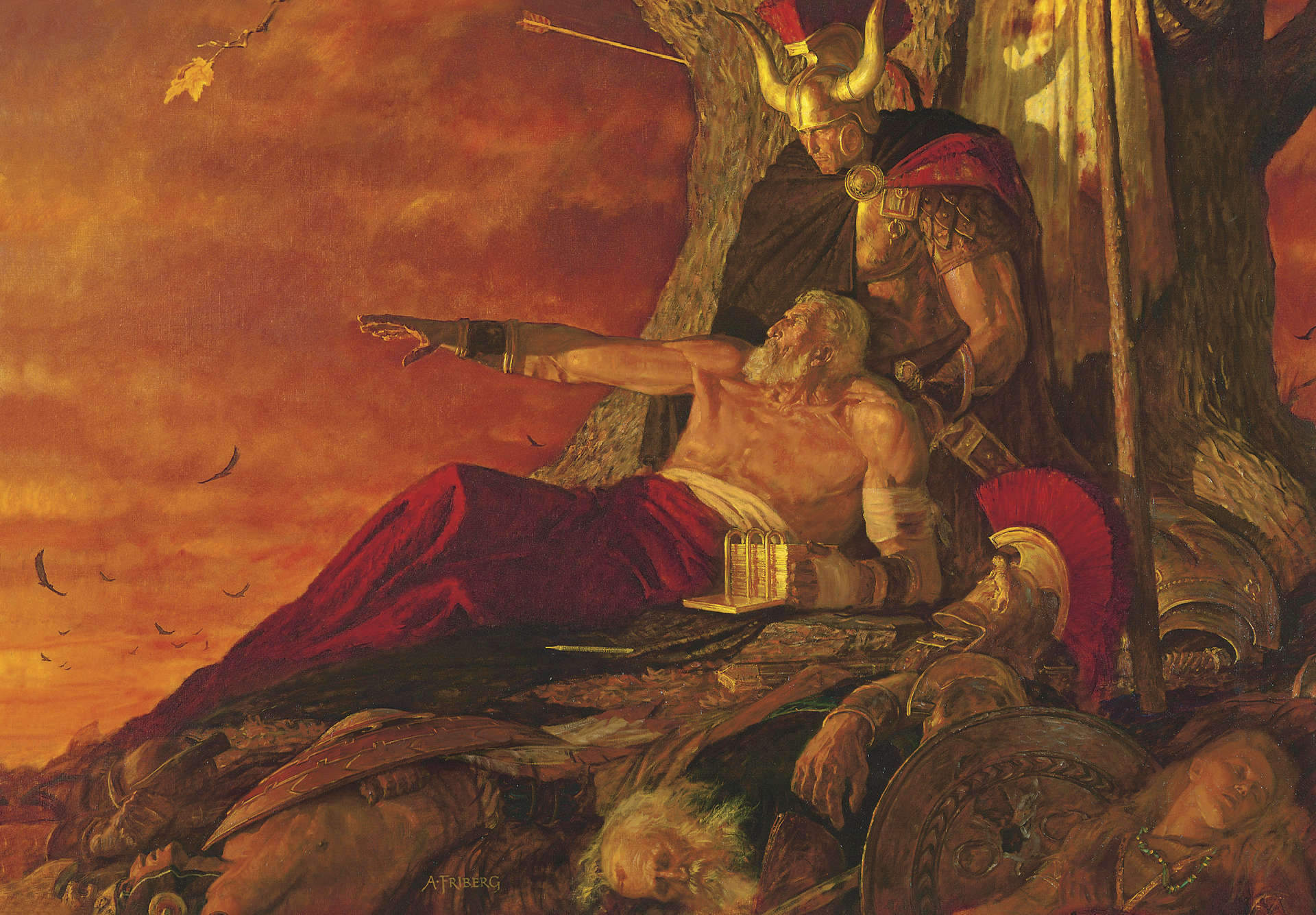
Moroni was militaristic and not a source of peace
Moroni has been cited for militaristic means. During my
mission in Texas, I visited compounds with pictures of Moroni on the wall. But
closely reading the text we see that Moroni repeatedly brought peace to such a
degree that the Lamanites rebelled against their king rather than take up arms.
In the face of an implacably murderous ideology, Moroni
showed that battlefield defeat discredits that radical ideology that led to war
and produced peace. He was such an expert peacemaker that he converted
committed fanatics during battle numerous times. Based on those battlefield
covenants he arguably converted more people than the missionary preaching and
the self-sacrifice of the Anti-Nephi Lehis. As recorded in Alma 47:2 and
Helaman 4:3, those that didn’t make that covenant were still inclined towards peace
years later. His actions didn’t result from or instigate a cycle of violence
but led to long eras of peace and more peace, defiance of cultural stereotypes,
and generosity than produced or showed by Ammon and his brethren. The righteous
example of Moroni suggests a path to peace that comes from decisive victory we
must recognize and apply, regardless of how uncomfortable his example might
make some people.
Anyone I don't like is a simp for war
This is usually wrapped up in insults like I’m an insane, warmongering anti-Christ that hasn’t met a war criminal I won’t simp for. These insults contain multiple ironies.
First, I’m old enough and have been studying history long
enough I remember wanting actual war criminals like Slobodan Milosevic and Uday
and Qusay Hussein locked up and executed.
Second, it’s always the least educated people I met, those
with limited education and no publications, who insult my intelligence,
education, and publications.
Third, Augustine warned “the passion for inflicting harm,
the cruel thirst for vengeance, an unpacific and relentless spirit” leads to
war.[5]
But I see this war like spirit every time I explain basic ideas about just war,
defend Israel, and simply disagree with a pacifist. I’m the “war monger,” but
they show more passion for war by their cruel thirst for insulting me.
Aside from all that irony, I’m pro war to the extent I’m
anti genocide and mass rape. When Putin launches the most nakedly aggressive
war of my lifetime (and I’m old enough to have lived through the Soviet Union),
it’s easy to stand against it. When I see the worst holocaust since the Holocaust, I must stand against it. Just war grounds me in the conviction that I am aligned with God’s justice, and equips me to answer objections without fear. (Though, I'll confess, not without annoyance.)
Just war only justifies war
Just war has always critiqued governments as much as it has supported force. I already mentioned the concern of the just war theorists towards civilians but there is more. Vitoria criticized Spanish policy towards colonials he and his fellow scholars led to reforms. This was during the age of discovery and conquistadors. So, what many people consider the worst abuses of the West were being critiqued and changed by just war theorists.
Decretalists in the Middle Ages and those like Gregory IX
increasingly moved society from settling disputes by combat to settling them by
lawsuit and the rule of law.[6]
They did this by aiming just war principles at wars of aggrandizement. For
example, they argued that losses in wars of dubious morality, such as the armor
and horses of a lord’s knights, could justify a legal claim requiring the lord
to provide reimbursement. Since arms, armor, and horses were costly to replace,
this made war far less profitable and thus discouraged campaigns unless there
was a strong justification, such as repelling a rival king’s invasion,
defending against robbers, or fulfilling duty to the crown. Again, during what
many people consider a darkened age of unrestrained violence just war theorists
were using a careful reading of religion and the law to limit the bloodshed.
Far from sanctioning violence, just war thinkers used
theology and law to restrain war and promote peace. Their concern for civilians laid the
foundation of today’s laws of war. The irony is that medieval scholars had a
more nuanced and devout grasp of thorny issues regarding war and peace than many modern critics who dismiss them.
Mormons have the restored truth, why bother with medieval
Catholics?
If you’ve read this far, you already know medieval Catholics were serious thinkers wrestling with the very questions we still face. Just war theorists like Aquinas, Vitoria, and Grotius have addressed revolution, civilian casualties, war crimes, and complex questions of law centuries before us. Their work still sharpens debates today. Duane Boyce’s argument about preemptive war, among others, could have been much sharper had he relied on the criteria of Hugo Grotius. Patrick Mason and David Pulsipher could better understand scriptures like Moroni 7:26 by using just war principles. Mark Henshaw could find additional material about just peace from those medieval Catholics.
Mormonism is young. We don’t yet have a systematic theology,
let alone our Augustine. Much of our debate unintentionally echoes older
Christian conversations, only with different proof texts and less rigor. To dismiss their
wisdom while boasting about “restored truth” is more chauvinism than
confidence.
As Brigham Young counselled:
Whether a truth be found with professed infidels… it is the business of the Elders of this Church to gather up all the truths in the world pertaining to life and salvation…and bring it to Zion.[7]
This war seems politically motivated and grey
I call this the bio lab defense.[8]
When Russia invaded Ukraine, everyone suddenly became an expert on history,
NATO, and bioweapons labs, muddying the waters until it felt acceptable to
doubt the justice of the war.
The same thing happened with Israel after the October 7th
attack, the worst slaughter of Jews since WWII. People brought up radical
Israeli terrorists from the ’90s or questioned the Jewishness of the victims.
Many other good people, who are generally inclined to help, are left confused and like Joseph Smith, they hear a war of words and tumult of opinions and don’t know which side is correct. But just war is no simpler than this: do you feel genuine sadness and a desire to stop the injustice? That is love and compassion. Then ask: do you love your neighbor enough to act, or do you follow distractions—NATO, labs, space lasers—that let you ignore that call?
Conclusion
The lessons of just war theory are not just historical
curiosities or sophistry. They are tools for moral clarity in our own time.
Study the thinkers who wrestled with the limits of force, the protection of
civilians, and the pursuit of peace. Reflect on scripture, history, and
contemporary events, and ask yourself whether your compassion compels you to
act. Challenge your assumptions, weigh difficult moral questions, and let a
spirit of just peace guide your words, your judgments, and your actions. True
moral courage comes not from avoiding conflict, but from confronting injustice
thoughtfully, decisively, and ethically.
Thanks for reading. If you found value in this work please consider donating using the paypal button below or by purchasing one of my books linked in the top left.
[1] Paul
Ramsey, The Just War: Force and Political Responsibility, (Rowan and Littlefield,
2002),145.
[2]
[3] On
the poor: D. 86 c. 21; On windows and orphans: D. 21 d.p.c. 5 and C. 15 q. 8 c.
4.
[4] Principles
of Politics and International Law in the work of Francisco Vitoria Antonio
Sera ed. (Madrid Edicicues Cultura Hispania 1946), 68.
[5] Contra
Faust. xxii, 74
[6]
Frederick Russell, Just War in the Middle Ages, (Cambridge
University Press, 1975), 148, 153, 174-177, 212.
[7] Doctrines
of Brigham Young, 248.
[8]
The Ukrainian biolab worked to decommission
large quantities of Cold War Era biological weapons.