I almost named my first
book modern problems to ancient solutions. I’ve also mentioned before that
I find classical Chinese theory some of the most thorough that I’ve seen
outside of maybe Clausewitz. It is all the more amazing because in some cases
these theories were expressed thousands of years ago. I was reading a new book
Just
War Reconsidered: Strategy, Ethics, and Theory by James Dubik.
I’ve got a book coming out on just war, and there are so many other books
on the subject I want to keep abreast as much as I can. The book itself was a
bit of a dud. But
the important part was that the book brought up important ideas that were addressed
a long time ago, hence the title of this post.
One of the dominant themes of Reconsidered is that a
large reason for having a moral strategy determined by high level leaders is to
make sure the soldier’s executing it are not dying in vain for it. President
Lincoln considered this idea in the Gettysburg
Address. Dubik said the soldiers should know that commanders care about
soldiers (p. 52). And on page 99 that soldiers are expected to risk their
lives, but know their lives are not thrown away, wasted in missions “without
achieving something that would give their sacrifices meaning.”
That sounds nice but isn’t new. Numerous classical Chinese
authors, (between 400 and 200 BC) commented on the connection between goals and
methods. One of the reasons the great military theorist Sunzi advised that the
pinnacle of victory is winning without a fight, was to avoid needless
casualties when they swarm over city walls like ants.
The purported descendant of Sunzi, Sun Bin, said simply that
when commander “employs them like earth and grass,” they won’t respect or
follow him. One
of the leading Confucians, Mencius attacked the leaders who treat ministers
like grass. In
both cases they referred to the clumps of dirt and grass that were often cast
aside without a thought by shoveling day laborers. These examples focused more
on battlefield leadership. But they shared high level responsibility of modern civilian
leaders and high-level military strategists.
The next comparison from
Dubik’s book was between the idea about civil control of the military. The
founders were concerned about an Oliver Cromwell type figure which is why they
required military funding on a yearly basis done by the House. After World War
II the civilians in the government passed the National
Security Act as a further safeguard. In this case, Dubik said that militaries
strong enough to protect were often strong enough to overthrow the government
(57).
This was a classic Chinese dilemma. The generals of the
Southern Jin dynasty of the mid-5th century AD could often sweep down the
Yangtze River and overthrow their civilian leaders. The An Lushan rebellion (755
AD) started in the periphery because of a powerful general gained power while
protecting the frontier. And the final defection of the Lu Wende, inspired by
civilian officials fearful of growing power, doomed the defeat of the Southern
Song in the 13th century to the powerful Mongol invasion.
To solve this, Chinese leaders often had what was called Tiger
Tallies, which were two halves of a totem that needed to be combined by the
civilian and martial leader, or provincial official and representative from the
central government before the provincial military leader could muster the
military.
On top of this, there were various ceremonies that
reinforced the need to remove a general from his command and source of power
before meeting civilian officials. The historical background for one of the seven
military classics, Methods of Sima, included this:
[After taking command and hearing news of the enemy’s
withdraw] thereupon [the general] pursued and attacked the [enemy],
subsequently retaking all the territory within the borders of the old fief,
returning with the soldiers. Before [the general] reached the state
capital he disbanded the units, released them from military constraints, swore
a covenant, and thereafter entered the city. Duke Ching (547-490BC) and the
high officials greeted him in the suburbs, rewarding the troops and completing
the rites, only afterward returning to rest.
The footnote explains that removal of military constraints
consists of the loyalty required of soldiers to their commander. This has
obvious implications and recalls Caesar crossing the Rubicon as the most famous
example of a military commander using the army for political purposes. I also
noted how there was both a ceremony, implied ritual, before Amalickiah could
enter the capital and meet the queen ( Alma
47:33).
Just like military
officials shouldn’t use their military power to intimidate civilian officials
or seize power, there are multiple
examples of how the military commander should not face interference in the
field from officials in the court with their often out of date and faulty
information. Dubik wrote about the example of President Johnson who brow beat
and demeaned his generals to the point that dissuaded the kind of sustained
discussion and debate needed for good high-level policy (61,95).
The military theorist Tai Kong explained it well here:
After the General has received his mandate, he bows and
responds to the ruler: ‘I have heard that a country cannot follow the commands
of another state’s government, while an army [in the field] cannot follow
central government control. Someone of two minds cannot properly serve his
ruler; someone in doubt cannot respond to the enemy. I have already received my
mandate and taken sole control of the awesome power of the fu and yueh axes [symbols
of authority similar to the tiger tally discussed above]. I do not dare return
alive. I would like to request that you condescend to grant complete and sole
command to me. If you do not permit it, I dare not accept the post of general.’
The king then grants it, and the general formally takes his leave and departs.
But the Tai Kong only discussed the general being free from
meddling. Johnson (and other poor modern leaders) denigrated their advisers. The
classical Chinese military theorist Wuzi discussed this danger as well. In my
book about classical
Chinese thought, I described the danger that theorists described as being
the smartest man in the room:
[The general Wuzi] attended a meeting in court where the
ruler was often dismissive of his ministers...After the meeting he expressed
his concern to the ruler by sharing the story about the King of Chu and the
value of ruler receiving wisdom from ministers: I have heard it said there are
no lack of Sages in the world and no shortage of Worthies in a state. One who
can get them to be his teachers will be a king, while one who has them as his
friends can become a hegemon. Now I am not talented, yet none of my ministers
can even equal me in ability…This is what the King of Chu found troublesome,
yet you are pleased by it. I therefore dare to be fearful.[7]
As usual, Wuzi seems to bridge the divide between various
camps to produce a sound and practical synthesis. In contrast to legalists he is a military official that seems supportive of the
ministerial class, but not so much so like Confucians. He supported the basic concept that a ruler should learn from his
advisers in order to create the best strategy which doesn’t needlessly
sacrifice his soldier’s lives. Wuzi simply argued that a ruler can be far more
powerful by listening to his ministers and side stepped the advice of Taoist
rivals about being unknowable.
Supporting a sustained debate to achieve good strategy is
offered by Dubik as a much-needed reassessment but he was simply repeating good
ideas elucidated thousands of years ago. This good debate was formed, by what
he said, was generals that possessed a “broad understanding.” This term was
immediately explained to mean an analytic mind that can see coherence amid fog
[a possibly Clausewitz term]
and listen to extended discourse (101).
This is an exhortation about military leaders could
penetrate the bureaucracy. The writings of Guanzi, often seen as the prototype
of a good Confucian minister also gave parameters for penetrating fog, but his “broader
approach” suggested moving beyond than super weapons or a larger number of
soldiers. I chose to include hit here because, Guanzi’s use of the term is broader
than the ability of keen generals to offer good policy advice:
The art of conducting warfare
consists… of acquiring a broad knowledge of the realm and an understanding of
strategy- all to an unrivalled degree… It is impossible for [the ruler] to hope
to bring order to the realm if his material resources do not excel those of the
rest of the realm. It is [also] impossible even if he excels in material
resources, but fails to excel in [the skill of] his artisans, or if he excels
in [the skill] of artisans, fails in weaponry. [Likewise] it is impossible even
if he excels in weaponry, but fails in [the quality of] his knights, or if he
excels in [the quality of] his knights, fails in his instructions. It remains
impossible even if he excels in his instructions, but fails to do so in
training, or if he excels in training, but fails in terms of having a broad
knowledge of the realm, or excelling in terms of broad knowledge, fails in his
understanding of strategy….[9]
The good ideas of
the past being so applicable to modern problems is the major reason why I would
rather read older books for their wisdom and avoid being so quick to abandon or
ignore those texts in favor of modern ideas. One of the most enjoyable parts of
being a historian is reading the wise words of an ancient scholar and being
impressed by their keen intellect and wisdom. It is the conceit of every modern
age to think that they alone have solved all the world’s problems. Yet they
only do so by abandoning the past. Such reasoning has resulted in the reign of
terror, massacres in the great leap forward, and the folly of pacificism
overriding just war theories.
I hope I’ve provided even a small part of their wisdom and I hope I’ve inspired
you to read them more.
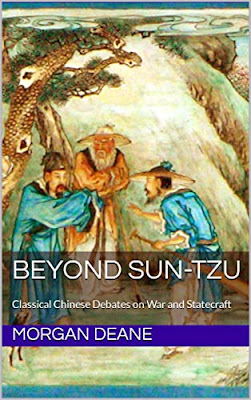
Thanks for reading. If you found value in this work please consider donating using the paypal button below, or buy one of my books linked in the top left. (If you liked this piece, you might enjoy Beyond Sunzi: Classical Chinese Debates on War and Statecraft.)

 Posts
Posts



_MET_DP835845.jpg)