Showing posts with label war and society. Show all posts

Friday, July 1, 2022

Outrage and Fighting for Life: Insights from Brad Wilcox to Abortion, via Ukraine


    When the war in the Ukraine started it was mere weeks after Brad Wilcox gave a controversial speech. I noted with irony and anger that many commentors wrote more often and more passionately about the supposed racism and sexism of Brad Wilcox than the actual deaths in Ukraine. Here you see at least five articles, from February 8th to the 15th, attacking Wilcox in strong terms. Russia invaded Ukraine on February 24th, and you see two tepid articles about the war in Ukraine. Both are rather generic that talk about food storage and the impact on missionaries, and another that reposted the church’s statement on peace followed by some grousing about the church’s position. Eventually, they talked about refugees, and the church in a time of troubles. Even over a longer time frame they produced fewer articles with none of the emotion that Wilcox inspired.

    I sardonically noted at the time, maybe if Putin gave a speech about "the blacks" and "the gays" then American liberals and isolationists will start to give a damn about his slaughtering innocents. In a moment of dark humor, after I noticed the inconsistent pattern to Wheat and Tare bloggers they posted a three part series about the dangers faced by homosexuals in Eastern Europe!!!!!

    Fast forward a few months and no one really cares about Ukraine anymore. Even though this week the Russians targeted a shopping mall filled with innocent people we already read many that question the need for continued aid.  The controversy of the day is the abortion ruling, but I have a long memory and can compare different reactions. With the tepid fight for Ukrainian life in my mind I read with interest this person's thoughts who seems ready to join the fight...to defend abortion.

    The author of the article tried to summon their inner Churchill and used the word "fight" a zillion times in addition to rather vivid imagery about battle wounds. The use of the word “fight” is odd coming from the same crowd that calls excommunication spiritual violence and barbaric. Putting aside the hypocritical use of violent rhetoric when it suits them, we should consider the ends that rhetoric is used for.

    Looking at their history on the blog, the author of fighting for abortion had nothing to say about the slaughter of innocents in Ukraine. Just a couple weeks after the war started, she did a three-part post on domestic violence. That is important, but I think the wide scale violence of war might be worth mentioning too. The author did say that "silence is violence" regarding LGBT issues. Overall, they have lots of passion and "fight" for the right to slaughter babies but very little fight against the wide scale suffering in Ukraine.

    To summarize from what I’ve learned in the Brad Wilcox fiasco through the Russian invasion of Ukraine and overturning of Roe v. Wade: gay people, “the blacks,” domestic violence, and the right to kill babies: Those are fighting words, except when fighting words are used to excommunicate liberals. The actual slaughter of innocent men, women, and children, including babies in the womb: shrug. Lets talk about the impact on missionaries in Eastern Europe or my pet passion for gay people.

    Lives are important. (You might even say all lives matter if that hadn’t been cancelled.) And when people being slaughtered through war or slaughtered as a means of convenience to a better life and back up birth control, it is wrong. (You’ll notice I left out cases of rape, incest, or life of the mother. As a military ethicist I recognize that while killing is wrong, sometimes, while still regrettable[Alma 48:23], it is necessary and just.)  

    The outrage that people show reveals their true intentions. Brad Wilcox inspired outrage because he touched upon items that are vitally important to some groups. Even though Putin’s invasion of Ukraine was the most aggressive military action I’ve seen since World War II, very few felt passionate about it, and fewer had those feelings long term. Though as I pointed out at the time, the problems that led to war don't vanish in a just a few weeks because there is something new and shiny to argue about. The potential conflict requires more than your standard talking points but thoughtful and sustained study that challenges your assumptions and demands your time even if it’s not click bait in your news feed. The recent supreme court decision has become the new shiny thing. But we must maintain moral perspective for all life and recognize that some people have skewed priorities that make them care about a poor speech from a church and killing babies more than truly Hitler like invasion and slaughter.

I work as a free lance author. If you found value in this work please consider donating using the paypal button at the bottom of the page or buying one of the my books linked to the top left. 

Monday, June 20, 2022

Case Closed? On President Nelson's Peace Talk


    Last April President Nelson commented on matters of war and peace during his addresses. His words seem authoritative. But if we examine longstanding issues the church has seen before this is not the case.  This post explains his words, the competing ethics in the scriptures, and the way church leaders apply the gospel during times of war using historical examples. They show that President Nelson’s words about bringing peace, are only one part of the story and his words in general were more narrow than past church leaders during times of war.

    He commented on the war during his Saturday and Sunday talks. On Saturday he said:

[Christ’s] gospel is the only enduring solution for peace. His gospel is a gospel of peace. His gospel is the only answer when many in the world are stunned with fear. This underscores the urgent need for us to follow the Lord’s instruction to His disciples to “go … into all the world, and preach the gospel to every creature.” We have the sacred responsibility to share the power and peace of Jesus Christ with all who will listen and who will let God prevail in their lives.

    On Sunday morning he said:

Any war is a horrifying violation of everything the Lord Jesus Christ stands for and teaches. The Savior commanded us to turn the other cheek, to love our enemies and to pray for those who despitefully use us. It can be painfully difficult to let go of anger that feels so justified. It can seem impossible to forgive those whose destructive actions have hurt the innocent. And yet, the Savior admonished us to ‘forgive all men.

My call today, my dear brothers and sisters, is to end the conflicts that are raging in your heart, your home, and your life. Bury any and all inclinations to hurt others — whether those inclinations be a temper, a sharp tongue, or resentment for someone who has hurt you. … We are followers of the Prince of Peace. Now more than ever, we need the peace only He can bring. How can we expect peace to exist in the world when we are not individually seeking peace and harmony?

    Case closed right? We should seek peace and stay out of conflict. Unfortunately, President Nelson makes the same mistakes that past church leaders and theologians have. He only presents one ethic when there are actually competing ethics in scriptures. In fact, when compared with past president his words are more narrow and one sided.  

    In my  forthcoming book on just war I describe what happened during World War II:[1]

McKay acknowledges some of the competing ethics found in the New Testament but takes great pains to minimize those that support the use of force. He says those instances of Jesus using force, or using the sword, do not refer to a foreign policy. But ironically, he does so by narrowing the scope of Jesus’ words and deeds, even as McKay [and now President Nelson] take the opposite approach and maximize the Saviors teachings about peace in the Sermon on the Mount to directly apply to foreign policy. If one assumes that Jesus’ teaching that he brings the sword is not “any justification for one Christian nation's declaring war upon another,” then in the same vein, the command of Jesus to turn the other cheek should be considered a personal standard and not a guide to foreign policy.

    President Hinckley also spoke about war and peace and offered different insights. He started, unlike President Nelson, by acknowledging the “contradictions of the peace of the gospel and the tides of war.” He recognized the duty for citizens to obey their sovereign authority, and for soldiers to obey the oaths they made. He acknowledged the right to protest as part of renouncing war and proclaiming peace in section 98.

    But the majority of his talk offered scriptures in support of just warfare:

When war raged between the Nephites and the Lamanites, the record states that “the Nephites were inspired by a better cause, for they were not fighting for … power but they were fighting for their homes and their liberties, their wives and their children, and their all, yea, for their rites of worship and their church.

“And they were doing that which they felt was the duty which they owed to their God” (Alma 43:45–46).

The Lord counseled them, “Defend your families even unto bloodshed” (Alma 43:47).

And Moroni “rent his coat; and he took a piece thereof, and wrote upon it—In memory of our God, our religion, and freedom, and our peace, our wives, and our children—and he fastened it upon the end of a pole.

“And he fastened on his headplate, and his breastplate, and his shields, and girded on his armor about his loins; and he took the pole, which had on the end thereof his rent coat, (and he called it the title of liberty) and he bowed himself to the earth, and he prayed mightily unto his God for the blessings of liberty to rest upon his brethren” (Alma 46:12–13).

It is clear from these and other writings that there are times and circumstances when nations are justified, in fact have an obligation, to fight for family, for liberty, and against tyranny, threat, and oppression.

    It can be seen here that President Nelson was hardly the final word on the subject. In fact, compared to the scriptures, and previous statements from Presidents McKay and Hinckley, his was one sided and borderline superficial. He is the current leader, and quoted Jesus, so most many members will declare the debate over and use this a cudgel against those who believe differently.

    Mormon doctrine is not found in single statements from church leaders. The scriptures and modern-day leaders have competing ethics regarding war and peace. And the strongest ones, like those from Presidents Mckay and Hinckley, account for all the scriptures. Weaker ethics instead latch onto some and ignore others and they don’t maximize their own while simultaneously minimizing others (something that Mason and Pulsipher do in their book as well). Those that believe in peace don’t take a prophet’s words about peace, and then unironically use them to start rhetorically violent fights against their fellow saints. But that is what happens often.  (But don’t worry, “they don’t wish to offend.”)

    President Nelson offered some good words on peace. I share the same wish for peace on Earth. Unfortunately, the desire for peace in the face of unchecked slaughter is what Thomas Aquinas called an evil peace.[2] And I can’t support a peace that allows slaughter, regardless of some superficial remarks in conference from the current leader of the church.

I work as a free lance author. If you found value in this ad free research please consider donating using the paypal button at the bottom of the page, or considering buying one of my books off Amazon linked in the top left. 

**********


[1] “Message of the First Presidency,” One Hundred twelfth Annual Conference of the Church of Jesus Christ of Latter-day Saints, [1942], (Salt Lake City; The Church of Jesus Christ of Latter-day Saints, 90-94.)

[2] Thomas Aquinas, Summa Theologica, 40, article two, answer to objection 4. https://www.newadvent.org/summa/3040.htm (Accessed September 5th, 2021.)

Saturday, February 26, 2022

Who is our Neighbor? Ukraine and the Christian Duty


    The following is a response to an LDS isolationist that wrote an apology for Putin here. I thought it was a concerning argument because it minimized the Christian duty that Latter Day Saints should have to stop the slaughter of Ukrainians. I reprint it here because, frankly, I'm kind of offended that an expert on the topic is so blithely censored by someone who claims to love liberty. 

    My response is also a sneak preview of an article I wrote for Public Square Magazine. I think it is a pretty good public statement on the Ukrainian crisis from a military historian with an upcoming book on military ethics.

    For my military analysis on the invasion please see my articles from the Epoch Times, particularly the Temptation of Isolationism, which applies to article I'm rebutting here, and Patterns in the Dust, which tells you what to notice and learn from the Russian performance. As they have stumbled in the early days to meet their goals I think it was particularly keen.

    Also notice below how much more closely I align to scriptures and major thinkers on the topic than the writer who deletes me for not "contributing" to the conversation. Without further ado:

    It's very concerning that your response to the most blatantly unjustified and nakedly aggressive war that I've ever seen is to try and make the issue grey. And you do so by claiming there are nefarious actors manipulating us into war, and by using a skewed history, from antiwar.com lol, to try and claim there are really no good guys. 

    You say you aren't excusing the invasion, but then you pretty much do by blaming NATO for it, linking to posts saying we should have recognized Russian territorial ambitions, and claiming we are manipulated if we think there are good and bad guys. 

    I agree that peace is the highest goal we should all strive for. But standing idly by in the name of peace as people are slaughtered is uncaring and frankly, un Christian. John Calvin called standing by while people are slaughtered the greatest injustice. Thomas Aquinas labelled situations like that an "evil peace."

    Catholic theologian Paul Ramsey summarized the point simply when he asked, what would the Good Samaritan have done if he happened upon the beaten traveler in the middle of the attack instead of after it? It is absurd to think in the name of peace (or the Mormon version of the impulse, renouncing war), he would have picked up the other cheek to be struck. Or posted a meme about peace or filter as he watched it. Maybe he would have lectured other would be interventionists that try to stop the beating about peace while giving a long tendentious history of Jewish bandit relations. 

    Clearly, the Good Samaritan would have done something, up to and including the use of force to stop it. That impulse doesn't stop because the scale is bigger or you have ideological filters and geopolitical quibbles. And that motivating love for our neighbor is before we consider clear Book of Mormon verses that plainly teach we shouldn't let those we love be killed by the "barbarous cruelty" of aggressors. Or the very plain, "ye shall defend your family unto bloodshed" (Alma 48:24; 43:47). 

    The Ukrainians are our neighbors. Despite your attempts to muddy the waters  they are more so than the Samaritans were to the Jews. (Which is why Jesus chose a good Samaritan and not a good Pharisee, wiseman, or libertarian to illustrate that love).  And all the talk of peace in your post is really a deflection from the loving obligation we owe to our neighbors. 

I work as a free lance author. If you found value in this work, normally I'd ask for a donation. But in this case please donate to an appropriate charity that will help the people of Ukraine. 

Friday, July 10, 2020

The Word and the Sword


I found a single verse in Alma that comments upon an important debate and important ideas in philosophy. Alma 31:5-

And now, as the preaching of the word had a great tendency to lead the people to do that which was just—yea, it had had more powerful effect upon the minds of the people than the sword, or anything else, which had happened unto them—therefore Alma thought it was expedient that they should try the virtue of the word of God.

The word having a more powerful effect on the mind than the sword comments on the debate between Legalists and Confucians in Chinese history. Legalists took one side of that debate as thinkers like Lord Shang and Han Feizi believed in the power of the state. Some of the basic concepts stated that the state should punish light crimes heavily and use a system of rewards and punishments to control the people, weaken the separatist tendencies of noble families, and harness the entire state for war. As part of that harnessing Legalists like Han Feizi thought religion and other items that could undermine the state were vermin.  

Lord Shang for example continually emphasized that the government should control the people and that a weak people will make the army doubly strong.[1] and “a fearful people, stimulated by penalties, will become brave, and a brave people, encouraged by rewards, will fight to the death.”[2]

Han Feizi rather stridently opposed calls for mercy, compassion, love and anything that might undermine the state’s ability to use the sword:

To reward those who cut off the heads of the enemy and yet to admire acts of mercy and compassion; to hand out titles and stipends to those who capture the enemy’s cities and yet to give ear to the doctrines of universal love [Mohism]; to strengthen one’s armor and sharpen one’s weapons in preparation for the time of trouble, and yet to praise the elegant attire of the civil gentry; to hope to enrich the nation through agriculture and ward off the enemy with trained soldiers, and yet to pay honor to men of literary accomplishment…to indulge in contradictory acts like these is to insure that the state will never be well ordered. The nation at peace may patronize Confucian scholars and cavaliers; but the nation in danger must call upon its frightening men.[3]

Religious writers, especially Confucians disagreed with this view. They argued a strong state might command men, but they are inherently fragile because they don’t win the love of and service of their people. The most widely cited belief comes from Mencius, a leading disciple of Confucius. He summarized the principle very well when he said that “when force is used to make men submit, they do not submit in their hearts…But when virtue is used to make men submit, they are happy in their hearts and sincerely submitted themselves.[4]

The Pheasant Cap Master, a Daoist text that looked towards a hopeful future, described a people that might obey threats of the sword, but secretly seethed at Legalist governments and waited for a chance to rebel. 

“Worthy men hide in a disordered generation. Above they have to follow the ruler, below, there is no straight speaking, When the ruler is arrogant in behavior, the people have many taboo words. So men distort their honest sincerity, capable knights disguise their true substance. Though their real mind is unhappy, they dare not but praise...they dare not but labor...they dare not but follow.[5] 

(Until they revolt. The Huainanzi attributed the swift and destined fall of the first Chinese dynasty to accumulated grievances.[6])

In a statement that seems somewhat simple Xunzi, a leading Confucian scholar specifically mentioned the tattoos and branding irons, (implements of punishments of Legalist states), as leading the people to view the opposing ruler as more like a father than their own:

If the [people in a Legalist army] favor the benevolent ruler [of the opposing state], look up to him as to a father or mother, and rejoice in him as in the fragrance of iris or orchid, and on the contrary regard their own superiors as so many wielders of branding irons and tattoo knives, as their foes and enemies, then human nature being what it is…how could they be willing to fight for the sake of men they hate and do harm to one they love?[7]

The first and last quote include details about the efficacy of soldiers forced into war by an authoritarian state compared to choosing to fight because their hearts are devoted to their leader. But the most important point of all the writings is that the state, or as Mormon wrote, the sword, can only change or compel men so much. The Confucian and Daoist writers argued very well that force fails to capture the hearts of the people and produces changes that are more superficial. The Book of Mormon includes an example of this. The people of Alma were subjugated by the Amulonites who then institutde the death penalty for those caught praying. But the power was temporary because “Alma and his people did not raise their voices to the Lord their God, but did pour out their hearts to him (Mosiah 24:12.)” Eventually God helped them escape and the Amulonite’s use of the sword proved ineffectual to the hearts of the people devoted to God.

What is interesting though is that the sword still has a prominent place in this part of the text. Alma’s mission to the Zoramites was designed to avoid their defection to the Lamanites and a war (Alma 31:4), yet it ended up happening (Alma 35:9-11). Even the converts among the Zoramites had to take up arms to defend the country (Alma 35:14). Even though the text says the word had more power than the sword, the word didn’t produce the change they wanted while the sword did protect the Lamanite and Zoramite converts.

The supremacy of the word over the sword might be a subtle critique against Moroni. His Title of Liberty included prophecy, but also men running with their armor (and presumably weapons) to hear and covenant with those words (Alma 46:21).  Moroni later received permission from the people and the government to suppress dissenters with the sword and force them to fight for the cause of liberty (Alma 51:15; 17-20). This was a time of great danger for the nation as they faced a significant invasion, but I always find it odd to make people fight for freedom. As Xunzi pointed out, the people should love the ruler and their nation so much that they “[buckle] on their armor and enthusiastically [attack the enemy] without waiting for any orders from their superiors.”[8] While Moroni’s free men enthusiastically flocked to his Moroni’s banner; applying the commentary of Chinese philosophers, we might conclude that the King Men submitted with their lips and supported the Nephite cause but they secretly seethed at the government, perhaps fueling the insurgency later in Helaman.

Clearly a nuanced look at the history of the text would suggest the Nephites may have relied on the sword too much, despite Mormon’s statement in Alma 31:5. The word was stronger as it penetrated the heart and made for more lasting change than those compelled by the power and swords of the state. Yet military action remained a tragic necessity as seen by the results of the Zoramite mission. Its possible that the Nephite’s compelled the bodies with the sword but didn’t win hearts like they should. This underscores how truly important it is to led the word lead people to do what was just. And it impresses me that the Book of Mormon can have such robust conversations with the ideas debated by impressive Chinese thinkers.   

Thanks for reading. I work as a freelance scholar so if you found value in this work please consider donating using the pay pal button below or buy one of the my books linked in the top left. Thanks again! 

**********


[1] The Book of Lord Shang, JJL Duyvendak trans., (Chicago University Press, 1928,) 198.
[2] The Book of Lord Shang, 201.
[3] Han Feizi, Basic Writings, Burton Watson trans., (Columbia University Press, 2003,) 108.
[4] As quoted in Rickett, Guanzi: Political, Economic and Philosophic Essays Vol I, Alan Rickett trans., (Princeton University Press, 1985,) 12.
[5] The Pheasant Cap Master, Marnix Wells trans., (Three Pines Press, 2013,) 195.
[6] Liu An’s Art of War: Huainanzi chapter 15, Anderew Seth Meyer trans., (Columbia University Press, 2012, )107-108. Chen Sheng, a conscript soldier, arose…He bared his right arm and raised it, proclaiming himself Great chuh, and the empire responded like an echo. At that time, he did not have strong armor or sharp weapons, powerful bows or hard spears. They cut date trees to make spears; they ground awls and chisels to make swords, they sharpened bamboo and shouldered hoes to meet keen halberds and strong crossbows, yet not city they attacked or land they invaded did not surrender to them. They roiled and shook, overran and rolled up an area of several thousand square li…Chen’s force and station were supremely lowly, and his weapons and equipment were of no advantage, yet one man sang out and the empire harmonized with him. This was because resentment had accumulated among the people.
[8] Wei Liaozi, in The Seven Military Classics of Ancient China, Ralph Sawyer trans., (Westview Press, 1993,) 260.

Friday, April 20, 2018

Revisiting Alma 56:28 and Women in Combat

The Book of Mormon includes interesting insights into women and children that accompanies armies, possible military colonies, and the dual and ambiguous role it played in both promoting and diminishing Nephite security.
And also there were sent two thousand men unto us from the land of Zarahemla. And thus we were prepared with ten thousand men, and provisions for them, and also for their wives and their children. (Alma 56:28)
A modern reader would react with a great deal of surprise that women and children would accompany an army to the battlefield.  Modern armies usually travel far greater distances from home and operate as an all-professional force. These professionals often have organic logistical supports built into the unit that are also staffed by professionals. Ancient armies normally operated under different constraints. Even armies that fought at the Battle of Saratoga from the American War of Independence still had a significant camp following.  Ancient battlefields were often just outside their city walls, and rulers constructed armies composed of people who were normally peace-time farmers.  With limited manpower, the bulk of the conscripts were needed for fighting, and the remaining camp followers transported supplies, prepared the food, and performed other non-combat functions in order to maximize the use of fighting men.  The lack of weapons and armor for camp followers allowed them to carry more supplies than the soldiers could carry, thus extending the operating range. It also sped their march to the destination city.  Based on rough estimates from other ancient armies which conclude that non-combatants constituted roughly 33% to 50% of the army,[1] there were an estimated 700 to 1,000 additional women and children following the Nephite army.[2]  Since their intent was to garrison a city (Alma 56:15-28), it is assumed that these additional women and children allowed the maximum number of soldiers to perform military tasks, in this case providing scouts as well as building and manning the city walls.

2016 London 206
A special entrance at the Tower of London. I remember seeing the fireplace in the side room and being rather jealous because it was cold and soggy the day visited.

Additionally, this would bolster the morale of the fighting men, who were presumably conscripted for the duration of the war.  Under this assumption, and unlike America’s modern tour-of-duty system, the soldiers stationed on the frontier at Judea would not see their families until their release at the end of the war.  The pragmatic solution of bringing the families along not only bolstered morale,[3] but also solved the manpower problem that plagued the Nephite nation (Alma 58:8; 51:11).

The brevity of the text excludes definitive statements, but another possible explanation for the verse is the transfer of loyal soldiers and their families to the frontier as anchors.  The Han Dynasty in the first century B.C. established military colonies to protect their frontier and reduce logistical burdens by establishing local farms.[4] Caesar and other early Emperors of Rome granted land bonuses upon the retirement of their soldiers.[5]  These soldiers would gain the chance to become local magistrates, and their sons could become patricians and senators.[6]  In return, the central government knew that their frontiers contained a greater number of demonstrably loyal citizens capable of organizing and leading local militias in the defense of the Empire.[7] In the case of the Romans these military colonies were a short lived phenomenon in the late Republic until the rise of more limited garrison soldiers in the late 4th century.

In the case of the Nephites, they desperately needed more soldiers in the theater, and there is evidence that they needed more loyal soldiers, as well.  The war chapters in this section of The Book of Mormon are replete with references to subversive elements and anti-war factions (Alma 43, 48, 51:13, 53:8-9).  In this theater, Mormon also mentions how the enemy gained advantage through “intrigues” on the Nephite side.  Thus it is believable that the central government and Moroni sought to bolster a faltering theater with a relocation of loyal soldiers and their families.  After the relocation of these soldiers, the Nephite commander felt they were prepared with the addition of these reinforcements.

Women in Combat:

Women and children performed a strategic role in forming armies or defensive colonies and increasing morale as well as lowering the monetary cost of warfare. They also had a close physical and functional relationship to the army for protection and supply. Historically, the breakdown of the front, and particularly the fighting in cities led to women being involved in combat. The Book of Mormon doesn’t record women’s role in combat, but it is still likely, especially in urban combat, or in the camps following the rout of the army.  For example, the absolutely horrific account of murder, rape, and rampant cannibalism in Moroni chapter nine helps explain why it sounds as though women and children were included in the army when the Nephites made their final stand (Mormon 6:7).  In the abyss of destruction found in Ether 14, the last verse says that “the loss of men, women and children on both sides was so great that Shiz commanded his people that they should not pursue the armies of Coriantumr” (Ether 14:31).[8]  Again, the women and children seemed to be included as an integral part of the army. In crusader cities under siege women were recorded as manning the wall with a pot as a helmet.[9] (Some scholars suggest the strange headgear highlighted the otherness of women fighting in a traditionally male domain.) The women normally filled a role as water carries and boosts to morale.  Ancient Greeks women and slave would hurl stones and boiling water to kill invading soldiers.[10] Again, note the nontraditional weapons. The women present in crusading camps often faced the enemy when the army was defeated and fled.  One account includes a camp follower killing a soldier with a knife.  The Muslim victim being killed by a woman was used by writers to make the enemy seem less manly and the knife implied a cooking instrument and not a weapon.[11]

While women helped morale and likely performed vital functions and even fought, the concept of military colonies may have hurt the soldiers and ironically put the women and children in danger.  Again, an example from Roman history might help. Towards the end of the empire the government made the distinction between the frontier soldiers and a mobile reserve. Though there are significant problems with relying upon the mobile reserve. The logistics needed to support an army that big means they were fairly spread out, by the time they mobilized and marched to the frontier their enemies would have had as much as 3 months to complete their objectives and withdraw from Rome’s counter strike.
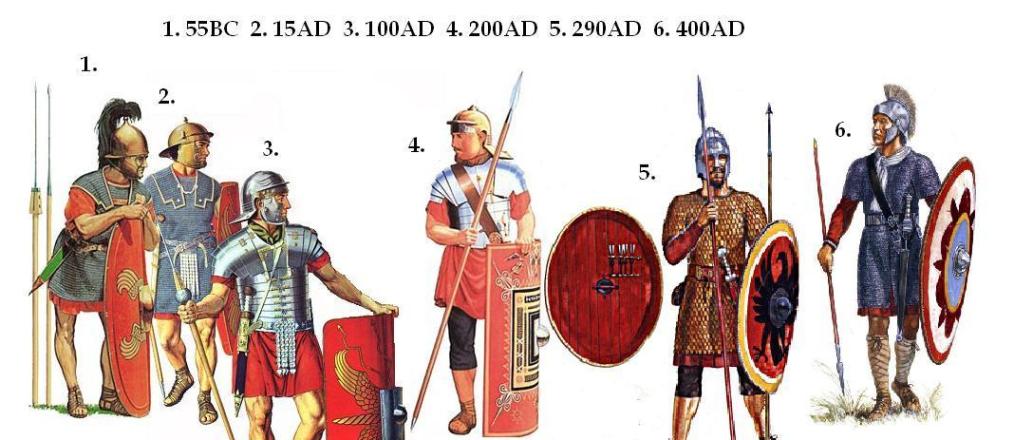
Roman armor
Evolution of Roman arms and armor.
The forces on the frontier had different problems. They were often regarded as secondary soldiers. In a strategy that called for a delaying action by frontier forces followed by a reprisal by the central army, the frontier forces weren’t expected to win which helped cause dangerous declines in quality. Helping this decline according to some scholars was the farmer soldier model. In order to ease the burden on the state soldiers often grew their own food, ran small businesses, and even became land lords. The basic premise is that every moment that soldiers spent farming, tending their herds, or otherwise engaged in business was time that they couldn’t spend honing their war making skills such as being able to operate in large formations or effectively use their swords. (Though the weapons and armor had changed by the late period.) Then the less effective soldiers would not be able to defeat armies in the field, or keep them beyond the borders of the empire, requiring women in camps and city walls to fight. I’m not sure how much I agree with this. Many military skills are like riding a bicycle, and most soldiers throughout history weren’t full time. Rather they were part time soldiers with military skills drawn from farms.

The inclusion of women and children in Alma 56: 28 is extremely curious in several ways. It suggests that women and children accompanied the army to the field or garrisons consistent with historical practice. This was possibly done for several reasons ranging from money to morale to help the army. But the inclusion of women and children with the armies could have hurt as well. If the army spent too much of their time supporting themselves as farmers and artisans, this would decrease their combat power. If the army failed or a city under siege the women could find themselves on the front lines and having to fight.

[Thanks for reading! I work as a freelance author. If you found value in this work please consider supporting this research using the pay pal button below.] 

**********
[1] Donald W. Engels, Alexander the Great and the Logistics of the Macedonian Army (Berkeley: University of California Press, 1978), 13.  Ross Hassig, Aztec Warfare, 64.
[2] This assumes that every soldier was married with children, which is impossible to say for certain.
[3] Engles, Alexander the Great, 13.
[4] Graff, Medieval Chinese Warfare, 29.  Lewis, Mark, “Han Abolition of Universal Military Service,” in Warfare in Chinese History, ed. Hans Van De Ven (Boston: Brill CO, 2000), 33-76.
[5] P.A. Brunt, The Fall of the Roman Republic: And other Related Essays (Oxford: Clarendon Press, 1988), 264.
[6] John Patterson, “Military Organization and Social Change in the Later Roman Republic,” in War and Society in the Roman World, eds. John Rich and Graham Shipley (London and New York: Routledge Press, 1993), 92-112.
[7] Of course, local leaders could also raise armies to support their own interests. See chapter two in Bleached Bones and Wicked Serpents: Ancient Warfare in the Book of Mormon about the breakdown of central control and the rise of private armies.
[8] See chapter one, in Bleached Bones and Wicked Serpents: Ancient Warfare in the Book of Mormon.
[9] Michel Evans, “Unfit to Bear Arms: The Gendering of Arms and Armor During the Crusades, in Gendering the Crusades, Susan Edington and Sarah Lambert eds, (New York: Columbia University Press, 2002), 54.
[10] John Lee, “Urban Warfare in the classical Greek World,” Makers of Ancient Strategy: From the Persian Wars to the Fall of Rome, Victor David Hanson eds, Princeton: Princeton University Press, 2010), 152-153.
[11]  Evans, Bear Arms, 52.

Monday, March 12, 2018

Notes on a Curious Verse- Helaman 11:33

The Rape of the Sabine Women.


Due to the narrative complexity, debates or its origins, and somewhat enigmatic narrative, many verses in the Book of Mormon can provide a multitude of ideas often in direct contrast to how short the text is. One of those is late in the Book of Helaman, and 11:33 reads: Yea, for they did visit many parts of the land, and did do great destruction unto them; yea, did kill many, and did carry away others captive into the wilderness, yea, and more especially their women and their children.

What follows is a summary and explanation of ideas and implications of this verse. I see four interconnected ideas possible in the verse that come from a critical historical perspective.[1]

Captive Brides:

Bride kidnapping is common among many ancient cultures across the world. The Book of Mosiah already described a clearer example of this practice (Mosiah 20:1-5). It is in line with many norms of ancient war. The winner of a conflict had jurisdiction over its inhabitants, and usually slew the men while taking the women and children captive.[2]

The capture of women and children could represent the need for labor of an arms industry (mining metal), additional soldiers for their army, or increased agricultural production.[3] But the practice of captive brides also has several economic implications. According to sources, sometimes the practice of stealing brides was simply a cover for a couple’s elopement in order to satisfy cultural expectations. Many more times, the practice occurred because “the men who resort to capturing a wife are often of lower social status [see below], because of poverty, disease, poor character or criminality. They are sometimes deterred from legitimately seeking a wife because of the payment the woman’s family expects, the bride price [emphasis added]…”[4]

People Over Land:


During periods of massive economic and social turmoil, a decline in population means that people become more valuable than land. The most famous instance is probably Europe after the Black Death. The population decline by as much as a third, meaning the law of supply and demand made existing workers more valuable.

The Chinese period of disunion faced a similar challenge. During the fourth century AD as I write in my book: [A]s a consequence of the partial depopulation of North China, the various regimes that arose…placed greater value on the control of persons than control of territory…. During [this period,] empty cultivable land could be found in abundance…while the labor power to make that land productive was often in short supply. Human populations, therefore, were prominent among the spoils of victory.[5]

The resulting power of the people necessitated compromises between the emperor and various local power holders ranging from former officials of dynasty, towns that mobilized their own militia under a magnate, and robbers that gained unofficial and (eventually,) official power. The compromise between the emperor and submitting warlords or Confucian officials allowed the emperor to strengthen his position, reduce the threats against him, and gain greater legitimacy as an emperor. It also allowed the warlord, bandit chief, or army leader to keep power, have his position legitimized, and have a chance to amass greater wealth and power. The wins of the emperor produced a positive feedback loop. The initial winner received the submission of various warlords and leaders. This increased the ruler’s tax base and the number of farmers he could call on to supply his army, and it made him look like a mandated ruler in the eyes of the Confucian officials who helped him govern and the people over whom he governed. But there were significant limits to this power. A single defeat would break the success loop. The rival generals still held their armies, so they could easily sense which way the wind was blowing and rebel, and because of the ideology surrounding the Mandate of Heaven, they could claim a powerful justification for their actions by arguing that the ruler had lost the mandate.[6]

State Formation:

The first two points suggest the attempted creation of a rival state. The stealing of Lamanite women by the priests of Noah started a new “ite” in competition with the Nephites. And the power of the Gadianton Robbers to take women and children suggests they had the basics of a state apparatus. Again, Giddianhi was educated; there were many “waste places” in Nephite lands (Helaman 11:20), and it appears as though Nephites traded land for peace with the Gadianton Robbers (3 Nephi 6:3). Even later in Nephite history the record mentions a treaty with them but provides little about their state (Mormon 2:28).

The fragility of both states might again take a cue from Chinese history. Both the Nephites and Gadianton Robbers had trouble consolidating their rule and protecting the people. As I’ve discussed previously, the rise of Robbers represented competing centers of power fighting for control. The conquest dynasties such as those from the period of disunion were even more fragile than Gadianton Robbers. Tribes like the Di didn’t have skilled bureaucrats who could collect taxes, administer rituals of leadership, conduct a census that taxes households, and raise their armies. On top of this, the Di tribe had only gained power within recent memory. There were still many gaps to their rule, which might specifically apply to weakening Nephite power. The various hilltop fortresses were only nominally loyal to the government. They still provided potential centers of opposition should the ruler falter and they shield peasants from taxes and the imposition of corvee labor. This weakened the government, as it couldn’t pay its army and didn’t have enough labor to build its own fortresses. Again, recalling Helaman 11:33, the most potentially damaging effect on a would-be emperor’s power was the tendency to relocate the population of defeated enemy states to areas around the capital. In times of severe chaos when central authority was weak or nonexistent, people often became more important than empty territory. By the time of the Battle of Fei River (383), there were over one hundred forty thousand households from the Xianbei and Qiang tribes stationed around the capital. They were easier to tax and control there, but they became a large sea of hostile people if the strength of the capital faltered, which it did in defeat at Fei River.

One final note is geographic specific, and that is how Mesoamerican rulers often needed a quick strike to legitimize their rule and provide captives for sacrifices. If we accept the notion that the Robbers weren’t just robbers but rather a rival state, then view could hold some merit. The warfare was needed on an economic basis but also for a cultural and political basis. Victory in battle, from Constantine seeing the Cross at the Battle of Milvian Bridge to the Chinese Mandate of Heaven, to the ritual ball court sacrifices of the Mayans was often the best divine diagnostic.

Ethnic Tension:

The final point would likely be the lowered social status of The Gadianton Robbers. Assuming these weren’t captive brides, economically important workers, or a need to show divine sanction of the state, their capture could just be part of the ethno history of the Nephites. The Greeks thought the Persians were weak and effeminate, the Romans thought the Greeks were duplicitous, mountain men often were perceived as brutish and darker skinned. The Nephites believed their opponents were cursed, indolent, bloodthirsty, and living in tents. Ethnic beliefs would hardly condone intermarriage with those that were considered ethnic others and mere robbers to boot.

The capture of women and children then is not a mere footnote or ambiguous verse sandwiched between speeches, but rather indicative of larger trends such as economic importance of people, but also the fragility of the states involved often in islands of power surrounded by seas of hostile people only loyal as long as they feared the military might of the leaders.

All of the factors are highly speculative and based on single verses combined with an overall picture presented in Helaman and an extensive knowledge of history. But the book of Helaman is shorter than the war chapters yet covers some 50 years. While some of the ideas in this section are extremely tenuous, they offer tantalizing clues into the nature of Nephite society, the underlying societal factors that drove prophetic warnings, and even possible sexual violence in the text.

What do you think?

*********

[1] There are many more ways to look at the text, and those that think the text is a fiction would find this silly. But I’m not having the same debate over and over again.

[2] Morgan Deane, Bleached Bones and Wicked Serpents: Ancient Warfare in the Book of Mormon, (Ebookit Press, 2014), chapter 2.

[3] William Hambling, Warfare in the Ancient Near East to 1600 BC: Holy Warriors at the Dawn of History, (New York: Routledge Press, 2006), 113, 205.

[4] Daniel G. Bates, “Normative and Alternative Systems of Marriage among the Yörük of Southeastern Turkey,” Anthropological Quarterly 47, no. 3 (1974), 270–287. You might also examine the practices of Boko Haram and ISIS who are doing the same thing in the modern age.

[5] David Graff, Medieval Chinese Warfare:300-900AD,(New York: Routledge Press, 2001), 60.

[6] Morgan Deane, Decisive Battles in Chinese History,(New York, Westholme Press, 2018), 40.

Monday, February 12, 2018

Forts, Resorts and Nephite Military Strategy

The Tower of London in the 12th century, they often painted it white. 


A particular discussion of forts and strategy prompted an interesting reexamination of what I thought I knew. Arthur Ferrill writes about the Late Roman Empire:

In a situation in which the enemy can almost certainly pierce the defensive perimeter, defense in depth and elastic defense are the two most likely military responses. The idea of elastic defense is simply to seek out the enemy’s attacking force and defeat it whenever possible. But defense in depth permits limited retention of frontier territory in forts manned by small forces…Defense in depth is based on the assumption that the frontiers cannot be made impenetrable (at least not at a reasonable cost), and that attackers will inevitably succeed in piercing the defensive perimeters. Such invasions can be thwarted, however, by maintaining relatively strong forts in a fairly deep band along the frontiers and a mobile army (or several scattered regionally) within the Empire. The forts must be strong enough to withstand attack and yet not so strongly defended as to become a drain on manpower weakening the mobile army. Since the barbarian invaders of the Roman period normally knew little about the techniques of siege warfare and could not place forts under blockade for fear of being caught by the mobile army, defense was in some respects theoretically realistic. During an invasion the forts served as pockets of resistance for storing food and fodder. Later, as the mobile army coordinated its efforts against the enemy with the small defending frontier forces, supplies could be denied to the invader while they were made available to the central reserve. When situated at strategic points such forts might also hold river crossings and passes thereby impeding the enemy’s movements.[1]

What interested me about this is that everything I’ve read tends to support the Nephite strategy of a defense in depth. For example, here is Nibley’s discussion of the practice:


Moroni’s defenses were based on a series of strong points, being a defense in depth, as modern defense-lines are; beside specially placed ‘small forts, or places of resort,’ towns and cities on the line were also converted into strong points (Alma 48:8). Such an arrangement can take the momentum out of any military steamroller and slow down or stop any attacking force, no matter how formidable, by forcing it to reduce one strong place after another or else bypass the fortifications and thereby leave dangerous enemy forces in its rear to disrupt communications and launch harassing counter-attacks on invading units.[2]
Me and my daughter, Tower of London 2017. 

So far so good, Nibley provided a decent description of the chapter and compares nicely to Ferrill’s definition of defense in depth. But the only problem is that the verse that talks about a system of forts and resorts, is never really mentioned again. The strength of fortifications for some major cities such as Bountiful, and Nephihah, and Mulek are mentioned. Moroni wrote his angry letter to the government because he felt it was easier to keep those fortified cities than take them. He tried to entice Jacob out onto the plains, and needed some extracurricular climbing to secure Nephihah.

But the vast majority of the war chapters suggest something different. When the Lamanites invaded with their “wonderfully great” army in Alma 51:11, they quickly seized most of the new cities along the seashore: Moroni, Lehi, Morianton, Omner, Gid, Mulek, and in an apparent typo or a narrative that got ahead of itself, Nephihah is listed here as well (Alma 51:26, compare Alma 51:24; 59:7.) There is little strategic depth here as Teancum searched out and “met” the Lamanite army. The Nephites didn’t hold key river crossings, or have fortifications with “limited retention of territory” behind enemy lines and definitely didn’t have a “fairly deep band” of forts throughout their territory. They were relatively close to Lamanite territory, (they did call it the “narrow strip of wilderness” after all, Alma 22:27) and they had little strategic depth. In the vast majority of cases it was Nephite armies that advanced to meet an invading foe in battle. This suggests the elastic defense more than defense in depth.

There were several times that what could be described as mobile armies operated with fortresses to attack and kill armies. But the limited Nephite geography combined with lack of institutional difference between the mobile army and garrison forces (that became rather prominent in late Roman history) makes this less persuasive for the defense in depth theory.

Moreover, I’ve read that there are actually differences between refuges, strongholds (Alma 50:6), and strategic defense. What we have in Nephite society is the first two, but it’s very unlikely they had the third.[3] As David Jones wrote:


Refuges function as short-term defense and only work against an enemy without the means to linger in an area for long periods. Refuges simply have to deter an enemy from organizing an assault. A stronghold, on the other hand, must be able to withstand attackers who can maintain supply lines to the siege site. Strongholds must be large enough to protect and house a garrison when under attack. They typically possess walls, towers, and some sort of moat—wet or dry. In the “strategic systems” type of fortification, multiple strongholds connect, much like a wall, to deny enemies access over a wide offensive front…Refuges are most likely found in small-scale societies of the band or tribal type, whereas strongholds are a product of small or divided sovereignties; they proliferate when central authority has not been established or is struggling to secure itself or has broken down…Strategic defenses are the most expensive form of fortification to construct, to maintain and to garrison, and their existence is always a mark of the wealth and advanced political development of the people who build them.[4]

In short then, based on a variety of factors that include a broader examination of the war chapters, and proposed Nephite geography, and the level of society necessary to produce wide spread fortifications, the Nephites practiced something closer to what Ferrill called the elastic defense and what I called the offensive defensive. In Mormon Perspectives on War I wrote:

This strategy was used by the Confederacy during the American Civil War, permitting them to choose the locations where critical military confrontations should occur: “Then the confederacy might muster adequate numbers and resources at critical places despite overall inferiority of strength.”[5] I contend that the Nephites were successful when they adopted this strategy. They were numerically inferior and, for much of their history, “nearly surrounded” by the Lamanites (Alma 22:29). Strategically they would receive the Lamanite attack. Once the attack entered Nephite territory they would then move offensively to force a battle at the time and location of their choosing. These tactical advantages would offset their numerical deficiency and result in victory.

So What

This might seem like an insignificant detail to many people, many others might have their eyes glaze over by trying to see the difference between elastic defense and defense in depth, or the differences between a refuge and stronghold. But being precise is important. Too often people, church members, conservatives, liberals, critics, and defenders, use labels such as war monger, terrorist, and snowflake, and let those labels do the heavy lifting in the argument. Without beating up on Hugh Nibley too much, (though I do have a project that offers a much needed critique of his military arguments), he and many others used the wrong term in this case that has obscured the debate. Apologist arguments in many cases have accepted Nibley’s writings as gospel truth when those writings really needed to be critically assessed.
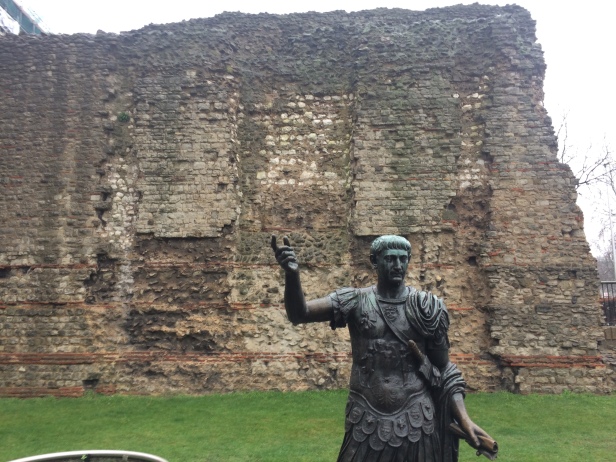
Old Roman Wall and statue of Caesar with a medieval wall built on top of it. Tower Station London. 

More importantly than being precise is how the fortifications can tell us about Nephite society. Armies don’t simply float down from the imagination of historians, but are raised, equipped, fed, and trained by the societies that field them. A stronghold defense, (the second kind of forts mentioned by Jones), correctly implies a small, struggling central authority trying to establish itself against external and internal threats.

In my next book, From Sinners to Saints: Reassessing the Book of Mormon, I often criticized Nephite leadership. One of the biggest critiques comes from the expense of maintaining fortifications and garrisons after the great war. In short, the fortifications were decisive in the war, but very few have looked at the unintended consequences of those forts. My chapter and the quote from Jones above suggest that cost of building and maintaining their strongholds led to a rapacious need for taxation and an abusive, self interested class of soldiers and government officials which fueled an insurgency and societal unrest. In plain language, the dysfunction in Nephite society seen in the Book of Helaman was caused by the reforms of Moroni during the war chapters. Jones’ analysis builds on that by providing a general rule which states that a society building extensive fortifications must be wealthy and politically complex.

This should add a great deal of poignancy and nuance to the prophetic denunciations about “getting gain” in the Book of Helaman. War is expensive, and preparing to defend against a Lamanite attack seemed to break Nephite society. (Recall the need to provide “defense at a reasonable cost” mentioned by Ferrill.) War seems like good business for some, Nephite society didn’t have ammunition supplies like World War I, but they likely had local elites that got rich off of the Nephite building programs and garrisons. The government needed more money to pay locals, or to use a modern phrase, pay their contractors. This required more taxes which could seem rapacious enough to fuel an insurgency. The soldiers benefited from the plunder associated with warfare. And the people suffered and there are many more effects. I have hundreds of pages in my book that discuss these items in further detail, but in short, the denunciations against “getting gain” likely refer to what was the ancient Nephite version of a military industrial complex.

[Thanks for reading. I work as a free lance writer, if you found value in this work please consider donating using the pay pal button below. Thanks!] 


**********

[1] Arthur Ferrill, The Fall of the Roman Empire, The Military Explanation, (London: Thames and Hudson, 1986,) 31, 45.

[2] Hugh Nibley, Since Cumorah, (Salt Lake City: Deseret Books, 1986.) Chapter 11. Please note Nibley’s use of “as modern defenses lines go”, this is quite ironic as Ferrill says most scholars accept certain arguments about Roman defense because it has a modern ring to it.

[3] Though I write in my new book that the consequences of the war chapters were expensive forts and garrisons for them that had negative effects on Nephite society, so I feel some vindication based on this quote.

[4] David Jones, Native North American Arms and Armor, (UT Austin Press, 2004), viii-ix.

[5] Russel Weigley, The American Way of War, (Bloomington, Indiana University Press), 97. Found in, Morgan Deane, “Preemptive Warfare in the Book of Mormon,” in War and Peace in Our Times: Mormon Perspectives, (Draper, Greg Kofford Books, 2012,) chapter 2.

Friday, September 29, 2017

Record Keeping Magic

[I'm starting a new position as a permablogger at Wheat and Tares. I've gusted posted there on and off over the years and they are trying to expand their offering. I've found they are a receptive and mostly positive audience to my ideas. As a result, most of these posts are also cross posted over there and they might add some background you've already heard.]

I’ve been operating a blog, Warfare in the Book of Mormon for the better part of a decade now. The most fruitful approach I’ve taken over the last several years is to read the text a bit more critically. This is only a blog so I won’t get into the methodological weeds, but I think the good guys aren’t as good as we think, and the bad guys aren’t’ always as bad.  There is a FAIR conference talk about ten years ago that talked about not having a testimony of the history of the church. This means that while the gospel is true, the history of the church is complicated, nuanced, grey, and not nearly as black and white as many members assume.  As I’ve taken this same approach to the Book of Mormon and tried to examine how the Nephites might not have been as noble and pure as the narrative implies, I’ve noticed that the Nephite record keepers are great magicians.

As Grant Hardy intimated in his book, Understanding the Book of Mormon, sometimes the text omits key material, or includes other material that essentially distracts from uncomfortable implications. He points out Nephi’s return with the brass plates. The narrative skips over’s Lehi’s reaction to instead include a rather rare example of a women speaking and complaining in the text. (1 Nephi 5:1-9) Hardy’s analysis uses that unusual inclusion plus the resulting peace offering to suggest that Lehi didn’t approve of Nephi slaying Laban. The Nephite record keepers use emotionally based language such as this to make the reader see what they want you to see, and ignore the context, implications, and unintended consequences detailed within the text.  This post briefly (as possible) looks at three examples that illustrate these magic tricks.
The burning of Sanjo Palace in Medieval Japan. I like this picture because the Samurai are often viewed as these noble Knight like individuals and even became the basis for the Jedi. But in this battle they burned the palace, and then killed all of the survivors as they fled. You can see a decapitation in the center of the picture. Historical reality is different than the often idealized views of the past. 


This land is my land 

The first example might sound a bit familiar. Last time I posted a dramatized account of Moroni’s army sweeping out the Lamanites in Alma 50:9.  They likely didn’t issue a 30 day eviction notice and do so with a regard for Lamanite civil liberties. In fact, while it’s not recorded in the text I bet they used many of their ethnocentric descriptions of Lamanites to justify their action (see the next section).  The Lamanites are dark, loathsome, bloodthirsty, and wild people while the Nephites will bring the light of Christ and civilization to the region.

In fact, the magic trick then becomes the very long discussion of how happy and secure this made the Nephites. Instead of considering how the Nephites may not have been Christlike to their neighbors, how they exercised naked power against their ethnic rivals, and how those refugees likely enhanced Amalickiah’s arguments about Nephite perfidy the chapter discusses how secure they were. Verse 12 discussed “the assurance of protection” offered by new lands, and waxed eloquent about how happy and blessed the people were until finally in v 23. the text says that there “was never a happier time” among the people.

Yet, just a few verses later, in the same chapter, Morianton does the same thing as Moroni and is defeated by Moroni (v.26-36)!  Instead of receiving praise, Morianton’s people taking up arms is presented in stark and dangerous terms. There was a “warm contention,” and Moroni was afraid the people of Bountiful would side with Morianton in the dispute (Alma 50:32.)  But instead of concentrating how the people of Lehi likely presented a one sided account of the conflict, and how naturally fearful anybody would be of Moroni, the text instead becomes a morality tale as Morianton beat one his servants. Morianton didn’t immediately chase his servant which suggests the possibility that she often ran away and then came back.  But this time she went to Moroni who then found significant moral authority to deal with Morianton.

This moral authority was needed because Morianton was simply doing the same thing that Moroni did a few verses earlier. But Morianton had the negatives of possible being an ethnic minority (because of the Jaredite root ending in his name), driving out Nephite settlers instead of Lamanites, and having the survivors flee to Moroni’s camp.  This is the second magic trick in this story.  In addition to ignoring the consequences of preemptive action seizing land and creating refugees, Morianton couldn’t do the same thing because he was morally corrupt and seditious.

Praiseworthy Bloodthirstiness


The next piece of magic again comes squeezed within a good deal of happy talk. After Nephi and Lehi preach to Lamanites, are encircled by fire, and have massive conversions, there is a stunning change in affairs. Suddenly there is peace, harmony, increased trade, and righteousness throughout the first part of Helaman chapter 6. Yet not all is good because the Gadianton robbers are still active (and we’ll get to that part of the story in a minute.)  

From a spiritual standpoint this is a great story, but conversion also results in societal changes as well. I discuss the historical incidents using examples from European history where I describe how conversion is crown deep. There are numerous benefits that range from added political power, top down government control, additional tools of statecraft, diplomatic benefits that include being part of the Christian club of nations. The conversion of Lithuania is a good case study for seeing all of these trends but for brevity I will focus on the diplomatic benefits.

In Helaman 6:20 the Lamanites are praised for using “every means” to “destroy” the Gadianton Robbers, which might be the only time in the scriptures their martial activities are praised. When the Lamanites are not part of the club they are described a wild, ferocious, bloodthirsty, barbarous, cruel, hardened and a plundering people (Enos 1:20, Mosiah 10:12 Alma 17:14 Alma 48:24). These are typical ethnic stereotypes of the other, but amazingly they disappeared when the Lamanites convert and fought the Gadianton Robbers. When the Lamanite Christians later became Nephites in order to fight the robbers in 3rd Nephi 2:12-16 their kids also became white!  Fighting satanic pagans under the banner of Christ gets you a good amount of praise from the recording historian (Mormon) as those fighters suddenly become part of the club. This piece of magic is consistent with historical practice and particularly prominent when the historian has a religious background.  

Wicked Chief Judge- Worst thing ever or minor inconvenience?

The final example comes from involves the Chief Judge. In Alma 46 changing a few laws is presented as a grave threat to liberty and resulted in rather passionate prayer, prophecy (and militarization) by Moroni. The Title of Liberty is praised in the most heroic terms. Nonviolent advocates like Jana Reiss and Joshua Madsen have called him a military “stud muffin” and “action hero”. His words helped me get through Marine Corps boot camp and many uncomfortable nights in the field, (at the risk of confirming stereotypes) during my mission in Texas I went to military compounds that quoted and framed the Title of Liberty on their gate, and the Frieberg painting was prominently displayed in my step dad’s office when he was company commander of the 82nd Airborne. This action was seen as a valiant defense of liberty but the magical description of the powerful Moroni obscures unintended consequences and contrasts with Helaman 6:39 and the trial of where Nephites lost control of the government with little more than a shrug and a whimper.
Just like the refugees created in Alma 50, after the Title of Libety the fleeing men of Amalickiah likely had much more ammunition to spin a tale in front of the Lamanites. He likely didn’t have to exaggerate much to imply that Moroni was an aggressive and dangerous leader.  Nothing says freedom for example like forcing people to support it at sword point (Alma 46:36). Historically failed revolts lands resulted in confiscated lands that were then distributed. Considering the high cost of equipping Nephites with new game changing armor,[1] I wonder if lands were taken or very least a heavy tax levied to support this move. Not only were Kingmen forced to support liberty at sword point, but they likely had to literally pay for it too. This seems like a good case of blowback if there ever was one, and it happened without anybody noticing because we get such warm fuzzies reading about the Title of Liberty.   

Moreover, when the Gadianton Robbers did obtain “sole management” of the government in Helaman 6:39, they were described in the worst terms. Mormon claims the Robbers did “no justice” in the land. They punished the poor because they were poor and allowed the rich to go free so they could go on whore mongering and killing (Helaman 7:4-5). 

Yet, one of the few detailed examples of their justice we have is actually fairly evenhanded. After Nephi prophesied of the murder of another chief judge he was arrested as part of the conspiracy.  They managed to arrest Nephi, an extremely vocal critic of the government, conduct an investigation, and then release him without any indication from the record that he was mistreated.  Nephi didn’t have his lands seized (like the Nephites did to the Lamanites in Alma 50 or possibly the Kingmen in Alma 46), as Nephi apparently maintained his residence in the capital city. Nephi wasn’t indefinitely detained before finally being executed like the Nephites did to their vocal critics during the great war (Alma 51:19; Alma 62:9).  Despite being a vociferous critic of an evil government that he says is inspired by Satan, Nephi received a fair amount of what we would call due process.  Of course, Nephi’s son did have an execution date set. And as a leader of a major or dominant religion, Nephi may have been too big to jail.  Yet this example is still illustrative of how losing control of the government wasn’t the world ending result, especially when we might infer even worse about the supposedly righteous rule of Nephites.

Nephite leaders preemptively seized a perceived threat against the government in Helaman 1, where the person’s sole crime seemed to be just thinking about flattering the people. That could have seemed like a decent reaction based on the chaos caused by other dissenters. But even King Mosiah had to plead to the people that they had no right to “destroy” his son Aaron should he reassert his right to the throne and spark a civil war (Mosiah 29:8), so it seems like a pretty common response that even applied to repentant missionaries. Reading John Welch’s, Legal Cases in the Book of Mormon, shows us that Alma the Younger had to be very creative in his sentence and execution of Nehor, which still inflamed sectarian conflict.[2]  There are many more examples we could infer about the injustice of the Nephites. Daniel Belnap for example, wrote a very good article detailing the strife and “stumbling block” that unrighteous and unjust actions of Nephites caused in the 18th year of the reign of the judges.[3] 

Helaman’s servant stabbed an assassin after nighttime spying (Helaman 2:6), and Nephi exposed another killer in Helaman 9:6. Lawyers and leaders within the Nephite nation were known to beat confessions out of criminals (Alma 14:17-22), and both Lamanites and Nephties attempted to poison each other with wine (Alma 55:13). Of course the beatings to get confessions were committed by unrighteous figures from the wicked city of Ammonihah. Though its important to note that no beatings were recorded during the period the robbers had “sole management” of the government. The Nephites even tested the wine on their prisoners first (Alma 55: 31-32)! Jailing the prophet for a bit in connection to a murder that he just predicated, hardly seems like the government of Satan, and seems comparatively better than some of the actions by righteous figures. Yet again, few readers notice because the Title of Liberty and preaching and prophecy of Nephi distract from that comparison and contrast.

Conclusion

The Book of Mormon is a complex book. Suggesting that the Nephites are unrighteous might be upsetting to some people. After I gave presented at the FAIR conference I got some strong rebukes by people quoting scripture suggesting that I was completely wrong in my reading. This analysis is admittedly speculative, but it’s no less so than the Heartland kooks that probably dominate your Sunday School.  This approach gives us the benefit of treating Mormon as a real person and historian with tension between the spiritual and history in his book. As Michael Austin said the last time this controversy arose, many members insist the book is historical, but then read the text as though it’s a bad novel or propaganda. If the Nephites were real people then they were self-interested just like everybody else in history, and particularly the children of Israel. As a result their record keeping shows the same techniques used by other ancient historians. They liked power and prosperity, and they wrote their history the same way others did. So their culture was seen as better, the “others” were seen as wicked, losing power to wicked individuals was the worst, and making smart moves to consolidate their power was wise. The Nephites were not cardboard cut outs, but acted like people throughout history, moving through a fallen and difficult world the best they can.

Thanks for reading. I work as a freelance writer. If you found value in this piece please consider donating using one of the pay pal buttons at the bottom of the page. 

*************

[1] Alma 43:19-21 suggest the armor was enough to scare away the Lamanites, and they blame their defeat on it 44:9). We don’t know the exact material. Large metal was not feasible in Mesoamerica at this time, and the Limhites brought back a large piece of armor because apparently it was rare. But it was heavier and enough to tip the balance of power.
[2] John Welch, Legal Cases in the Book of Mormon (Provo: Maxwell Institute, 2008), The Trial of Nehor.  
[3] Dan Belnap “And it came to pass . . .”: The Sociopolitical Events in the Book of Mormon Leading to the Eighteenth Year of the Reign of the Judges Journal of Book of Mormon Studies, 2014 (23): 101-139