Showing posts with label face of battle. Show all posts

Thursday, March 3, 2022

Fainted But Not Fallen: Learning From The Stripling Warriors


I delivered the following to the unofficial Las Vegas Singles Conference over President's Day Weekend. It's been a busy time for a military analyst but I wanted to post this before too much time had past. I hope you enjoy it.

    Thanks so much for having me. I attended these conferences for years. Being the geek that I am I mostly attended the classes, and being the guy that I am I mostly stayed for the food. I was very disappointed that it was cancelled but very pleased that some unofficial version of it has been recreated. I hope everyone is having a good time and learning a great deal…and maybe meeting a few people. 

    Before we get started, I wanted to highlight a few things from my background that might help enhance the message I’m going to share. I wasn’t always going to be a military historian. It was what I love studying the most but as an undergraduate I was told that you can’t really have a career in military history. So, I applied to various programs around the country with specialties in other areas. But I got rejected from all of them. I was questioning my ability, feeling like a failure, and wondering what I was going to do moving forward when I found a military history program. It was online, expensive, and not very well known so it was kind of a gamble. But I did it, and it was great. I received advanced training in what I have always loved. The rest is…history eh eh eh. Not only do I specialize in military history, but I also regularly teach, publish, and present on the subject. That success was because I failed. I can’t imagine doing anything else and I don’t know if I would have specialized in military history if I succeeded at first. 

    Going back farther than that, I served in the Marine Corps. After I discuss some of the military history about wounded soldiers suffering from combat stress, I’ll give you some application. Those applications might sound indulgent or lazy. I’ll talk about this more after I set the stage, but I expect all of you are really good at giving yourself the Mormon version of the Patton speech, but not very good at paying attention to your mental health and emotional needs.  So, it’s important to realize that when this crusty old Marine who knows a thing or two about sucking it up and pushing through it, suddenly talks about mindfulness, and self-help, you should give yourself a break too.

    The final point is simply that I’m single too. I know that you can get good advice from any source. Yet it does get kind of annoying when you’re getting advice from someone who’s single experience consists of marrying the first person they dated six months after their missions when they were 21. As some of might feel in back or knees every day, 21 was a long time ago. I’ve been single for awhile like many of you here, and I hope that helped me really personalize the message for you today. 

    With those personal notes out of the way we can get to the scriptures. The Stripling Warriors were always very inspirational. I read all the war chapters during boot camp and appreciated them a great deal. The young men sacrificed their own happiness to march off to war, and fulfill an obligation for their parents, who had covenanted not to take up arms. And the young men had so much faith they trusted their commander to lead them into battle. It’s recorded in Alma 57 that they fought and to the great astonishment of Helaman, not a single one of them had died. 

    But many of them had fainted due to their battlefield wounds. In Alma 57:25 and 26 we read:  And it came to pass that there were two hundred, out of my two thousand and sixty, who had fainted because of the loss of blood; nevertheless, according to the goodness of God, and to our great astonishment, and also the joy of our whole army, there was not one soul of them who did perish; yea, and neither was there one soul among them who had not received many wounds.

    And now, their preservation was astonishing to our whole army, yea, that they should be spared while there was a thousand of our brethren who were slain. And we do justly ascribe it to the miraculous power of God…

    What impresses me about this scripture, and it forms the central point of my talk, is the treatment of those who fainted was no different than those who hadn’t. All of them received many wounds, and those who fainted from them weren’t put in a different category that had less faith. They weren’t considered doubters cast off from God because their wounds made them stop participating in the battle. They were described in verses 19 and 20 of Helaman 57 as “firm” and “undaunted.”   And yet even though they were faithful- to use modern terms they were rms, went to church, attended seminary, and were considered valiant youth- they still faced wounds in battle to the point that at least for a time they couldn’t continue the fight. 

    How long they were out of the fight depended on the care they received. We have some clues from scriptures that discuss the care of wounded soldiers. Alma 6:40 indicates that the Nephites had an understanding of herbs used to cure fevers. Alma 4:20 suggests Alma the Elder was wounded in battle and he recovered enough to lead the nation and preach for years. The survival of these individuals suggests medical care on the battlefield, though the majority of cases refer to off-field treatment. We don’t know what care the Stripling Warriors received. Alma 58 concludes the account of the war in that theater. It included garrison duty, but also daring maneuvers of Helaman’s small army. So, it is possible that they were in that army, or they convalesced for quite a while in garrison duty.

    Either way they would likely have mental scars that lasted far longer than their physical wounds. Surviving a battle often left both long-term physical and psychological scars. Our knowledge of conditions like post traumatic stress, and combat stress as we’ll see below is rather new but suffering from it is not a uniquely modern experience. Shakespeare suggested that victorious soldiers would reminisce every St. Crispin’s day, and those who didn’t participate in battle would “hold their manhood cheap” or feel like less of a man for missing the battle. Yet in reality, those who survived battle still suffered a great deal. Many people lost limbs, walked with a limp, or held battle scars. Captain Moroni died at the relatively young age of 43 shortly after the war (Alma 43:17; 63:3), allowing for the possibility that his life was cut short because of the rigors of the campaign, the lingering effects of his wound in Alma 52:35, and the stress of nearly 20 years of constant combat and campaigning.

    Lisa Hawkins and Gordon Thomasson writing for what is now the Maxwell Institute employed a methodology used to describe survivors of the Holocaust and found that both Almas, Amulek, Jacob, and especially Mormon and his son Moroni showed elements of being survivor witnesses to incredible carnage. 

    The Stripling warriors survived the battle, and were considered faithful. But they likely needed mental support after the battle and for the rest of their lives. Thankfully, we have modern research that indicates how that might have looked in the immediate sense of combat stress, and how that can look generally as they and we pursue our spiritual goals 

    One of the modern terms we know best is called Shell Shock. This was first reported in British soldiers who reported the symptoms of head wounds- things like a ringing in their ears (which having TMJ I relate to), amnesia, headaches, dizziness, tremors, and hypersensitivity to noise- without reporting any head wounds. By World War II this had been identified as combat stress disorder, which occurs during combat, as opposed to post traumatic stress which is long term and after combat. Combat stress includes symptoms like fatigue, slower reaction times, indecision, disconnection from one's surroundings, headaches, hyper vigilance, nausea, and the inability to prioritize. Many of these symptoms are like regular stress we face in everyday life. Where the body’s reaction system is left in the on position, with resulting flooding of chemicals into our brains and bodies, which in turn produces physical challenges. 

    The difference between World War I and II was seen in the treatment of those soldiers. It remained poorly understand early on and as a result it wasn’t treated very well. There was confusion regarding how it was caused, if it was more physical than mental, and how closely related to battle it really was. Shell shock related to physical conditions like close artillery fire and concussions in the British army resulted in the soldier receiving a wounded stripe and qualification for a pension. If the shellshocked soldier was not closely related to a shell explosion they were labelled as sick and that soldier was not entitled to the wounded stripe or pension. 

    Going back to the Book of Mormon, it would have been like attaching an asterisk to the fainted Stripling Warriors and only praising those who didn’t succumb to wounds. Thankfully, by World War II the identification and procedures for handling combat stress was much better. It was recognized as a combination of physical and psychological stress and in high intensity combat scenarios- think the Battle of the Bulge in World War II- could be just as common as physical injuries. 

    These simple methods addressed two competing factors that often complicated treatment. Both factors had to be accounted for at the same time but were often contradictory when seen in the soldier. First, there was an overwhelming physical reaction and need to get away from combat. And the second was a feeling that they needed to stay strong and prove themselves IN combat, and that they were letting down their friends who were still fighting. In short, and to repeat this important point, you had people who physically felt compelled to flee combat but also the compelling urge to stay in combat. It is no wonder their nervous systems went crazy, because they were being pulled apart from the inside. 

    Accounting for these competing principles in dealing with combat stress are the most import part of understanding the spiritual concepts of being fainted without fallen like the Stripling Warriors. You won’t get this from other speakers who got married at 21 like it was no big deal and have stayed married, or the usual homilies you hear so often at church that never help. 

    But being single is painful. 

    You see everyone else get married. For year after year and eventually decade after decade you wonder when your turn will ever come. You go on hundreds of dates, thousands of church activities, say millions of prayers, give yourself the same pep talk over and over again and nothing ever changes. You have to endure everyone’s meet cute stories in sacrament meetings, you get told that you can get married after you die, which is the Mormon version of better off dead. You have bad date after bad date to try and remedy the problem, and you get accused of being sinful, mean, or jealous if you roll your eyes at any of the above examples. 

    At a certain point, like the soldier in the trench, or the Stripling Warrior in battle the pain is too much, and you have to faint, or get away from the battle. Your nervous system and body are telling you that you need a break. That is the first point of combat stress, to get away from the pain. 

    The second point exists at the same time, and it is most important to a Mormon audience. The second point is that you worry over feeling like a failure. You want to show faith in God, build the church, raise righteous kids and worry that fainting from the fight means you have failed in all of those goals.  

    I’ve lived this so I know it well, but Mormons are really good at putting pressure on themselves instead of recognizing their own mental health needs.  In other words, you are really good at prioritizing the second imperative, the notion that you are Saturday’s warrior and can’t give up the fight, instead of the first notion, that the pain is too much and you need some rest and recovery before you have a mental breakdown or leave the church for good.  

    As a result, you end up being the combat stressed soldier, that no one ever treats for stress. You already know why that is, because you’ve internalized the mantras to the point that you probably hate yourself for even feeling point number one, or the desire to get away from the pain. The mantras include: You don’t have enough faith; you don’t try hard enough to make meeting memorable. You don’t have a positive attitude for the lame singles activity. There are no boring meetings only boring people. You have to endure to end and return with honor.  I could go on. 

    Yet, the Stripling Warriors were allowed were enough space to feel both. They exited the battle, its true, but remained faithful. Allied soldiers were fighting Hitler, and they were allowed a break from the battle. You are a beloved child of Heavenly Father, Jesus died for you, you can give yourself a break too. 

    And the techniques for dealing with combat stress aren’t that complicated. One British officer summarized it pretty simply: for emotional cases, unless they are very bad…give him a rest at the aid post if necessary and a day or two’s sleep, [hot shower, and warm food, then] go up with him to the front line, and, when there, see him often, sit down beside him and talk to him about the war and look through his periscope and let the man see you are taking an interest in him.

    Put simply, they let the soldier go to the rear areas. In most cases, it was only a couple miles from the front.  Sometimes simply a warm meal, shower, and good night’s sleep for a couple days was enough to get them battle ready. The leaders cared about the soldier’s life and emotional wellbeing. So, a short break from the combat relieved imperative number one, to get away from the pain, and some self help with the expectation that their break was temporary, was enough to get them back into battle and obviate imperative number two, the feeling that you are letting down your fellow soldiers and country. 

    It isn’t an exact comparison, but we can make some spiritual points here that are very clear. Most singles are good soldiers, but there comes a point when the battle pains effect every faithful member.  The Stripling Warriors showed you don’t have to feel split in two by denying either of them. 

    Let me say clearly, if any experience, attending church, singles events, reading scriptures, going to the temple- is painful, so much so that you feel like you’re bursting your emotional stiches, stop doing it. It is okay to prioritize your mental health. If attending church is too much, you can do something else until you feel emotionally healed enough to go back. Go to the park, watch church videos. And because you’re good at those Patton speeches I have some scriptures that will help. Jesus has said plainly in John 4:24 that he is spirit, and you can worship him in spirit and in truth. Alma asked the Zoramites in Alma 32:11, “do you suppose you can only worship God in your synagogues once a week?” If the singles activity isn’t something you want to do, stop doing it. Host your own movie and pizza night instead. If the temple experience isn’t helping, try reading some books about it instead, or simply enjoy the lush courtyard instead of the ceremony. 

    This is where my Marine Corps experience comes in handy to make me sound authoritative. I was a corporal and had to put my foot in the rear end of people that wouldn’t perform. And I’m telling you, it is okay to prioritize your mental health at the expense of your church obligations. At worst you have fainted, but you haven’t fallen and like the Stripling Warriors there is no asterisk by your name for supposedly having less faith because you attend to your emotional pain and stress. 

    Perhaps more importantly we might look at Moses. I first heard this scripture from a psychologist at a past singles conference. He treated, basically, overworked LDS housewives, that were so worn out that they were committed for psychiatric care. In Exodus 18 the father-in-law of Moses came to him. Moses was working all day hearing the cases brought before him and leading the people. Moses said he had to do this because the people needed him (or in other words, imperative number two for those suffering from combat stress.) But Jethro’s advice addressed imperative number one, the need to address his mental health, he said, “What you are doing is not good. You and these people who come to you will only wear yourselves out. The work is too heavy for you; you cannot handle it alone.” 

    The psychologist at the conference hammered this point home with personal application. How many people would Moses have helped if he drove himself mad? How many members of your family are you helping if you’re in the car sobbing in between meeting at church? How many people is that relief society president helping when she’s in the white padded room?  You aren’t living the blessed life God wants you to if your stress has made you numb and on the verge of a nervous breakdown. In that fraught mental state, you aren’t enjoying the sunset, smiling and laughing with your kids, providing service to your neighbor, or doing any of the good things that God wants for your full and happy life. I’ve been watching the Office. And if you can relate to Michael, who was so stressed and hurting from life that he saw a train in the background and start sprinting towards it, you aren’t going to advance the work of God. And most importantly, you aren’t going to meet your eternal companion by hoping they’re making themselves miserable the same time you are. 

    You’re more likely to attract someone while living your best life. Be mindful of your stress and anxiety. Make sure you are eating and sleeping.  Fill your life with good activities and hobbies. We all have this fear that maybe we will never find someone to marry. If you don’t, at least you are still living in a way that gives you the best chance of making yourself happy. You aren’t waiting for someone else to come along before you start living. 

    In summary, if the things in the above paragraphs applied to you, then you might be a fainted soldier, but not fallen. You can give yourself treatment to get back into the fight. If you’re computer has virus you take it into the shop. You get your broken car fixed right away. But you won’t take the time to deal with the trauma, and yes, I mean trauma, of being a single, divorced, or gay member of the church. Like the Stripling Warriors, or shell-shocked rifleman in the trench, you may feel the need to withdraw from combat, but it doesn’t have to be long term or bad for your spiritual health. 

    I tried to offer a theory based on the Stripling Warriors and likened that story to combat or just plain stress, and the great emotional pain of being single in a church. I then gave advice about how to be fainted without fallen by giving yourself time to heal. This involved two major imperatives: You want to remove the pain at the same time you struggle not to betray the cause and disappoint God. Hopefully I given you some good advice that addresses both imperatives. 

    The modern member who is fainted but not fallen might not look like a traditional member of the church for awhile. But that doesn’t mean they aren’t faithful, they don’t care about the fight, and they aren’t trying their hardest to rejoin the fight as soon as possible. They are attending to their combat wounds by increasing their mental health. They might be staying active in nontraditional ways. Because they care about their mental health, they are likely far more sensitive to their fellow warriors who might seem ready to faint, but are unnoticed by any of their church leaders. 

    As you do these things you will be granted greater calm. Like the Stripling Warriors in Alma 58:11 they could feel God’s Spirit speak peace to their souls. As you heal, eventually you’ll be able to rejoin the fight and be a member that is considered no less faithful than the fainted Stripling Warriors. 


Tuesday, December 11, 2018

Beloved Moroni? The Common Soldier's View


This might sound like an easy question to answer. After all, the book of Alma clearly stated:

Now behold, this Lehi was a man who had been with Moroni in the more part of all his battles; and he was a man alike unto Moroni, and they rejoiced in each other’s safety; yea, they were beloved by each other, and also beloved by all the people of Nephi. alma 53:2 
But there is more to the story than simply taking this passage at face value. My problem with simply accepting this verse was voiced in response to a controversial three part article by Duane Boyce. In part two he used a biased account from the Nephites to explain how the Nephite record keepers weren’t biased.[1]The Book of Mormon is of course something that should be used by those who think it has spiritual value. But that doesn’t mean its historical implications are correct. For the sake of space I won’t defend or explain the methodology I use though you can find explanations in several other places.

Examining the key verses

To put it simply, what if the claim about being beloved is just a rhetorical insertion? After all, there are no accounts of people rushing into the streets to proclaim their love for Moroni and throwing flowers at his feet. There is an account of people ripping their clothes symbolically, donning their armor, and rushing to support a political/military leader to subdue his enemies. That fits with our vision of Moroni as a strong and mighty man, but not with one that makes him seem sympathetic, cuddly, and beloved. (You might compare him to Stannis from Game of Thrones. He was right, just, and mighty, but described as more iron than velvet.)

In Alma 48 is used as a frequent qualification for the man as well: “if all men had been…like unto Moroni, behold, the very powers of hell would have been shaken forever.” Again, that is a powerful endorsement of spiritual strength from an editor of the same religion and who was so infatuated with Moroni since he named his son after him. This statement reinforces Moroni’s strength in fighting evil and shaking the foundations of hell,but still doesn’t give any specific indications that he was beloved by the people.

Outside of Alma 48:17, Moroni was often described in the text as someone who was angry, pursued counterproductive negotiating strategies, vowed a war of extermination against the Lamanites and a coup against his own government, pursued bloody and direct battle when perhaps other strategies might have worked better, and left a legacy of what could objectively be described as aggression. Parsing the praise of Moroni suggests that he didn’t do anything in particular to gain the favor of his people, and likely did a great deal to alienate them.

Soldiers reacting to religion and work

Generals have their own stereotype of the church lady,Stonewall Jackson for example was known to walk through the military camps and soldiers would quickly hide their playing cards and start a church meeting to avoid Jackson’s displeasure. The very qualities that made him shake the foundations of hell would likely make him extremely annoying, and piously self-righteous to the average soldier that cared about their alcohol ration(Alma 55:11), time with the family (Alma 56:28), or time to patronize the world’s oldest profession ( Alma 39:3).

This gets in to how righteous the army really was. Some elements were likely zealots just as righteous as Moroni, (perhaps the soldier in Alma 44:12-13) but I think many were about the average soldier throughout history. There are no scriptures that really say all of them were a super righteous army, we tend to fill in the blanks ourselves which is the whole point of this post. For example, when King David was trying to cover up his affair with Bathsheeba he gave Uriah leave to make a conjugal visit with his wife (2 Samuel 11:6-11.) But Uriah was so righteous that he refused. The thought that David could cover up his crime using this ruse suggests that David also thought most soldiers would have gladly spent a night with their wife than be hard core and super dedicated.

But Moroni was kind of person the kind of leader that ordered his soldiers to make fortifications (Alma 50:10; 53:7) perform nighttime activities such as patrols and extensive guard duty (Alma 53:1, 5, 7),and harvest or distribute food in some way (again, Alma 53:7). These are good military strategies, but taken to taken to an extreme, and speaking from personal experience, all of these activities generally make the soldiers work so much that they wouldn’t have time for soldiering or leave with their families. In fact, on the day of this writing I found a great piece that looked at how the military creates endemic stress that destroys lives and families. Yet families are the very item he used to motivate his soldiers with the Title of Liberty before and during battle. In short, a few verses after it said he was beloved, we can read several reasons the average soldier would grumble about him even when they weren’t in battle:

And it came to pass that he did no more attempt a battle with the Lamanites in that year, but he did employ his men in preparing for war, yea, and in making fortifications to guard against the Lamanites, yea, and also delivering their women and their children from famine and affliction, and providing food for their armies. Alma 53:7
Describing Moroni without using Scriptures

Despite having many verses that suggest Moroni was an uncomfortable man to be around, rosy and laudatory accounts still exist.Notably, these are lacking a specific assessment of verses but, they mold Moroni in the image of their own Gods (D&C 1:16).

The first is from Kendal Anderson. (The whole book is pretty lousy so I won’t belabor that point but you can read my review here.) Anderson asserted that “the fruits of the Nephite war of defense against the Lamanites were peace, liberty, freedom of religion, the mass conversion of Lamanite POWs, and the restoration of Nephite lands and property (144).”

But this is stunningly ignorant of the text. As soon as a single chapter after the war ended the Nephites lost their capital to the Lamanites. By Helaman 4, Moroni’s son could only regain half the land. And the Book of Helaman is replete with wicked chief judges, the constant quest for money (Helaman 6:7, 18; 7:5, 21), and Lamanites that were more righteous than the Nephites (Helaman 6:1). This is hardly the golden age of peace and liberty that Anderson claimed. I have a general problem, (get it, general! hehe), with Libertarians’ vision of Moroni because he was an agent of the government that forced men to fight for liberty, which sounds like the opposite of their politics.

David Spencer in Moroni’s Command was better, but still misses the mark:[1]


[Moroni] cared deeply for his men, and was enraged when he thought they were being mistreated by the government. A typ­ical soldier, he hated bureaucracy, especially when it affected his soldiers’ well being and lives…In today’s world, Captain Moroni would be considered a soldier’s soldier.This means a man who leads from the front, shares the deprivations of his men, who puts his mission and men above himself, and who never asks his sub­ordinates to do things he is not willing to do himself.

But the argument is not as solid as it seems. Notably, it lacks any specific verses that described his behavior outside of the beloved scripture that inspired this post.

Cared about His Men

“He cared deeply for his men”…when they were being starved by the government and Moroni thought he could berate them using that example. When Moroni complained to the government it was in response to losing a key city,the leaders thoughtless state, and how the soldiers suffering was a result of their wickedness. Moroni wrote more about his sacred duty to defend his country than soldiers, and suffering of the latter was more of an exhibit condemning the politicians than a plea for their relief. Again, there were no specific mentions of how he suffered (though he did say he suffered Alma 60:3). Spencer says Moroni shared their depredations but can’t point to a specific verse. Despite Alma 60:3 which again sounds more rhetorical than real, there is no indication in the text that Moroni slept in the same tent as his soldiers, ate his food last, or let his men drink first. Unless otherwise mentioned, it is strongly likely Moroni had the best accommodations and food and awe struck readers are filling in the blanks when there is evidence to suggest otherwise.

The general sharing the suffering of the soldiers is so rare but beneficial for morale that it is included in classical Chinese texts. The Wei Liaozi states:[3]

Now when the army is toiling on the march, the general must establish himself [as an example.] In the heat he does not set up an umbrella;in the cold he does not wear heavier clothes. On difficult terrain he must dismount and walk. Only after the army’s well is finished does he drink. Only after the army’s food is cooked does he eat. Only after the army’s ramparts are complete does he rest. He must personally experience the same toil and respite.In this fashion even though the army is in the field for a long time, it will be neither old nor exhausted.

Chinese generals who did this, such as Wuzi/Wu Chi, were noted in historical texts:[4]
In his position as general, Wu Chi’s custom was to wear the same clothes and eat the same food as the mend in the lowest ranks. When sleeping he did not set out a mat, while on the march he did not ride a horse or in a chariot. He personally packed up his leftover rations, and shared all labors and misery with the troops.

Once when one of his soldiers had a blister, he personally sucked out the puss for him. The soldier’s mother heard about it and wept. Someone said to her: Your son is only an ordinary soldier, while the general himself sucked out the pus. What is there to week about? The mother retorted: That isn’t it. In years past Duke Wu sucked his father’s blister. His father went to war without hesitation and subsequently died at the hands of the enemy. Now Duke Wu again sucks my son’s blister, so I don’t know where he will die. For this reason I weep.
The Book of Mormon doesn’t contain the same detail about Moroni. The text can’t include everything, but Moroni is the central figure of the densest sections of the text. There is some evidence that he did night time scouting on his own (Alma 62:20). He allowed the women servant who was beaten by Morianton to enter his camp (Alma 50:31). Yet there is little indication that he voluntary served watch while the sentries were established, ate last,donated his tent to his soldiers, and similar lore that would have developed around him if he truly shared their suffering.

The Mission and Men Above All

The final point from Spencer was that Moroni put “mission and men above himself.” Like the emphasis on preparing for war a breakdown of this phrase has awful connotations for soldiers. There is always a trade off between driving soldiers and taking care of them, but taken to the extreme,caring about the mission above all else means the army might waste away from over exertion. In fact, proper marching without exhausting the army is vital component of victory. As Wuzi (the same one that reportedly sucked the puss out of his soldier’s foot) wrote:[5]

In general the Way to command an army on the march is to not contravene the proper measures of advancing and stopping; not miss the appropriate times for eating and drinking; and not completely exhaust the strength of the men and the horses…If advancing and resting are not measured;if drinking and eating are not timely and appropriate; and if, when the horses are tired and the men weary, they are not allowed to relax in the encampment,then they will be unable to put the commander’s orders into effect. When the commander’s orders are thus disobeyed, when encamped they will be in turmoil,and in battle they will be defeated.

The text presents mixed evidence that Moroni and Nephite leaders in general truly guarded against over working his men in support of the mission. In Alma 52:28-31, the text emphasizes the advantage gained from Moroni’s men being fresh compared to the Lamanites. But Alma 56:50-51 describes a negative Nephite performance and repeats the word weariness twice in consecutive verses. And the operations in Alma 51 produced “much fatigue (v.33).” That mixed evidence combined with the point that he likely over worked his men in non-combat functions suggests that he did not suffer with his men, and put his God appointed mission above his soldiers to the detriment of the latter.

Conclusion:

In short, Moroni is praised in the text using rather stark terms as righteous, powerful, and beloved. But taking away the blinders from that hagiography with a closer and critical look suggests there are negative implications in that praise. He was powerful, but he could use anger to try and solve problems that were better served with patience and tact. He worked hard at preparing his people in defense of their families, but gave such a blizzard of commands that soldiers likely had little time to enjoy their families. He left a strategic legacy that did not lead to a golden age of peace, but ill served the Nephites.[6] He led from the front, like every military leader in this age. He protested the mistreatment of his men, at the same time that it served his political and military interests. He says that he suffered with his men, but the text doesn’t any specific examples. He protected his religion, with armed men storming a public space. He was sternly religious at the sharp point of hiss word, and he put his men and mission above himself to the point that he likely worked the latter group into the ground. Given the evidence from the text compared to a single verse from a far removed editor, I don’t think he was beloved.

A critical assessment of the text finds that Mormon the theologian, and possibly the limitations of sources which didn’t include the average soldier’s experience and feelings, overrode the accuracy of the text in describing him as loved. This is controversial, but it’s no less supported by a careful reading of the scriptures. Thanks for reading. I work as a freelance writer. If you found value in this work please consider donating using the paypal button below so you can get more of it!! 

*********
[1]“A Lengthening Shadow: Is Quality of Thought Deteriorating in LDS Scholarly Discourse Regarding Prophets and Revelation? Part Two” Duane Boyce, Interpreter:A Journal of Mormon Scripture 26 (2017): 49-92.

[2]David Spencer, Captain Moroni’s Command:Dynamics of Warfare in the Book of Mormon, (Cedar Fort Press, 2015,) 25-27.

[3] Wei Liao-Tzu, Ralph Sawyer Translated, The Seven Military Classics of Ancient China, Westview Press, 1993,) 249.

[4]Sawyer, Seven Military Classics, 193-194.

[5] Ibid., 215.

[6] I discuss this legacy in great detail in From Saints to Sinners: Reassessing the Book of Mormon.

Wednesday, August 22, 2018

China's Peace Disease

Rare Nationalist Propaganda, 1938

[This is more of a policy piece I developed as part of a site devoted to experienced driven commentary. It also includes material for a future book I’m writing introducing Modern Chinese Problems and Strategy.]

Hardware is fairly easy to assess. The speed of missiles, the range of sensors, and the amount of Aegis destroyers are all fairly certain quantities. But how they are used is not. Wars are not simply a math contest and generals are not mathematicians. Strategy, training and surprise matter just as much, if not more than the systems themselves. This is where the RAND report and so many analysts falter. They provide a chilling picture of material imbalance and possible scenarios such as China’s invasion of Taiwan in 2020. But they don’t account for the training and professionalism of the US military. For example, American pilots have been flying missions as part of the war on terror for almost 20 years. While the planes may need spare parts, the average fighter pilot has thousands of hours of combat experience.

China fought its last active war in 1979. There are few if any officers and military members that have experience operating in war time conditions. The last joint naval and land operation occurred in 1955. That means the senior leadership in China’s military has little combat experience. And none of their NCOs and junior officers has seen any combat. The Chinese do have an increasing number of sophisticated missiles, ships, and weapons, but there is little indication of how they will perform complex operations in wartime conditions. Training exercises are important, and China has many of them, but there is little that can replace the skills gained from war time experience. Chinese fighter pilots for example, often go through very basic training exercises and have trouble showing initiative. War time conditions include a great deal of stress, confusion, unexpected events and a limited time in which to make decisions. An untested military using untested technology means their missile threat may be one of the many militaries around the world that look and sound good on paper as they promise the “mother of all battles” only to melt away when the conflict starts. Assuming Chinese forces skillfully use their new missiles, these are a high use and rapidly depleted weapon. In this case it means China would have a strong first punch but little staying power once the missiles run out.

This peace disease is exacerbated by personnel problems. China has had a one child policy that affects their modernization of their military and interacts with general trends. The one child policy results in what Chinese analysts often call the “little emperor” syndrome. These are the only children of parents who are often spoiled to the point that the military lifestyle is rather jarring to them. Almost 70% of recruits are only children and this increases to 80% in some front line combat units. On top of that, the general effect of modernization, such as an increasingly urban and sedentary lifestyle means that recruits, on average, are taller, weigh more, and just can’t fit into tight military equipment built for a different average from 20 or 30 years ago. The pollution for which China is known for limits potential recruits even further. Many of potential recruits have severe lung issues that limit their ability to run and leads to an increase in respiratory diseases. The increasingly technical demands from these fancy weapons systems require recruits with more technical ability and aptitude. Average test scores have risen which suggests China is finding better recruits. But due to the above problems with modern and urban living, they often recruit rural candidates as well that have little exposure to complex technical systems and little ability to master them.

The solution to this has been to relax recruitment standards and hope that China can train them up to military standards. But many recruits don’t stay in very long. Many military assignments are in remote inhospitable locations far from home. Mid-career soldiers often have limited professional development opportunities and their skills aren’t as readily transferable to civilian sectors. Soldiers often receive low pay and benefits which makes retention difficult, and incentivizes a recurring problem with corruption.

On top of having trouble retaining recruits and seasoned mid career personnel, the culture of the military often prohibits independent and local decision making. They often refer decision making to higher units. Their training exercises are often a way for unit commanders to look good for higher ups. There is severe pressure for Red Units to win, resulting in exercises that fail to identify weaknesses. As alluded to above, there is legitimate worry that their fighter pilots are “dumb.”

The end result of all this severely undermines the click bait fearmongering that is popular among many academics. A closer look suggests that Chinese recruits are often physically and psychologically unprepared for combat and the advanced Chinese weapon systems. They have limited training opportunities and retention among the most skilled. They have a training system that often limits junior officers and promotes a culture of delayed decision making that could prove catastrophic in combat. Chinese officials are aware of the problem and doing more to rectify the situation. But only success in combat can truly dispel the dangers and drawbacks that come from these trends.

This kind of in depth analysis isn’t nearly as attractive click bait compared to fearful hot takes about supersonic weapons, drone swarms, and obsolete carriers. But it is very important to move beyond headlines and the short attention span of social media. Chinese analysts like Zhao Hui have pushed back on this narrative. After calling the arguments “untenable, unscientific, rustic, inhibit self-confidence, and may lead to misguided policy …” he provided two examples. In the Gulf War in 1991 Iraq had just fought an eight yearlong conflict with Iran, and the United States had not fought a major engagement since their withdraw from Vietnam 16 years earlier. Yet the lack of combat experience didn’t stop the United States from winning in overwhelming fashion.

The other example comes from World War I. The British had been involved in a long string of colonial wars, including the Boer War. Yet in the first (and almost decisive) phase of the war the British conducted a “continuous retreat” against victorious German forces. The United States in particular should be concerned because their experience comes from counter insurgency brush wars in contrast to a likely heavy weight match with China. Just like the British, their experience might be in the wrong area leaving them over stretched and unprepared for conventional combat.

Zhao provides several good points that I don’t think completely prove his case. It is possible for an untested military to beat a more experienced one. Those armies each had particular advantages in strategy, culture, and training that proved more decisive than the length of time since their last conflict. For example, the German army in World War I had an incredibly high standard of training, their General Staff College was the best in the world other nations tried to copy, and they had a venerable history and culture of excellence. As the Chinese philosopher Sunzi might have said, the German military was like the release of a torrent of water flowing down a mountain, the swoop of a deadly falcon catching its prey, or the release bolt from a crossbow. The German’s lack of recent military experience was a far less measure of their competence than their training, strategy, and élan.

Likewise, the Iraqis fought Iran for almost a decade. But those battles were largely stalemates along a static and somewhat geographically constrained front. The US in contrast had overwhelming air power, faced the Iraqis across a different front, led a large coalition and was fighting a war of liberation in contrast to Iraqi soldiers that were fighting for a dictator. Again, like the Germans, the combat experience was one factor among many that didn’t affect performance in that case.

It’s true the United States is fighting an insurgency and long war on terror. The military faces legitimate dangers of imperial over stretch as their hardware has deteriorated and many soldiers have faced multiple deployments. But the military is upgrading its equipment. The pilots in particular have received advanced and invaluable training that gives them the edge over Chinese pilots despite fighting brush wars for decades. More importantly, while there are examples of inexperienced forces beating ones that have more experience; China has many other problems that raise significant concerns. The Chinese military remains untested, they have trouble recruiting and retaining high caliber soldiers, they have new equipment that hasn’t been integrated into the military in combat conditions, and they don’t have the élan and institutional experience of the United States and German militaries that can compensate for peace disease. America might be overstretched, but unlike China’s peace disease, the institutional experience and quality of the American soldier can compensate while it is doubtful for China.

The major problem with those examples was that victory resulted from a variety of factors more than experience that included military culture, training, and equipment. There are two relevant examples from Chinese history which shows these additional factors.

The first comes from the Song Dynasty. Ruling in the same time frame as the European Middle Ages, the Song fought several wars with the Kitan Liao empire. The Chinese treaty with the Kitan produced long periods of peace interspersed with wars. The Song dynasty performed horrible at the start of these wars. The generals were accustomed to rather pleasant peace time requirements, and the soldiers were untrained. But the baptism of combat quickly produced a trained group of officers and soldiers that rose to the occasion and produced results for the empire. (Or as Mao said, their experience was “paid in blood.”) But they again went through a long period of peace and the same pattern repeated itself when the next war broke out 30 years later. This was a good example of peace disease, as the military performed well in combat with good leaders, culture, and advanced medieval weaponry, including extensive gunpowder weapons hundreds of years before Europeans adopted it. They simply lacked rigorous peace time training.

The next example comes from a military with lots of experience. The Nationalist army under Chiang Kai-Shek unified the country in 1926 and ruled during what is called the Nanjing Decade. This period has the dubious distinction of being before their fight with the Japanese, before World War II eclipsed that struggle, and before the Communists won the Civil War in 1949. As a result, they are often viewed from the lens of defeat in 1949 instead of their victories in the 1920s. New scholarship shows that the Nationalist army had strong espirit de corps and bold aggressive tactics that carried them to victory against the warlords. But they faced defeat, not because of imperial over stretch or because of their lack of peace disease but due to several important factors.

Against the Communists, the Nationalists fought forces that were just as motivated as they were. The extremely rough terrain of Jiangxi province, where Mao based his rebellion, was particularly unsuited to aggressive maneuver. In fact, the aggressive independent maneuver that secured victory against the warlords resulted in devastating ambushes and defeat against the Communists. Against the Japanese, they were simply overwhelmed by a superior military machine with more advanced equipment. The Chinese nationalists fought well, but the Japanese had more and better artillery, which was properly distributed to its front line units. They had support from tactical air forces and naval batteries which pummeled the Chinese units. Chiang Kai-Shek’s units, though experienced, didn’t have the same staying power and offensive punch that the Japanese did and they suffered accordingly.

Peace disease is a very important factor but it is one among many. The current Chinese army has a multitude of problems which suggest they will not be able to perform like the Germans in World War I, Japanese in World War II, and America in the Gulf War. Based on historical precedents they will likely pay for the needed combat experience by the blood their soldiers in the early phase of any conflict despite click bait fear mongering.

Thanks for reading. I work as a freelance writer and if you found value in this work please consider donating using the pay pal button below. 

Friday, June 8, 2018

Thucydides in the Book of Mormon


I haven’t read Thucydides account of the Peloponnesian War since I was an undergraduate. Because I’m a military historian I thought it would be valuable to go through it again. What follows is a peak into what I describe to my students as “active reading.” As I go through it I’m not just trying to follow the narrative, but I’m engaging the material, questioning it, seeing how it might apply, and generally making notes in the margins and brain storming as I read. I’ve mainly applied it to the Book of Mormon (with a click bate title of course), though as you might have seen in my articles at W&T, I also include notes on comparison to Chinese history, and current events. What eventually happens is this information remains in the back of my mind until I have some kind of ah ha moment, start a new project, and I’ve had to spend a good deal of time searching and even have to re-read these books to find the mental note I took. (I should really take better notes.) Without further ado, here is a peak behind the curtain as passages that inspired additional thoughts.


i.22 “What particular people said in their speeches, either just before or during the war, was hard to recall exactly, whether they were speeches I heard myself or those that were reported to me at second hand. I have made each speaker says what I thought the situation demanded, keeping as near as possible to the general sense of what was actually said.”

This is a good discussion of the kind of questions people ask about historical sources. There seems to be three options that he has which are : actual words (this is more likely for public speechs like Pericles funeral oration), paraphrase (which might apply to things like the Melian dialogue that happened in private), and historical fiction, which is Thuycdides basically having people say what he thinks they would say.

I’ve thought about this a good deal in the Book of Mormon. John Gee pointed out how Limhi’s speeches all occurred in events where a scribe would be present. Amalickiah in 47 is particularly revealing though. Alma 55:5 suggests that at least one of the servants of the Lamanite king served in the army, he (or they) could provide a source for the killing of the king and at least second hand political knowledge of the Lamanties. But the direct speeches and tactics of Amalickiah are more complicated. It could be propaganda, or like the Book of Judges in the Bible, a collection of folk tales about the figure eventually written down. But the way he ruthlessly maneuvered into the kingship suggests something a little more organized than a collection of tales. It could be a genre of Mesoamerican literature that highlight great or infamous deeds of leaders. Regardless of the exact nature of the record, I find an intriguing insight from Thucydides about the difficulty of reconstructing speeches exactly, which should inform our understanding of the text.


i.10 He does, however, show that all the rowers in Philoctetes’ ships were also fighters, for he writes that all the oarsmen were archers. As for passengers on the ships, it is not likely that there were many, aside from the kings and other top people, especially since they had to cross the sea with military equipment on board, and in ships without the protection of upper decks, built in the old pirate fashion. So if we take the mean between the largest and smallest ships, we find that not many went to Troy…

I thought it was very interesting that Thucydides analyzed the numbers of Homer. As I’ve discussed before, questioning numbers is one of the first things that professional historians did. Unreliable eye witnesses, deliberately or accidental corruption of the text, numbers as a colloquial or symbolic use (I’ve told you a thousand times, 666), and historians use of battle for a didactic or moral point can change the numbers. As usual, when historians do these techniques to assess other texts, it’s seen as good scholarship. When the same thing is done to assess the text of the Book of Mormon, it is attacked as mental gymnastics and dismissed with a snide and condescending, “we know the book is false anyway.” (As a reminder, I delete comments like that on my posts.)


i.23 “ I believe the truest reason for the quarrel, though least evident in what was said at the time, was the growth of Athenian power, which put fear into the Lacedaemonians and so [they felt] compelled… into war.”

The war chapters inspire a good deal of writing, but it is mainly a good deal of speculation and inappropriate and superficial analogies. What I’ve tried to do in all of my research is look beyond battle to see it a culmination of tactics, strategy, history, culture, material culture, and geography. In doing that I’ve tried to look for the causes of the war chapters. There are a few models I’ve suggested such as the anthropological or great person model. The former sees the war as a competition for resources, trade routes, prime farm land, and the control of tax bases. The latter looks at the role that great people like Moroni and Amalickiah had in leading to war.

But the third model comes from Thucydides account of the Peloponnesian war which is a classic tale of interstate rivalries. After leading the Greeks to victory against the Persians, Athens and Sparta split and competed for the leadership of Greece. Athens started in the much more dominant positions with a fleet and eventually a lucrative empire . But the Spartans were powerful as well and they continued to vie for influence in Greece with a fearsome land army and set of allies opposing Athens. This competition for leadership in the political sphere led to armed competition as Athens tried to maintain its preeminent status and deny Sparta any more strength. So I’m kind of impressed that I could remember what Thucydides thought was the main driver of the war.

The shift of the Zoramites into the Lamanite sphere of influence (Alma 31:4; 43:4), the shift of the Anti Nephi Lehis into the Nephite sphere of influence (Alma 27:22-23), the expansion of the Nephites into the wilderness after expelling the Lamanites, the quick strike at Ammonihah (a city that only tacitly acknowledge Nephite rule, Alma 49: 6) in order to bolster Lamanite claims to Kingship (keep in mind that was the first city they attacked several times) point to the geo political factors of expanding and contracting spheres that cause conflict. This happens in particular during times of rapid growth or decay of one power against another and definitely recalls the “fear” that drove compelled them to conflict.


iii.82 Civil war ran through the cities…and they reversed the usual way of using words to evaluate activities. Ill-considered boldness was counted as loyal manliness; prudent hesitation was held to be cowardice in disguise, and moderation merely the cloak of an unmanly nature. A mind that could grasp the good of the whole was considered wholly lazy. Sudden fury was accepted as part of manly valor, while plotting for one’s own security was though a reasonable excuse for delaying action. A man who started a quarrel was always to be trusted, while one who opposed him was under suspicion…

Sounds like an average day online. I’ve seen this a good deal and its one of the most frustrating aspect of being a writer. Angry clowns seem to get all of the attention, while reasoned assessments get ignored. In fact, I’ve lost writing positions because I wasn’t angry enough or angry at the right people. You could also look at the counter puncher in Trump, the incivility of twitter, those for whom cuck is their favorite and frequent insult, and bomb throwers who sling warmonger, racist, and sexist with reckless abandon.

I used to teach a class on Pakistan, and my students often reacted with shock and a sense of smug superiority at the number of Pakistanis that riot over false rumors of desecrating a Quran, or those that believe the CIA and not terrorists are behind plots. But before you pat yourself on the back for not being one of those people, and confidently attack Trump and his supporters, realize that there are people who lose their jobs before they get off the plane, and consider how many of you have reposted an inflammatory memes and news without knowing the whole story. In the upside down word described by Thucydides you can be part of the problem while simultaneously thinking you are better than everybody.


vii.44 Battles are easier to understand in daylight, but even then soldiers who are present scarcely know more than their own particular experiences. So in a night battle-and this the only one in the war to involve large armies- how could anyone know anything for certain. Though the moon was bright, they saw each other as you’d expect in the moonlight: bodies were visible, but there was no way to know whether they were friends or enemies.

I wrote something about the experience of battle in the BoM. Thucydides account above would have been a pithy quote to share. Here is the relevant material from my article:


“logic insists that battle amongst thousands of people would be a noisy affair — and the early battle sounds would be quickly added to by thousands of clashing weapons and the screams of the wounded and dying. Moreover, the rush of adrenaline triggers physical reactions that make battle notoriously difficult to understand for those participating in it.
‘Studies have found at least half of participants [in battle] will experience the event in slow motion, a fifth in faster-than-normal time; two-thirds will hear at ‘diminished volume’ … a fifth at amplified levels; about half will see … with tunnel vision and black out everything not directly ahead and the other half with amazingly heightened clarity. Most individuals will suffer memory loss, while others will ‘remember’ events that never occurred.’ Alexander Rose, Men of War: The American Soldier in Combat at Bunker Hill, Gettysburg, and Iwo Jima (New York: Random House Books, 2015), 72–73.

Back to Thucydides:


vii.50 Then most of the Athenians took the eclipse to heart and called on the generals to stop, while Nicias- who put too much faith in divination and such practices- said he would not even consider moving now until they had waited the twenty-seven days prescribed by soothsayers.

This is an interesting passage. It seems to go against what I typically believe about ancients, that most of the practices were believed, but often discarded or changed when they conflicted with military realities. Despite the ancient’s belief in the super natural, rituals that harm the warrior’s efficacy in battle usually don’t last long or became heavily modified, symbolic, or placed on monuments without being practiced extensively. Losing blood and fasting would produce a weakened state that would make combat difficult. It’s possible the noncombatants fasted, or this was posted on monuments to please the masses of people (who wanted righteous rulers), but not actually done in private. We could see this passage as an example of how Thucydides did not put much stock in divination rituals as this superstition prevented the Athenians from escaping Sicily.

Conclusion:

This was a very enjoyable read and I’m moving to the portable Greek reader for more insights. Some passages reinforced previous points, some provide a new angle, others points provided trenchant reminders about human nature, the speeches are electrifying, even if they might be historical fiction more than history, and overall I’m reminded of why his book is required reading for college students. And I still shake my head at the foolishness of the Sicilian Expedition. What have you read recently that you really enjoy?

Thanks for reading. I work as a freelance author. If you found value in this work please consider donating using the paypal button below. 

Friday, April 20, 2018

Revisiting Alma 56:28 and Women in Combat

The Book of Mormon includes interesting insights into women and children that accompanies armies, possible military colonies, and the dual and ambiguous role it played in both promoting and diminishing Nephite security.
And also there were sent two thousand men unto us from the land of Zarahemla. And thus we were prepared with ten thousand men, and provisions for them, and also for their wives and their children. (Alma 56:28)
A modern reader would react with a great deal of surprise that women and children would accompany an army to the battlefield.  Modern armies usually travel far greater distances from home and operate as an all-professional force. These professionals often have organic logistical supports built into the unit that are also staffed by professionals. Ancient armies normally operated under different constraints. Even armies that fought at the Battle of Saratoga from the American War of Independence still had a significant camp following.  Ancient battlefields were often just outside their city walls, and rulers constructed armies composed of people who were normally peace-time farmers.  With limited manpower, the bulk of the conscripts were needed for fighting, and the remaining camp followers transported supplies, prepared the food, and performed other non-combat functions in order to maximize the use of fighting men.  The lack of weapons and armor for camp followers allowed them to carry more supplies than the soldiers could carry, thus extending the operating range. It also sped their march to the destination city.  Based on rough estimates from other ancient armies which conclude that non-combatants constituted roughly 33% to 50% of the army,[1] there were an estimated 700 to 1,000 additional women and children following the Nephite army.[2]  Since their intent was to garrison a city (Alma 56:15-28), it is assumed that these additional women and children allowed the maximum number of soldiers to perform military tasks, in this case providing scouts as well as building and manning the city walls.
2016 London 206
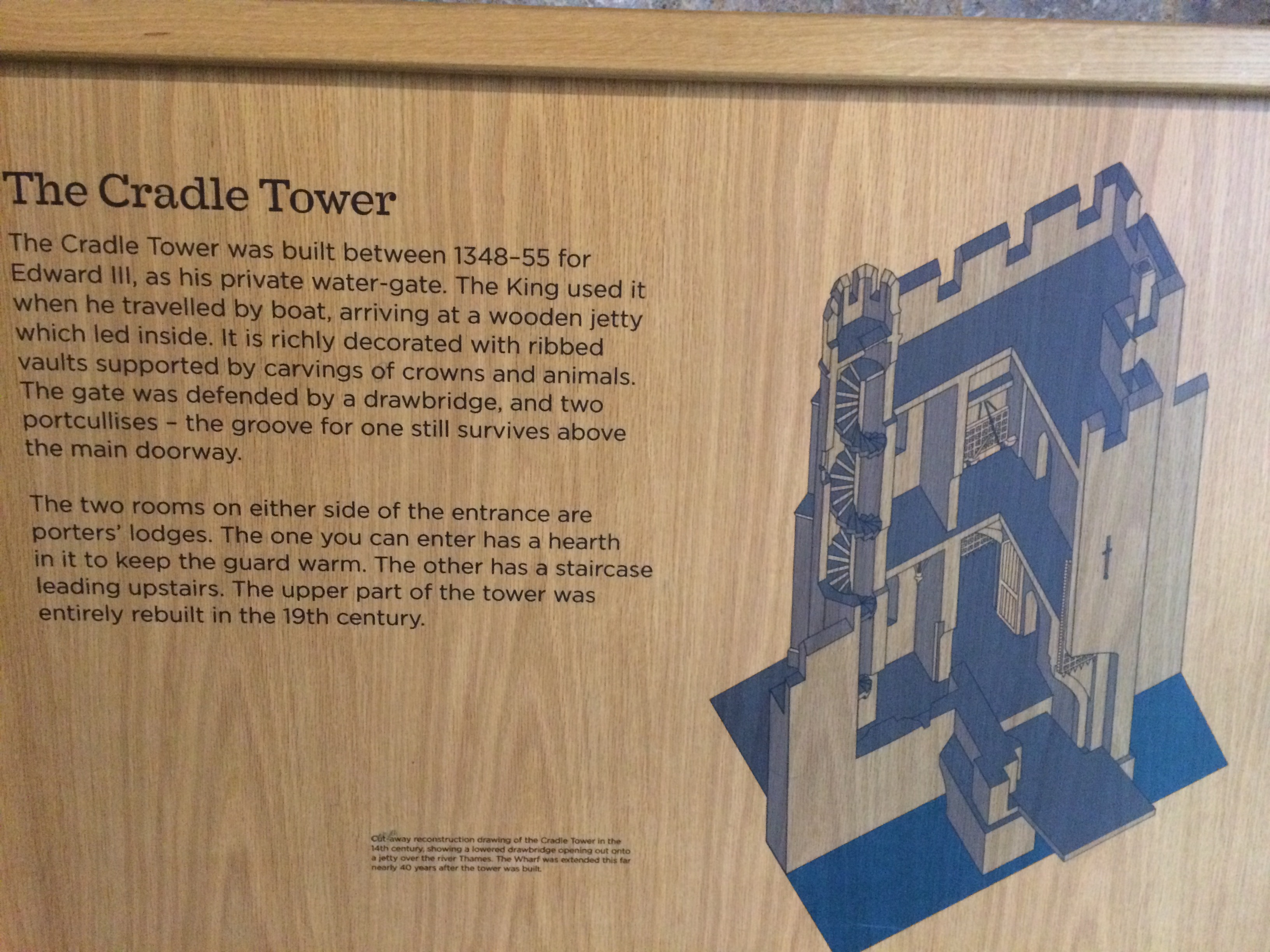
A special entrance at the Tower of London. I remember seeing the fireplace in the side room and being rather jealous because it was cold and soggy the day visited.

Additionally, this would bolster the morale of the fighting men, who were presumably conscripted for the duration of the war.  Under this assumption, and unlike America’s modern tour-of-duty system, the soldiers stationed on the frontier at Judea would not see their families until their release at the end of the war.  The pragmatic solution of bringing the families along not only bolstered morale,[3] but also solved the manpower problem that plagued the Nephite nation (Alma 58:8; 51:11).

The brevity of the text excludes definitive statements, but another possible explanation for the verse is the transfer of loyal soldiers and their families to the frontier as anchors.  The Han Dynasty in the first century B.C. established military colonies to protect their frontier and reduce logistical burdens by establishing local farms.[4] Caesar and other early Emperors of Rome granted land bonuses upon the retirement of their soldiers.[5]  These soldiers would gain the chance to become local magistrates, and their sons could become patricians and senators.[6]  In return, the central government knew that their frontiers contained a greater number of demonstrably loyal citizens capable of organizing and leading local militias in the defense of the Empire.[7] In the case of the Romans these military colonies were a short lived phenomenon in the late Republic until the rise of more limited garrison soldiers in the late 4th century.

In the case of the Nephites, they desperately needed more soldiers in the theater, and there is evidence that they needed more loyal soldiers, as well.  The war chapters in this section of The Book of Mormon are replete with references to subversive elements and anti-war factions (Alma 43, 48, 51:13, 53:8-9).  In this theater, Mormon also mentions how the enemy gained advantage through “intrigues” on the Nephite side.  Thus it is believable that the central government and Moroni sought to bolster a faltering theater with a relocation of loyal soldiers and their families.  After the relocation of these soldiers, the Nephite commander felt they were prepared with the addition of these reinforcements.

Women in Combat:

Women and children performed a strategic role in forming armies or defensive colonies and increasing morale as well as lowering the monetary cost of warfare. They also had a close physical and functional relationship to the army for protection and supply. Historically, the breakdown of the front, and particularly the fighting in cities led to women being involved in combat. The Book of Mormon doesn’t record women’s role in combat, but it is still likely, especially in urban combat, or in the camps following the rout of the army.  For example, the absolutely horrific account of murder, rape, and rampant cannibalism in Moroni chapter nine helps explain why it sounds as though women and children were included in the army when the Nephites made their final stand (Mormon 6:7).  In the abyss of destruction found in Ether 14, the last verse says that “the loss of men, women and children on both sides was so great that Shiz commanded his people that they should not pursue the armies of Coriantumr” (Ether 14:31).[8]  Again, the women and children seemed to be included as an integral part of the army. In crusader cities under siege women were recorded as manning the wall with a pot as a helmet.[9] (Some scholars suggest the strange headgear highlighted the otherness of women fighting in a traditionally male domain.) The women normally filled a role as water carries and boosts to morale.  Ancient Greeks women and slave would hurl stones and boiling water to kill invading soldiers.[10] Again, note the nontraditional weapons. The women present in crusading camps often faced the enemy when the army was defeated and fled.  One account includes a camp follower killing a soldier with a knife.  The Muslim victim being killed by a woman was used by writers to make the enemy seem less manly and the knife implied a cooking instrument and not a weapon.[11]

While women helped morale and likely performed vital functions and even fought, the concept of military colonies may have hurt the soldiers and ironically put the women and children in danger.  Again, an example from Roman history might help. Towards the end of the empire the government made the distinction between the frontier soldiers and a mobile reserve. Though there are significant problems with relying upon the mobile reserve. The logistics needed to support an army that big means they were fairly spread out, by the time they mobilized and marched to the frontier their enemies would have had as much as 3 months to complete their objectives and withdraw from Rome’s counter strike.
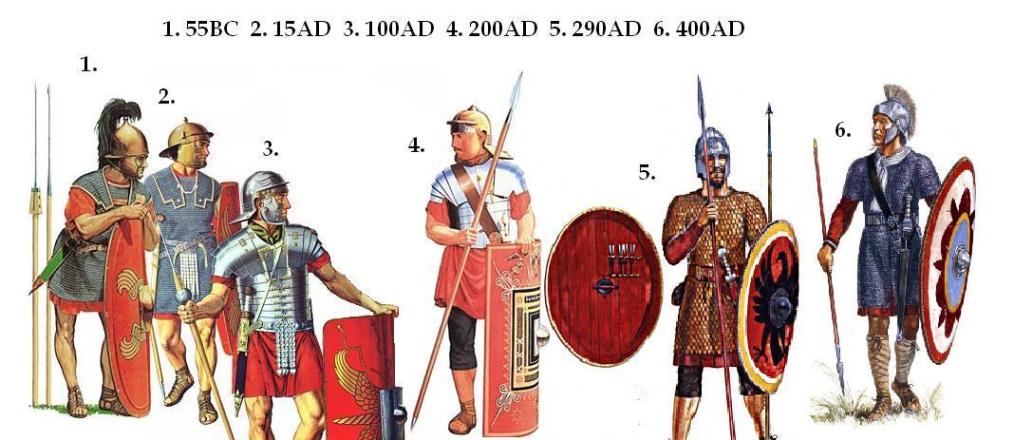
Roman armor
Evolution of Roman arms and armor.
The forces on the frontier had different problems. They were often regarded as secondary soldiers. In a strategy that called for a delaying action by frontier forces followed by a reprisal by the central army, the frontier forces weren’t expected to win which helped cause dangerous declines in quality. Helping this decline according to some scholars was the farmer soldier model. In order to ease the burden on the state soldiers often grew their own food, ran small businesses, and even became land lords. The basic premise is that every moment that soldiers spent farming, tending their herds, or otherwise engaged in business was time that they couldn’t spend honing their war making skills such as being able to operate in large formations or effectively use their swords. (Though the weapons and armor had changed by the late period.) Then the less effective soldiers would not be able to defeat armies in the field, or keep them beyond the borders of the empire, requiring women in camps and city walls to fight. I’m not sure how much I agree with this. Many military skills are like riding a bicycle, and most soldiers throughout history weren’t full time. Rather they were part time soldiers with military skills drawn from farms.

The inclusion of women and children in Alma 56: 28 is extremely curious in several ways. It suggests that women and children accompanied the army to the field or garrisons consistent with historical practice. This was possibly done for several reasons ranging from money to morale to help the army. But the inclusion of women and children with the armies could have hurt as well. If the army spent too much of their time supporting themselves as farmers and artisans, this would decrease their combat power. If the army failed or a city under siege the women could find themselves on the front lines and having to fight.

[Thanks for reading! I work as a freelance author. If you found value in this work please consider supporting this research using the pay pal button below.] 

**********
[1] Donald W. Engels, Alexander the Great and the Logistics of the Macedonian Army (Berkeley: University of California Press, 1978), 13.  Ross Hassig, Aztec Warfare, 64.
[2] This assumes that every soldier was married with children, which is impossible to say for certain.
[3] Engles, Alexander the Great, 13.
[4] Graff, Medieval Chinese Warfare, 29.  Lewis, Mark, “Han Abolition of Universal Military Service,” in Warfare in Chinese History, ed. Hans Van De Ven (Boston: Brill CO, 2000), 33-76.
[5] P.A. Brunt, The Fall of the Roman Republic: And other Related Essays (Oxford: Clarendon Press, 1988), 264.
[6] John Patterson, “Military Organization and Social Change in the Later Roman Republic,” in War and Society in the Roman World, eds. John Rich and Graham Shipley (London and New York: Routledge Press, 1993), 92-112.
[7] Of course, local leaders could also raise armies to support their own interests. See chapter two in Bleached Bones and Wicked Serpents: Ancient Warfare in the Book of Mormon about the breakdown of central control and the rise of private armies.
[8] See chapter one, in Bleached Bones and Wicked Serpents: Ancient Warfare in the Book of Mormon.
[9] Michel Evans, “Unfit to Bear Arms: The Gendering of Arms and Armor During the Crusades, in Gendering the Crusades, Susan Edington and Sarah Lambert eds, (New York: Columbia University Press, 2002), 54.
[10] John Lee, “Urban Warfare in the classical Greek World,” Makers of Ancient Strategy: From the Persian Wars to the Fall of Rome, Victor David Hanson eds, Princeton: Princeton University Press, 2010), 152-153.
[11]  Evans, Bear Arms, 52.

Tuesday, August 15, 2017

The Day They Came

Cross posted at Wheat and Tares. 

The villagers were enjoying the last coolness of the night before the sun rose. A gentle breeze rolled off of the ocean from their semi-permanent shelters. A few women were already beginning to grind nuts and millet to make the morning meal.  The men were stirring, ready to hunt wild pigs and speer fish to supplement the fruits and grain.

As the sun rose the first hint of danger was the barking and squawking of small animals in the village. On top of the hill, the birds suddenly flew from the tree tops and thick brush. The rustling of fleeing animals from the underbrush got louder. Once the sun has crested the hill it outlined the approaching soldiers. Their head gear added to the length of their shadows, and the sun glistened off of their new heavier armor made of glass, bone, and pieces of metal. Their swords were already in hand, and they had started to pick up the pace in their balanced ranks.

The cry went up from one of the women and the village became a scene of commotion. The women screamed for their children, or just screamed in terror. The old men stirred more slowly, sad at what they knew was coming to their village. They had warned the younger elders of the perfidy of their neighbors, just as their grandfathers had warned them.  They even received warnings from fleeing political leaders. He told disturbing tales of armies that were led by a young, angry, firebrand who it was said, often discussed his desire to seize more land and used the army to intimidate disagreeing opponents. It was said he spent small fortunes on arming them with new and heavier armor, he desired the extermination of everybody who opposed him, and he sent that army to pull down and level his opponents and seize their wealth.  And the intimidating soldiers, with heavier armor stood right in rank and file as evidence in front of the terrified villagers.

The young men in the village were moving the fastest. The soldiers marched forward with a steady crunch, swhoosh, chrunch, swhoosh and by the time the soldiers had marched to the bottom of the hill they faced a small line of young men and experienced warriors armed with swords, curved swords, and slings made out of bone, jade, obsidian. The fleet and elite warriors of the village managed to put on hide armor and thick, padded cloth armor.

The captains yelled to maintain ranks, and the chief captain yelled the order to attack, and the soldiers rushed forward with a unifying cry! The skirmish was over quickly, as the heavier and ornate armor of the army deflected the blows of the warriors. Only one of them every now and again was even wounded, while the lightly armored and surprised warriors were quickly killed and overwhelmed. The few armed with slings managed to wound a few soldiers, mainly in the legs, but it was a one- sided conflict. The defeated villagers grabbed whatever they could and rush into out the other side of the village. They fled in small groups with bits of necklace, pottery, food, and clothing.

Each family in the village had at least one small boat for fishing in the sea, and it proved useful in crossing the nearby river. The softly rushing water flowing through reeds, and the croak of frogs contrasted with the smell of smoke, screams of the wounded and dying, the mourning for the fallen and the crackling fire that soldiers had started. Those who fought the fear and the heart break to look behind them saw the rising smoke. They would never come back to what they considered their home. They faced an uncertain future among loosely related political and ethnic groups around the capital and its environs, the surviving men resolved to get revenge for their eviction and looked forward to telling their stories of woe to whoever would hear it. Maybe they would be allowed to speak from the towers…

*****
English colonists attacking the Pequot in 1636. I know this brings up imperialism and other sensitive matters, but that was not an exclusive Western, white, and modern sin. I think an argument can be made that the Nephites were imperialists as well. 


In the village the captains started organizing the consolidation. They focused their ire on a large wooden tower. It was recently built in the center of the village and the army didn’t need to guess what lies it had testified to. They just barely missed capturing that traitor and he had found a friendly audience among this group. They torched the tower immediately.  The semi-permanent structures were torn apart by soldiers. The new space would be the location of a governor’s headquarters, the first homes for new settlers, and store houses for the expected farming and hunting.  Most importantly, they would have space for a barracks. The wood could be used for new palisades on top of the planned berms around the city. The remaining individuals not quick or healthy enough to flee were held captive. The soldiers were under strict orders not to rape them, but some of them certainly leered enough to make the women and girls uncomfortable. Their last king had outlawed slavery years earlier, but the soldiers had plenty of work to do before the coming settlers, they wanted some reward and could use the cheap labor provided by the captured individuals. The captured would work in the houses and fields of the new elites and be grateful for the steady employment and lifestyle far above their current savage condition.

The chief captain sheathed his sword and took a deep breath. He examined the bustling activity and felt a surge of pride. He had sworn and oath to protect his people and continue to do so. The berm and palisade along the river would prove a solid defense against the depredations of these savages. They’ve wasted this land, and laid waste to his land for far too long. They’ve been even more restless since that traitor escaped, and he instinctively took another satisfying breath of the burning wood from the tower.  He point north and south along the river and directed the new patrols to hunt down and capture stragglers. He asked his assistant to bring his writing equipment and erect a small table. He needed to report to the Chief Governor, and make sure the new settlers arrived in orderly fashion. The security of the realm depended making this region productive…
***** 

This is a dramatic recreation of the events in Alma chapter 50 and includes elements from the war chapters in general. That chapter describes Moroni’s actions to fortify the land and expel Lamanite settlers in rather laudatory terms. Verses 18-21 actually described a Nephite golden age that happened right after these actions. As Grant Hardy described, in literary accounts the text often tries to distract a person. I thought it was interesting that the account moved away from Moroni’s actions to instead discuss how happy the Nephite’s were. But I thought a more critical look at his actions suggest this might have had negative consequences, such as a flow of angry refugees, and a confirmation of the insidious stories that Amalickiah was telling. I doubt the process of securing the wilderness areas was pleasant. They didn’t get an eviction notice with 30 days to prepare; it was likely an unpleasant and violent experience for those that experienced it. I also added some reasonable embellishments based on my knowledge of military history, the history and geography of the region, and human nature. I hope you enjoy it, I might add this to the introduction of my next book, and if I was really ambitious perhaps I would write a Game of Thrones style epic fantasy based on the war chapters. What details did you notice from the scriptures? What details do you think I should have added? Thanks for reading! 

[I work as a free lance writer. If you found value in this work please consider making a donation using one of the pay pal buttons at the bottom of the page.] 

Friday, January 20, 2017

Experiencing Battle in the Book of Mormon


I'm proud to announce my article, "Experiencing Battle in the Book of Mormon" has just been published by the Interpreter: A Journal of Mormon Scripture.  The abstract reads: Historical chronicles of military conflict normally focus on the decisions and perspectives of leaders. But new methodologies, pioneered by John Keegan’s Face of Battle, have focused attention on the battle experience of the common soldier. Applying this methodology to a careful reading of details within the Book of Mormon shows an experience in battle that is just as horrific as it is authentic.

The process took a little longer than I had anticipated. I actually thought this might come out last summer in time for the gospel doctrine lessons on the war chapters.  But it is here and ready for your reading enjoyment.

[I'm a free lance writer. If you found value in this work please consider making a small donation using one of the pay pal buttons at the bottom of the page. Thank you.] 

Thursday, March 24, 2016

What was Battle Like?

[The following is part of an article I've written that tries to answer the simple question, what was battle like for the average Nephite soldier. The whole product is too long to repeat here, and is currently under review from editors for publication. But I'm happy to produce a snippet here for you.] 

Once the opposing armies reached each other on the battlefield it followed a rough sequence of events.  Linda Schele and David Friedel suggested that Meosamerican warfare included ritualistic pre battle insults.  These activities followed an “honorable precedent” that went back 20 katuns ( about 400 years) or more.[1]  Real life battles, even as the armies were advancing, was a confused mélange that recalled the floor of the New York stock exchange, with screaming warriors bellowing battle cries, commanders attempting to shout orders, battle drums, gongs, trumpets, or cymbals, the braying of pack animals or cavalry horses, and the pounding of one’s own heart thumping in their ears, quickly added to by the screams of the dying and thousands of clashes of metal. Moreover, the rush of adrenaline triggers physical stimuli that make battle notoriously difficult to reconstruct.

“Studies have found that at least half of participants [in battle] will experience the event in slow motion, a fifth in faster than normal time; two-thirds will hear at ‘diminished volume’…a fifth at amplified levels; about half will see…with tunnel vision and black out everything not directly ahead and the other half with amazingly heightened clarity. Most individuals will suffer memory loss, while others will ‘remember’ events that never occurred.”[2] 

Schele and Freidel’s recreation of Mayan battle then fails to take into account the impractical nature of trying to understand each other during this kind of physical stress on a chaotic battlefield.[3] As other historians have suggested when examining pre battle insults, this is much more likely a stylized recreation of the account embellished far after the battle rather than a faithful recreation of events.  Some kind of pre battle yelling and insults probably did happen but instead of ritual communication between groups it was far more likely they were spontaneous outburst to strengthen the shouter’s morale and nearby comrades than any type of cross army communication (Alma 43:49-50; 3 Nephi 4:8-9). We should expect that writers with military experience such as Mormon and Moroni would avoid stylized after action accounts in favor of more realistic descriptions.


[1] Linda Schele, David Freidel, A Forest of Kings: The Untold Story of the Ancient Maya (New York: William Morrow and Company, 1990), 151.
[2] Rose, Men of War, 72-73.  
[3] Karl Friday, Samurai Warfare and the State in Early Medieval Japan, (New York: Routledge Press, 2004), 145-149.
[Thank you for reading. If you found value in this work please consider subscribing or making a one time donation below.]