Showing posts with label army composition. Show all posts

Monday, February 8, 2021

Zombie Apocalypse...Reading List


    The former high school buzzed with activity. The office now processed new recruits. The gym and its showers were the main living areas. A field of roped off areas, cots, and duffel bags filled with uniforms and scared recruits. Captain Deane walked down the hallway and the rest of the rooms were just as chaotic. Filled with supplies like the new, simple, unjammable rifles, and the lobo. The E tool handle combined with an axes hand that could take of the heads or lobotomize the zombies. He smelled a faint whiff of dinner coming from the lunchroom and suppressed a smile of Chris Farley dressed up as a lunch lady. He finally made it to the general’s lounge. Of course, he took the teacher’s lounge, which had the few nice pieces of furniture. Deane doubted he could convince the general they needed education, even while bivouacked at a school. They were scheduled to march on Santa Fe and began to roll back the zombie menace from the Mountain West safe zone in one week. Many of the kids in there didn’t even know how to hold their weapons.

    The general dismissed the officers in front of him and gave Deane an annoyed look. This starts well Deane thought.

    “We don’t have time for books.” The general said. “We are due to start marching in a week, what are you going to teach them that is so important?”

**********

    The general Raj Singh, the Tiger of Delhi showed the way to defeat zombies was a square formation that recalled British firing lines. This was a common way to increase fire. When the British failed to form their lines, such as the Battle of Isandlwana they ran out of ammunition they were overwhelmed by swarms of Zulus. Sounds like the Battle of Yonkers right sir? Or the Chinese failure at Chongqing. In contrast, a much smaller group of cooks, medics, and various noncombatants at Rorke’s Drift formed a square, distributed ammunition, and defeated a much larger Zulu force. We need to teach our small unit leaders the importance of proper tactics. By reading Herodotus, we can read a small group of three hundred Spartans held off a million Persians.  We need to learn how discipline, like the Spartans, or cooks at Rorke’s drift used discipline, holding together in a line can defeat much larger forces.

    Small unit commanders will have to make a multitude of decisions with lives on the line. If they survived this far, they already know that, but they have riflemen in the military under a US flag so what they do, and how we win the war for humanity matters. What number of casualties are acceptable when you send soldiers on a mission?  This applies to those barely adults we have sitting in the gym, but also to the civilians that happen to be near a battle. If we lure a zombie horde to our firing line like Hope, do we have a responsibility to clear out civilians from the area, even if it risks more combat deaths? At what point is it acceptable to lose a certain amount of men in calling a retreat? We will encounter civilian areas that have been under siege (see below) since the great panic and the food riots, how will we judge their use of criminals as human shields?  We will also face various warlords and LAMOEs (Last man on earth, pronounced Lame-O) out in the wild requiring us to know a variety of small unit tactics and good moral judgement. A good introduction on the subject is Michael Walzer’s Just and Unjust Wars. Walzer answers questions like should soldiers take extra risks, calling for civilians in a cellar before tossing a grenade, or flying daylight bombing missions to better aim and avoid missing military targets and bombing civilian ones. The doctrine of military necessity describes how moral standards can be set aside during times of war when disaster is a worse alternative than whatever moral sin is being contemplated. Our small unit leaders need to have a base of knowledge beyond whatever they saw in pop culture in making those decisions. Zombie war is more than shooting zombies and requires at least a basic grasp of wartime ethics.

    The sieges of these towns are incredible. We held the critical Rocky Mountain passes during the winter and cleared the mountain west. We likely won’t face another siege, but we should still be ready.  The warlords who established themselves after the government fled might surround a patrol, counterattack our bases, and the tide might turn and we face another zombie horde. I hear the one around Hero City (formerly New York) numbers in the millions. And we aren’t exaggerating like Herodotus. Unit leaders need to know how to set up a perimeter and defense, guard areas of entry, prevent against sabotage from Quislings, how to react to breaches, and how to perform zombie specific tactics like thin the herd using fire attacks. There is a chapter in Sunzi on fire attacks that is often overlooked for people waxing eloquent about knowing thy enemy. The Romans were so merciless in their attacks and sparing survivors Josephus’ account of the Siege of Jerusalem is especially applicable to a city about to fall. The most comprehensive is from Aineias the Tactician, who writes from a bevy of personal experience and focuses exclusively on how to survive a siege.

*********

    “So you see sir, we can do that reading list using the books in the library in under a week.” Deane said.

    The supply guys didn’t like it, but Deane got a room and a few hours each day for platoon leaders and above for a crash course in zombie reading.


    The above material borrowed heavily from the World War Z universe and is a fun application of military history.

Monday, May 7, 2018

Their Kingdom For a Breast Plate


My daughter was on youtube the other day, and she discovered how to go on cruises for free. As a specialist in Chinese history I thought that might be worth trying out. In the process of completing my application to be a subject matter specialist on cruises to China, and here is the point of this weird introduction, I came across a youtube video of my FAIR Mormon presentation and the comments on it. (I much prefer the written word but you can check it out here.)

Some comments are sad, some interesting, and others hilarious while most are all three at the same time, befitting social media I suppose. Someday I might address all of them, but one criticism in particular seemed really strong before I reassessed and realized that my instincts and argument remain sound. The criticism is repeated in full below and questions whether the government provided Nephite armor or if that responsibility fell on each soldier:

Where does it say that the Nephi state is paying for the heavy armor? To be sure Moroni thought it up but my reading has always giving me a sense that it was every citizen’s duty, the the (sic.) Greeks, to fund their own heavy armor so that should the need arise these citizen soldiers could mobilize and go off to war….
The source of Nephite armor is a critical piece to my argument. The argument surrounding the Nephite use of heavy armor was a 40 page chapter in my latest book, and an associated argument occupied 45 minutes at the FAIR Conference. The short version is that the Nephite need to armor their soldiers required money and changed their strategy and tactics. I hadn’t fully considered the source of the armor, and it was apparent I naturally assume the government provided it. Since my book is about reassessing our assumptions of the text that is somewhat embarrassing, but upon further examination (and examining the composition and cost of the armor along the way), I think that criticism is wrong.

The first piece of evidence came from a great know why from Book of Mormon Central. These are great write ups that answer pertinent questions by summarize existing literature on the subject.

In discussing Captain Moroni they said:
David E. Spencer…suggested that prior to this point, individual soldiers were responsible for arming themselves. This probably resulted in uneven or inadequate armor for the rank-in-file. Under Moroni’s command, each soldier was equipped with a full ensemble of protective gear, which included breastplates, arm-shields, head-shields, and thick clothing.[1]
This was good validation, but I wanted to go the primary source to see for myself.[2] I found that a close examination of the text brought more questions than answers, while at the same time reinforcing my assessment of the text. He said that armor was likely self-brought before this but introduced by Moroni at this point as part of his genius.

Spencer mentioned that the armor Morori introduced was cheap. Metal armor was unlikely probably very expensive, slow to make, cumbersome, and unsuited to the tropical climate.[3] As a result, the new Nephite armor likely didn’t contain much metal, but consisted of thick clothes with plates at specific points (head, arm, and breast are specifically mentioned by the text.) He goes on to say that it was likely rawhide, ceramics or wood and thinks that the Aztecs borrowed it. (The last part was somewhat annoying, because he said in the introduction that he was going to comment based upon his personal experience and not necessarily historical research, but then he threw out comments and pictures that strongly suggest historical connections throughout the book.)

This is where my questions come in, because I wonder about everything in the above paragraph. My research determined that the exact nature of Nephite “breast plate” is unknown. One book was particularly enlightening and I found that North American tribes used wood, shell, antlers (I really enjoyed that one,) bones, stone, cloth, stones in cloth with sand and glue, rods, skins (elk, wolf, buffalo, deer) and even tightly woven strands of willow trees.[4] Jones described “breast plates of rib bones” found in Pueblo sites for example. The Spanish noted that wooden helmets from the northwest were “as heavy as iron.” Captain Cook described a “breast plate of wood” that could stop musket balls at mid-range. So it’s possible to have heavy nonmetal armor that used thick clothing, reinforced by rigid “plates” at selected points.
Wooden armor from a Pacific North West tribe.

There are all sorts of details we don’t know which complicate definitive analysis. We don’t know the exact composition of armor, what animal(s) provided the hide (if it was hide), what was indigenous around 100 BC, and if the soldiers were supplied or brought their own. I disagree with Spencer’s analysis because the Nephites show the weaknesses that Spencer said would dissuade them from using them: expense, fatigue, availability of material. For example, even if it was just hide or leather armor, supply and demand could make it expensive. When the fur trade exploded in colonial North America the price of beaver peltscould double within a short timeframe. The Lamanites quickly adopted the same sort of armor (Alma 49:8), and initiated what some have called an “arms race.”[5] So whatever material was used was likely in high demand with two armies each of 10-30 thousand soldiers needing to be equipped.[6]

It’s true that heavy armor is impractical in many things and ill-suited to the Mesoamerican climate, but it worked well for what the Nephites needed. During the war chapters this largely included: defeating Lamanite armies in the field, fighting in and around cities (such as the plains of Nephihah 52:20), and ambushes along likely routes like Alma 43. They would be less effective after quick marches and in rough terrain. For example, Helaman blamed the fatigue of Antipas twice in two verses (Alma 56:50-51). Moroni focused on marching the Lamanites in circles while keeping his forces “fresh” (Alma 52:28, 31). In pursuing insurgents into the “mountains…wilderness,…and secret places” the Nephite army was decidedly less effective to the point of impotence (Helaman 11:25, 28-29). Heavy infantry are far more effective in massed groups. Thus, without the time to arm, equip and mass their soldiers, a mobile army of Lamanites easily slew the Nephites in “small bodies” (Helaman 1:24).

Later in Spencer’s book he compared the tendency to decide a battle in a single day to the Greek (and Western) Way of War espoused by Hanson.[7] But the Greeks were heavy infantry wearing heavy metal plates and decided the action by charging each other. I describe the use of heavy infantry on the battlefield in my book all of the advantages and disadvantages are fully present in the Hoplite. So needless to say, This undermines his idea of mobile, lightly armed soldiers with cheap hide armor.

Now that I’ve shown why I disagree with the assessment of Nephite armor, lets get back to who supplied it. Rome had armories scattered throughout the empire. In fact, Ferrill argued that it was the loss of logistical edge in terms of both men and material replacement that helped lead to their critical decline in the early 5th century.[8] The Book of Mormon strongly suggests Moroni equipped his men with armor supplied by the state. The verse in question says that that the people of Nephi, or that Moroni, had prepared his people (Alma 43:19). I’m not a grammarian but the text clearly takes pains to point out Moroni’s role in preparing his people with armor. The army “delivered” people from famine (Alma 53:7), suggesting they formed a or the distribution network for the Nephites. Finally, the revolutionary and decisive nature of the armor suggests a mass produced and distributed product that even if built using cheaper material (which would likely undermine its revolutionary impact) would have still represented a significant cost to the government.

Not to mention that transferring the cost of warfare back to the state (for supplying the armor) would represent a shift. The government has to pay for the armor somehow. The government didn’t do that because of their largess, but the crisis they were in, the forceful personality of Moroni, and likely the confiscation of land from King Men.

So what kind of infantry did the Nephites have? What were breastplates made of? Did the government supply the armor? The answers seem to be that the Nephite infantry was heavy enough to strike fear in their loin clothed enemies, and win bloody encounters where they charged each other in shock battle. Their battles were such that they recalled the clash of the heavy hoplites of ancient Greeks. The “plates“ are far less specific. But judging from the effects of the armor in battle, it was significantly more than hide armor. Judging from the effects on Nephite tactics and strategy, i.e., more success in shock battle accompanied by fatigue, less speed, and limited strategic range, along with what we know historically where the Nephites likely lived, I would wager their armor consisted of thick cloth as a base, with bones and metal plates adding additional protection in key places with arm shields on the non-sword hand. (Simply wrapping a piece of hide around the fore arm can act as padding, so hide could be a good candidate for the shield.) These pieces were not the same as a metal cuirass, but heavy enough to matter. That’s why I use the term “heavier” in my book because it operates in a space between European style heavy infantry and cloth or hide armed armies. Finally, the mass production and distribution on top of strong clues in the text makes it more likely the government sponsored this.
Notice the clothe plus additional armor for the head, chest, and non sword hand.


The increased cost of this armor and fortifications could have fueled what seemed like a rapacious government, which in turn sponsored a violent insurgency. Much like the British victory in the Seven Years War, the Nephite victory contained the seeds of their own destruction. That’s a good deal to rest on a breast plate, but that’s how amazing the Book of Mormon is.

About the title of this post: I borrowed a phrase from Shakespeare about a kingdom for a horse. In this case I wanted to show that because of its effect on the war, and possible negative effects on Nephite society after winning the war, the Nephite use of breast plates cost them their country. I also thought it had a nice ring to it.

[Thank you for reading. I work as a freelance author. If you found value in this work please consider donating using the pay pal button below.]

*********

[1] David E. Spencer, Captain Moroni’s Command: Dynamics of Warfare in the Book of Mormon(Springville, UT: Cedar Fort, 2015), 14. Alternatively, armor may have been more limited and less protective before Moroni introduced the full ensemble of armor mentioned in Alma 43:19.

[2] Ironically, I had a free copy of this book so I could provide a blurb. The irony comes because I was good enough to promote a book for Cedar Fort Press, to be placed on book shelves in Deseret Book, but neither organization wanted my books on military history. So I’m good enough to sell books for them, just not my books.

[3] Spencer, Dynamics, 27-28.

[4] David Jones, North American Arms and Armor, Shields and Fortifications (Austin, University of Texas Press, 2004), 85, 107.

[5] John Sorenson, Mormon’s Codex: An Ancient American Book, (Salt Lake City: Deseret Book, 2013), 98.

[6] I’m basing army sizes based on what seems like a decimal system described by A. Brent Merrill, and the multiple armies occurring in multiple theatres. A. Brent Merrill “Nephite Captains and Chief Captains in the Book of Mormon” in Stephen Ricks and William Hamblin Ed. Warfare in the Book of Mormon (Provo, Salt Lake City: Foundation for Ancient Research and Mormon Studies and Deseret Book, 1991).

[7] Spencer, Dynamics, 60.

[8] Arthur Ferrill, The Military Collapse of the Roman Empire, (London: Thames and Hudson, 1988), chapter 2.

Monday, February 12, 2018

Forts, Resorts and Nephite Military Strategy

The Tower of London in the 12th century, they often painted it white. 


A particular discussion of forts and strategy prompted an interesting reexamination of what I thought I knew. Arthur Ferrill writes about the Late Roman Empire:

In a situation in which the enemy can almost certainly pierce the defensive perimeter, defense in depth and elastic defense are the two most likely military responses. The idea of elastic defense is simply to seek out the enemy’s attacking force and defeat it whenever possible. But defense in depth permits limited retention of frontier territory in forts manned by small forces…Defense in depth is based on the assumption that the frontiers cannot be made impenetrable (at least not at a reasonable cost), and that attackers will inevitably succeed in piercing the defensive perimeters. Such invasions can be thwarted, however, by maintaining relatively strong forts in a fairly deep band along the frontiers and a mobile army (or several scattered regionally) within the Empire. The forts must be strong enough to withstand attack and yet not so strongly defended as to become a drain on manpower weakening the mobile army. Since the barbarian invaders of the Roman period normally knew little about the techniques of siege warfare and could not place forts under blockade for fear of being caught by the mobile army, defense was in some respects theoretically realistic. During an invasion the forts served as pockets of resistance for storing food and fodder. Later, as the mobile army coordinated its efforts against the enemy with the small defending frontier forces, supplies could be denied to the invader while they were made available to the central reserve. When situated at strategic points such forts might also hold river crossings and passes thereby impeding the enemy’s movements.[1]

What interested me about this is that everything I’ve read tends to support the Nephite strategy of a defense in depth. For example, here is Nibley’s discussion of the practice:


Moroni’s defenses were based on a series of strong points, being a defense in depth, as modern defense-lines are; beside specially placed ‘small forts, or places of resort,’ towns and cities on the line were also converted into strong points (Alma 48:8). Such an arrangement can take the momentum out of any military steamroller and slow down or stop any attacking force, no matter how formidable, by forcing it to reduce one strong place after another or else bypass the fortifications and thereby leave dangerous enemy forces in its rear to disrupt communications and launch harassing counter-attacks on invading units.[2]
Me and my daughter, Tower of London 2017. 

So far so good, Nibley provided a decent description of the chapter and compares nicely to Ferrill’s definition of defense in depth. But the only problem is that the verse that talks about a system of forts and resorts, is never really mentioned again. The strength of fortifications for some major cities such as Bountiful, and Nephihah, and Mulek are mentioned. Moroni wrote his angry letter to the government because he felt it was easier to keep those fortified cities than take them. He tried to entice Jacob out onto the plains, and needed some extracurricular climbing to secure Nephihah.

But the vast majority of the war chapters suggest something different. When the Lamanites invaded with their “wonderfully great” army in Alma 51:11, they quickly seized most of the new cities along the seashore: Moroni, Lehi, Morianton, Omner, Gid, Mulek, and in an apparent typo or a narrative that got ahead of itself, Nephihah is listed here as well (Alma 51:26, compare Alma 51:24; 59:7.) There is little strategic depth here as Teancum searched out and “met” the Lamanite army. The Nephites didn’t hold key river crossings, or have fortifications with “limited retention of territory” behind enemy lines and definitely didn’t have a “fairly deep band” of forts throughout their territory. They were relatively close to Lamanite territory, (they did call it the “narrow strip of wilderness” after all, Alma 22:27) and they had little strategic depth. In the vast majority of cases it was Nephite armies that advanced to meet an invading foe in battle. This suggests the elastic defense more than defense in depth.

There were several times that what could be described as mobile armies operated with fortresses to attack and kill armies. But the limited Nephite geography combined with lack of institutional difference between the mobile army and garrison forces (that became rather prominent in late Roman history) makes this less persuasive for the defense in depth theory.

Moreover, I’ve read that there are actually differences between refuges, strongholds (Alma 50:6), and strategic defense. What we have in Nephite society is the first two, but it’s very unlikely they had the third.[3] As David Jones wrote:


Refuges function as short-term defense and only work against an enemy without the means to linger in an area for long periods. Refuges simply have to deter an enemy from organizing an assault. A stronghold, on the other hand, must be able to withstand attackers who can maintain supply lines to the siege site. Strongholds must be large enough to protect and house a garrison when under attack. They typically possess walls, towers, and some sort of moat—wet or dry. In the “strategic systems” type of fortification, multiple strongholds connect, much like a wall, to deny enemies access over a wide offensive front…Refuges are most likely found in small-scale societies of the band or tribal type, whereas strongholds are a product of small or divided sovereignties; they proliferate when central authority has not been established or is struggling to secure itself or has broken down…Strategic defenses are the most expensive form of fortification to construct, to maintain and to garrison, and their existence is always a mark of the wealth and advanced political development of the people who build them.[4]

In short then, based on a variety of factors that include a broader examination of the war chapters, and proposed Nephite geography, and the level of society necessary to produce wide spread fortifications, the Nephites practiced something closer to what Ferrill called the elastic defense and what I called the offensive defensive. In Mormon Perspectives on War I wrote:

This strategy was used by the Confederacy during the American Civil War, permitting them to choose the locations where critical military confrontations should occur: “Then the confederacy might muster adequate numbers and resources at critical places despite overall inferiority of strength.”[5] I contend that the Nephites were successful when they adopted this strategy. They were numerically inferior and, for much of their history, “nearly surrounded” by the Lamanites (Alma 22:29). Strategically they would receive the Lamanite attack. Once the attack entered Nephite territory they would then move offensively to force a battle at the time and location of their choosing. These tactical advantages would offset their numerical deficiency and result in victory.

So What

This might seem like an insignificant detail to many people, many others might have their eyes glaze over by trying to see the difference between elastic defense and defense in depth, or the differences between a refuge and stronghold. But being precise is important. Too often people, church members, conservatives, liberals, critics, and defenders, use labels such as war monger, terrorist, and snowflake, and let those labels do the heavy lifting in the argument. Without beating up on Hugh Nibley too much, (though I do have a project that offers a much needed critique of his military arguments), he and many others used the wrong term in this case that has obscured the debate. Apologist arguments in many cases have accepted Nibley’s writings as gospel truth when those writings really needed to be critically assessed.
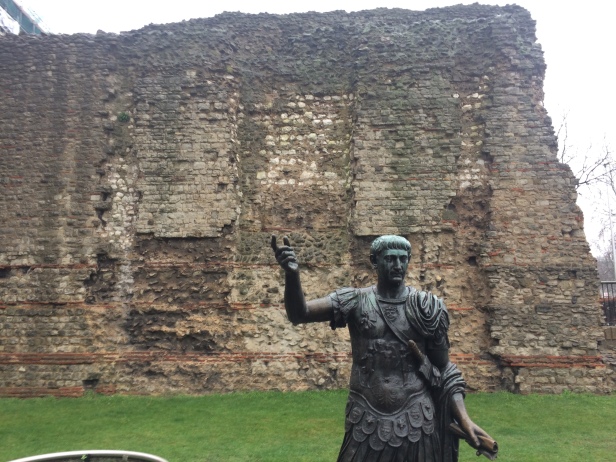
Old Roman Wall and statue of Caesar with a medieval wall built on top of it. Tower Station London. 

More importantly than being precise is how the fortifications can tell us about Nephite society. Armies don’t simply float down from the imagination of historians, but are raised, equipped, fed, and trained by the societies that field them. A stronghold defense, (the second kind of forts mentioned by Jones), correctly implies a small, struggling central authority trying to establish itself against external and internal threats.

In my next book, From Sinners to Saints: Reassessing the Book of Mormon, I often criticized Nephite leadership. One of the biggest critiques comes from the expense of maintaining fortifications and garrisons after the great war. In short, the fortifications were decisive in the war, but very few have looked at the unintended consequences of those forts. My chapter and the quote from Jones above suggest that cost of building and maintaining their strongholds led to a rapacious need for taxation and an abusive, self interested class of soldiers and government officials which fueled an insurgency and societal unrest. In plain language, the dysfunction in Nephite society seen in the Book of Helaman was caused by the reforms of Moroni during the war chapters. Jones’ analysis builds on that by providing a general rule which states that a society building extensive fortifications must be wealthy and politically complex.

This should add a great deal of poignancy and nuance to the prophetic denunciations about “getting gain” in the Book of Helaman. War is expensive, and preparing to defend against a Lamanite attack seemed to break Nephite society. (Recall the need to provide “defense at a reasonable cost” mentioned by Ferrill.) War seems like good business for some, Nephite society didn’t have ammunition supplies like World War I, but they likely had local elites that got rich off of the Nephite building programs and garrisons. The government needed more money to pay locals, or to use a modern phrase, pay their contractors. This required more taxes which could seem rapacious enough to fuel an insurgency. The soldiers benefited from the plunder associated with warfare. And the people suffered and there are many more effects. I have hundreds of pages in my book that discuss these items in further detail, but in short, the denunciations against “getting gain” likely refer to what was the ancient Nephite version of a military industrial complex.

[Thanks for reading. I work as a free lance writer, if you found value in this work please consider donating using the pay pal button below. Thanks!] 


**********

[1] Arthur Ferrill, The Fall of the Roman Empire, The Military Explanation, (London: Thames and Hudson, 1986,) 31, 45.

[2] Hugh Nibley, Since Cumorah, (Salt Lake City: Deseret Books, 1986.) Chapter 11. Please note Nibley’s use of “as modern defenses lines go”, this is quite ironic as Ferrill says most scholars accept certain arguments about Roman defense because it has a modern ring to it.

[3] Though I write in my new book that the consequences of the war chapters were expensive forts and garrisons for them that had negative effects on Nephite society, so I feel some vindication based on this quote.

[4] David Jones, Native North American Arms and Armor, (UT Austin Press, 2004), viii-ix.

[5] Russel Weigley, The American Way of War, (Bloomington, Indiana University Press), 97. Found in, Morgan Deane, “Preemptive Warfare in the Book of Mormon,” in War and Peace in Our Times: Mormon Perspectives, (Draper, Greg Kofford Books, 2012,) chapter 2.

Friday, January 19, 2018

Let he that is without doubt throw the first spear: Tikal 378


The benefit of being a blogger and free-lance writer is that I don’t have to come up with different projects for every cap. What follows is preliminary research for my next book about battle at 400 AD. These will likely undergo further revision, though, as you’ll see, there is still plenty to debate about Tikal in 378 so I will disagree with somebody no matter what the final form looks like. For a brief primer I would the this page, especially rulers 14-16. For its place in apologetics you might consult this article.

The first part of this post examines pre battle insults, the second part examines the impact of new technology on Mayan warfare and some of the changes to Tikal’s army that remains unexamined by most scholars, and the last part summarizes the highly speculative analysis surrounding issues with Tikal, before offering a few thoughts on apologetic arguments.

Nature of Pre Battle:

Tikal 378 AD is a pivotal year for Tikal. In Mormon circles it supports the idea of a militaristic influence and expansionist warfare that could decimate entire cities. Fire is Born arrived in the city of Tikal on Janurary 16th 378 on the same day the previous king, Jaguar Paw died. He amassed the forces of Tikal to fight their rivals at Uaxactun. In the decisive victory for Tikal they conquered their neighbors, introduced a new form of warfare, and left some very ambiguous questions in the process, many of which can be aided by the use of military history.

For the sake of length I will not summarize the battle in great deal, though you might enjoy reading the dramatic recreation in The Forest of Kings, though that recreation could use the hand of a dedicated military historian. The most glaring case occurred when Linda Schele and David Friedel suggested that the Mesoamerican battlefield included ritualistic pre-battle insults. These activities followed an “honorable precedent,” as far as the written sources say, that went back 20 katuns (about 400 years) or more.[1] Yet a study of historical battlefields finds these behaviors unrealistic. Real-life battles, even in the early stages of the conflict, were a confused melee of screaming warriors bellowing battle cries; commanders attempting to shout orders; battle drums, gongs, trumpets, or cymbals; the braying of pack animals or cavalry horses; and the pounding of one’s own heart. This noise had to be processed or understood by those likely wearing helmets or head gear that limited hearing. The records describing the battle of Tikal don’t mention all or many of these specific things, but logic insists that battle amongst thousands of people would be a noisy affair — and the early battle sounds would be quickly added to by thousands of clashing weapons and the screams of the wounded and dying. Moreover, the rush of adrenaline triggers physical reactions that make battle notoriously difficult to understand for those participating in it.

Based on the analysis of the chaotic and loud battlefield then, Schele and Freidel’s recreation of Mayan battle fails to take into account the impractical nature of trying to understand each other during this kind of physical stress on a chaotic battlefield.[2] As other historians have suggested when examining pre-battle insults, this honorable tradition is more likely a stylized recreation of the account embellished long after the battle rather than a realistic recreation of events. The battle between Tikal and Uaxactun did include some verbal chanting, but instead of ritual communication between groups it was far more likely they were prearranged outbursts with some elements of spontaneity to strengthen the shouter’s morale and that of nearby comrades.

During the Battle

My next book focuses on the connection between armies and the society that creates them. This is especially important in considering why the Battle of Tikal in 378 was so important. After the embellished account of pre battle ritual insulting the two sides clashed. According to the most detailed account of the battle, initially the forces of Uaxactun pushed back Tikal’s military. The sides then separated, and that’s when Tikal forces debouched from the tall grass flanking the enemy army. Armed with hunting weapons like the spear thrower (atatl) and green obsidian tipped blows darts, apparently the first time adapted to the lowland battlefield, they had a devastating effect that killed the best warriors of Uaxactun, and drove the enemy army back to their capital. These changes had several implications about the changing nature of warfare that simply focusing on glyphs would fail to assess.

Generally, the skill required of a weapon and form of combat limits the number of participants in that form of combat. Elite warriors and possible members of military orders, fighting another elite warrior required a certain amount of skill and training which in turn limited the amount of warriors an army could field. Ross Hassig showed in detail the complicated way that warriors faced off with other warriors. Even though it was Aztec warfare, the weaponry and goals are familiar enough to glean specific details about the skill and danger required in hand to hand combat among elites.

For example, in striking their opponent, the obsidian tipped swords embedded in wood had a difficult time cutting through bone. Since the warriors aimed to capture, and the swords had difficulty with bones, they likely aimed for the fibula of the lower leg, which was thinner, likely covered by less armor, and happened to be the most broken bone found in ancient battles. (My daughter’s friend showed up to school in cast because she broke that bone falling off her scooter.) Yet even though it’s incredibly painful and would temporarily incapacitate an opponent, the captured enemy with a broken or damaged fibula could still walk back to meet his gruesome fate in the ball courts or pyramids.

Yet instead of using a weapon that required training, expert parries and even targeted blows at a specific part of the body, the new weapons in this battle were so easy to use that the militia and commoners used them. The mass of elite infantry in front of them made relatively easy targets as well. The spear throwers and darts had greater range, accuracy, and penetrating power than regular throwing spears. This meant that Tikal could field a larger military with a smaller population in quicker time. They didn’t have to spend massive amounts of time and money training an elite military class (that their population probably couldn’t support anyway). Tikal could lose the first part of the battle where their warriors were pushed back, but win the second part because they massed an untrained population that could strike from a distance at an opportune moment.

Long term, Tikal could likely rely on its militia of spear throwers to give them an edge in battle against their enemies. It’s unclear how long this advantage lasted and likely didn’t last for long. In the short term Fire is Born is attested by monuments at Uaxactun, on the monument to the new ruler of Tikal (see below), and in several other nearby cities. Tikal entered a long silence from the late 6th to late 7thcentury that suggests a period of subjugation and weakness. But it is a very generous inference to say that some spear throwers gave them a 200 year advantage. As a matter of survival other powers would quickly implement the new equipment and tactics unless two factors prohibited it: Some kind of cultural prohibition against it. But the Star War ideology and spear thrower iconography became a dominant feature of Classic Maya, so that is unlikely. Or it was technology that was remained a secret, but the spear throwers weren’t a secret, it was their aggressive and unexpected use that made the difference.

In short, Tikal likely gained only a short term advantage from changing both weapons and tactics. The consequences of those changes- the larger military made possible by slightly different tactics as well as the additional prestige and income from their conquests, combined with the vigorous leadership of Fire is Born resulted in a roughly 40 year advantage.

I’m pleased to add that after I wrote the above analysis George Cogwell wrote this and he seems to agree with my anlaysis: I see such success as results of new tactics and more discipline units, possibly new weapons such as atlatls, probably the demographic strength to put more men in the field [though he posits a larger army based on a larger population, not a large army based on simpler weapons and tactics as I argue]…[and] a few exceptionally skilled leaders.[3]

After the Battle: Limitations of Sources

The failure to answer the question of technology implementation and the effects of the new battle weapons and tactics to change society fundamentally suggests the limits of sources in Mesoamerican studies. The glyphs on monuments are important keys to understanding and certainly better than nothing, but they are still incredibly limited. What follows are a summary of major hypothesis concerning key figures such as Owl Throwing Spear and Fire is Born, the extent of foreign intervention, and the relative use of military force in these events. They are intended to show the head spinning nature of all of these conflicting theories, are will then be contrasted with the supposed “speculative,” “weak,” or “fringe,” apologetic arguments using similar sources.

First, even their pronunciations remain in flux. I’ve been using the name Fire is Born, but he was originally called Smoking Frog, and you can also call him Siyaj K’ak’, which many modern scholars prefer. (I’m a Chinese historian that hates the dashes and apostrophes of the Wade Giles system, so I gravitate towards names that keep me near the home keys.) Fire is Born is nominally recognized as the Tikal war chief but anything beyond that is debated. It’s not in doubt that Fire is Born won the battle and Tikal conquered Uaxactun.

The story begins with his arrival on the same day as the previous king’s death. But its not even clear fire is Born physically arrived from somewhere else or was even a foreigner. The glyph describing the arrival of Fire is Born in Tikal could also mean that he is “of” or from Tikal. One author suggested that Fire is Born could also have been returning from a pilgrimage to Ho’ Noh Witz, which is assumed to be Teotihuacan, but could also be a place name of a different city or one that hasn’t been discovered yet.

Alternatively a powerful king of Teotihuacan, a symbol, and a title, depending at turns on the monument and who you ask.

One of the most contested terms is Spear Throwing Owl, a glyph that originated in Teotihuacan and is assume to refer to particularly powerful king that ruled from 364-439. Fire is Born could be Spear Throwing Owl’s war chief who arrived in Tikal the same day their last king, Jaguar Paw, died. There is no battle glyph so some suggest that the ruler simply died without an heir. Yet the snakes tail entering owl eyes glyph was a secondary phrase that meant violent conquest. This was added to the glyph for arrival in other cities such as Palenque which leaves open the possibility of a violent military event that killed Jaguar Paw (or Chak Tok Ich’aak).
Curled Snout. He is notable for the spear thrower and square shield, both of which are militaristic and foreign images.

Curled Snout (or First Crocodile, Yax Nuun Ahiin I), the new ruler of Tikal installed by Fire is Born, has been called the figurative son of Spear Throwing Owl (in a supposed bid to help commoners overlook the fact that he was not the son of a last king), and called the literal son of Spear Throwing Owl. Scholars further suggest that Fire is Born had Spear Throwing Owl as a kingly title, or as part of his name. Others point out that the iconography for Stormy Sky (Curled Snout’s son), that supposedly refers to Spear Throwing Owl, don’t include an owl or spear thrower, (they argue its another bird like an Eagle and just a shield) so it could refer to some kind of kingly title or influence from Teotihuacan.

Schele and Friedel argued that Fire is Born was the brother of the last great king, Jaguar Paw. At the death of the previous king Fire is Born then appointed his nephew, Curled Snout as ruler of Tikal, and Fire is Born ruled Uaxactun as sort of an empire by family rule. Finally, “arrive” might also be a figurative sense and not refer to movement at all. Scholars postulate that Fire is Born was the head of a great house that overthrew the last king or gained power (and arrived in a sense) after his death.

Conclusion:
The limited reference to previous rulers and the martial iconography suggests a retrenchment and change in Tikal back to traditional iconography. This is not an Owl and only contains a shield, which leads to debate if this is a different way of saying the Spearthrowing Owl, or the something different.

When I was an undergraduate I was told that history is more like Swiss cheese than we normally think. It is full of holes and historians use their sources to try and fill them. The holes for Mesoamerican history and this event in particular are bigger than most. When your head stopped spinning from the previous section you likely noticed the significant questions pertaining to the identity, role, origin, and accomplishments of pivotal figures in Mayan history, and interaction between various groups. If you had trouble following the previous section and all of the conflicting theories, its okay because that was my point. The analysis that tries to solve these problems is so speculative and based on so little data that there are wildly different theories that interpret them.

After reading about the wildly different interpretations, analysis, and conclusions, as well as the obscure grammatical debates that come from a very small set of incomplete stelae, I am even more convinced that apologetic arguments, particularly those about Mesoamerica, are dismissed because of a prioribeliefs that historicity of the book is laughable, and not because the arguments are inherently weak.

John Sorenson presented a case that place Book of Mormon people in history with Mormon’s Codex. Off the top of my head it includes the sudden absence of white sculptures in highland Guatemala, the two different building materials suggesting two different ethnic groups building a temple in Santa Rosa, the sudden building program around 75 BC in the same area, the volcanic eruptions around 50 AD, and the sudden depopulation of Chiapas in the early terminal classic followed by new and different settlements, are all arguments that take incomplete data, apply the same scholarly methods, and come up with conclusions just as strong as the argument Spear Throwing Owl is mentioned in a glyph that doesn’t contain either a spear thrower or an owl. This point is debatable, but if I adopted the same tactics as critics of apologists, I would say they are grasping at straws, demand more proof, claim the argument doesn’t really show anything, question the scholar’s credentials and character, and insist upon peer review for every minute point, but never actually say why the argument is wrong. Then I would copy and paste a list of objections to the argument from Wikipedia, call it a sincere letter, let it go viral and then become a professional copy and paster. As you might have guessed, I think more study of limited data is important, even if different conclusions are reached, I just wished critics would allow arguments in favor of a historical Book of Mormon the same courtesy.

[Thanks for reading. I work as a free lance author, if you found value in this work please consider donating using the pay pal button below.] 

********

[1] Linda Schele and David Freidel, A Forest of Kings: The Untold Story of the Ancient Maya (New York: William Morrow and Company, 1990), 151.

[2] Karl Friday, Samurai Warfare and the State in Early Medieval Japan, (New York: Routledge Press, 2004), 145–149. While modes of battle aren’t the same between Samurai and Mesoamerican peoples, the important points are the practice and effect of pre-battle insults, as well as the general chaotic nature of the pre-battle phase and the effect it had on participants.

[3] George Cogwell, “A Perspective From Outside the Maya Region,” in The Maya and Teotihuacan Geofrrey Braswell, ed. (University of Texas Press, 2003,) 331.

[4] Maria Ponce De Leon, “Problematic Deposits and the Problem of Interaction: The Material Culture of Tikal during the Early Classic Period” in The Maya and Teotihuacan Geofrrey Braswell, ed. (University of Texas Press, 2003,) 192.

Friday, January 5, 2018

Ma$ter$ of War or Non Cent$?

Ron Madson is a popular peace advocate and writes at the Mormon Worker. We’ve bumped into each other at conferences and each have dueling chapters in the same book. At the Mormon Worker he wrote a piece called Ma$ter$ of War. My eye was attracted to it because, and I swear, my first hope was  this was some random post about the latest expansion to Lords of Water Deep, a cool ability in the Big Trouble in Little China table top game, or forgotten classic by Avalon Hill.  Instead, it was a long argument against warfare.  I invite you to clink the link on the Mormon Worker and read for yourself as I won’t quote much. But I will respond to the major arguments he made about the financial waste of war, and what seems like, upon initial inspection, a convincing moral case against war.

Problems in the Numbers Game
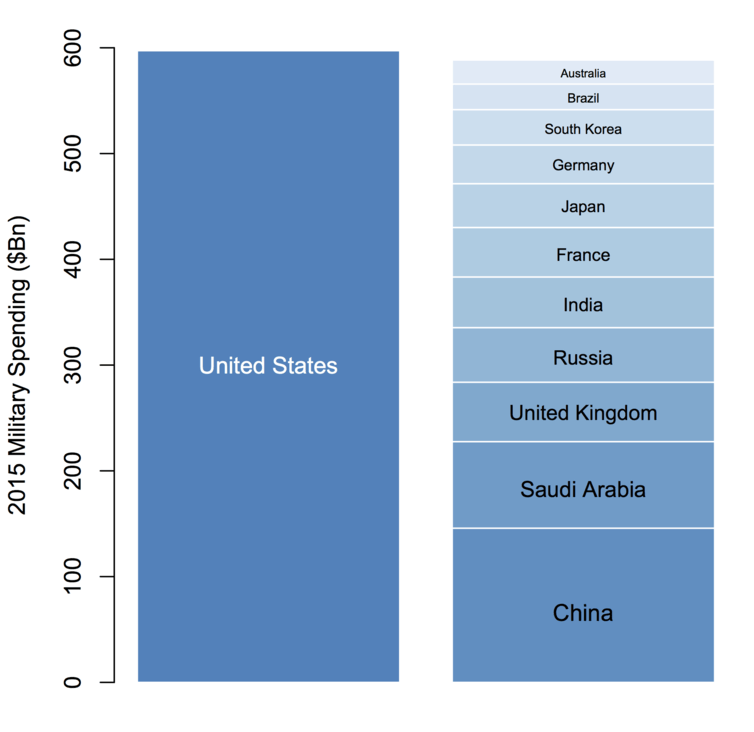
American Spending

The first major flaw concerns defense spending. Madson offers an infographic that shows a giant bar graph of American defense spending, followed by the next 7 to 11 countries combined (depending on which chart is used.) Yet the problem is that many countries likely misreport their spending.  Just with China there is considerable evidence of cooking the books. Sinologist June Teufel Dryer for example estimates that Chinese spending is much higher based on several factors.[1] She points to complaints of province leaders feeding and housing soldiers to argue that the Chinese don’t report many of their personnel costs, such as housing and food. She argues that the cost of their nuclear weapons program, which is rather large, and the cost of their weapons acquisition programs are not included either.

The low range of the reconfigured Chinese budget is 30-40% higher than what the Chinese report. The high range of estimates would place their budget as much as ten times higher. The median derived by most analysts suggests a military budget three to four times their disclosed amount. Using the amount China admits to (144 billion in military spending in 2015) and then multiplying by 4 (the amount that most analysts suggest) would place China roughly equal with the US in spending. And considering the low cost of living, that money can sustain a much larger military than it can in the United States.

The Problem with Spending

More importantly, Madson’s arguments assume that threats are simply a function of math. As though there is some sort of theme park cut out with his hand out that says, your spending must be this high in order to be safe. If that were the case then mathematicians and accountants would be the generals. More important than just the amount of money spent, is how the money is spent, the way soldiers and systems are deployed, and then the way they are led in combat.

Military analysts contend that America doesn’t need more spending that what it does not to meet its threats. They simply have to better use what they currently have and spend. For example, since we already mentioned China, America regularly conducts Freedom of Navigation patrols in the South China Sea. These stress the importance of international law which is needed to counter the use of brute force to seize disputed territory.  American forces have upgraded their anti-missile defense by doing such things as upgrading the radar on Aegis ships, and networking the advanced sensors on the F35 with anti-missile firing platforms. Yet to meet the threats from China the air and naval bases needs more built in resiliency. This means they need repair kits, bomb shelters and redundant communication systems.  The ships need better close in defenses such as rail guns. (Not to mention they could probably use some remedial courses in how to steer.)

Both of these are necessary to counter a Chinese strategy that relies on hundreds and even thousands of missiles, some of which that can hit Guam. In the event of war China is expected to launch these missiles at key elements of U.S. expeditionary forces such as airfields, ports, logistics hubs, and carrier strike groups.  Without the built in resiliency the US forces could be paralyzed and denied access to Taiwan, the South China Sea, or disputed islands around Japan.  China would then have a free hand in seizing key territory in what they call the “first island chain.” If successful, by the time American forces recover from the missile barrage, China would have seized the territory they wanted, and could present the world with a fait accompli similar to Russia’s annexation of Crimea.
Speaking of Russia, the geography of the Baltic members of NATO places the US in a similar problem of seizing key territory before America can properly respond. In extensive war games RAND concluded that Russia could field as many as 25 battalions within 10 days of the start of hostilities, compared to 17 for NATO. That doesn’t sound like an insurmountable difference, especially with NATO’s advantage in airpower. Using Madson’s logic then, we are wastefully spending more money than we need to. Except that current NATO forces are overwhelmingly light and would be overwhelmed by concentrated Russian artillery, missiles, and armored units. In the same war games analysts concluded that the Russians would capture Riga, the capital of Latvia, within 48-60 hours after invading.

To counter this, analysts have suggested pre supplied and forward deployed heavy battalions in the region. The armored brigades don’t represent many more soldiers than are already deployed in the region, but they will provide the key elements that force Russian heavy units to slow their advance, get off roads, and concentrate for battle, and essentially make them better targets for NATO air power. I asked over a year ago if the current NATO brigades in the Baltics are just a speed bump, and without critical adjustments that largely don’t involve money, but just a repositioning of forces and systems already in the area, they will remain that way.

This is getting a bit detailed, but I wanted to show the reader that matters of budget, strategy, and force structure matter just as much, if not more than simple screeds against spending money. The US faces real threats from a resurgent and aggressive China and Russia. Both of whom often cook the books to distort their massive military spending, and which have upgraded key forces such as missile technology that can stun the US into inaction through a massive surprise attack.

Problems with Morality

So far, I’ve shown how numbers are not a simple measure of threat. Countries like China cook the books and allies cut their military budgets to spend on social programs, which both distort the relative amount of spending. But spending money takes away from valuable social programs that help lives when the military just take lives. According to Madsen, we’ve been terrorists nonstop since 9/11.  There is significant debate about the efficacy of social programs and their solvency, and perhaps I’ll address that in another post, but here I want to discuss the misuse of the word terrorist, and offer a brief word concerning morality in warfare.
Manson

I discussed this in far more detail back during the Bundy fiasco.  But the short version is that terrorism is used far more for its pejorative and emotional value than its clinical description. Its very popular to repeat the cliché that one man’s terrorist is another man’s freedom fighter. In the sense that words themselves are weapons, this is entirely true.  Various revolutionary groups, terrorists, and the governments that oppose them can use the terms to either bolster their position or undermine their opponents.

Yet, despite the manipulation of words, and despite some of the disputes over the definition of terrorism, it’s still entirely possible to tell the difference between a freedom fighter and a terrorist.  Items such as the donning of uniforms, discrimination between military and nonmilitary targets, discernment against or deliberate targeting of civilians, and declarations of war from recognized heads of state, makes it very easy to distinguish between George Washington and Abu Al Baghdadi. There is some overlap between insurgents and terrorism, but its not nearly so indistinguishable as the purveyors of the cliché would lead you to believe.

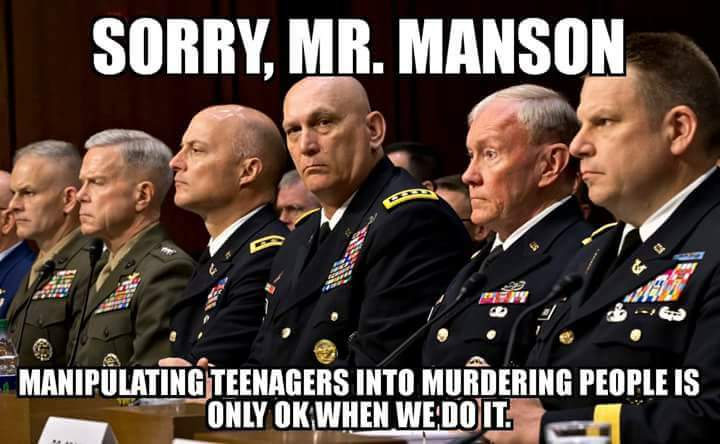
Manson had a cult of personality that viciously and randomly stabbed people, including a pregnant women, while walking on the street. A soldier, wearing a uniform, in a constitutionally declared war is ordered into combat against other soldiers. This makes the morality of killing far different between the two.  Even saying that, America rains death from above which is still horrible right? Yet killing a civilian by accident is different than deliberately targeting him or her. If they happen in the course of legitimate acts of war and the direct intention is a morally acceptable military target, then unintentionally killing civilians is within the realm of just war. That is still tragic and a horrible loss of life, but not a war crime or terrorism.[2] The public could reasonably ask if the military should have been more cautious, and used better judgement (not to mention aim) during the situation. But the military already works hard to have precision weapons that only hit their intended target, they assess targets and before they bomb in built up urban areas (such as the recent Battle for Mosul) they assess potential civilian loss. Even after all of these precautions, civilian lives are lost which doesn’t make it terrorism.

To make matters even more difficult, ISIS and other groups deliberately cloud the situation by militarizing nonmilitary targets such as hospitals and schools, and then trying to shield military targets with civilians. (The deaths of civilians in the latter case would be a war crime on the part of those using the human shields.)[3]  This complication makes it more than “the US is evil for killing civilians or bombing a hospital,” because bad actors deliberately muddle the distinctions between acceptable and unacceptable targets. Moreover, like the hands up, don’t shoot narrative, (which was the lie of the year,) the supposed victims of these air strikes wale to the nearest reporter with an often tendentious narrative, which is then tabulated by anti-American NGOs and repeated by people like Madson.

In short, the context of fighting a war makes American actions legal, civilian losses are strenuously avoided, but often accidentally happen; despite being unintentional consequences of just warfare they are often exaggerated by American enemies to anti-American sources by the very people who criminally muddled the distinction between military and nonmilitary targets and put civilians in harm in the first place.  Madson magnifies rare American misdemeanors and ignores the frequent felonies from bad actors.

Conclusion

I’ve provided a sober assessment of the American budget, disposition of forces, and morality of warfare (as well as my pet peeve when people misuse terrorism.) I did go into a bit of detail and couldn’t cover many other items.  But I hoped that I showed that these are complex issues that deserve more than shrill moral condemnation.

China and others cooks the books to make American military spending look overwhelming. Even if it was, money spent is not the entire sum of threats faced, but based on particular circumstances and the US faces real challenges. American forces fight justly within recognized rules of war and seek to avoid civilian casualties against a barbaric enemy that deliberately kills, rapes, and uses civilians as shields in pursuit of their savage world view.   Instead of Master’s of War, his post is more like some $hoveling Non-cents.

[Thanks for reading. I work as a freelance writer so if you found value in this work please consider donating using the pay pal button at the bottom of the page.] 
********
[1] June Teufel Dryer, Recent Developments in the Chinese Military,” A Military History of China, David Graff, Robin Higham eds, (New York: Westview Press, 2002), 285-302.
[2] Michael Walzer, Just and Unjust Wars, 153-155.
[3] Gary Solis, The Law of Armed Conflict: International Humanitarian Law in War, 320. “If civilian casualties result from an illegal attempt to shield a legitimate military objective with a human shield, those casualties are the responsibility of the side using the human shield.”

Wednesday, August 23, 2017

Abinadi as a soldier?

The Maxwell Institute has posted a series of blog posts about their summer study series. Nate Oman suggested that Abinadi could have been a soldier. The evidence is seen in several places, such as Mosiah 11:20 saying that he was among "them." But the closest antecedent was the victorious army in verse 19. There is more as well and you should go read the blog post, and I can't wait for the entire argument to appear. I think the argument is intriguing and has merit. I especially never thought something like the antecedent of a pronoun being that important. I always assumed that "among them" referred to the people. But if Abinadi was speaking among the people of course he was one of them. So there must be something more which Nate identifies.

I haven't had a chance to explore this more fully, but I thought my reading of Mosiah 15 as a Biblical type scene was pretty good too.  And of course, I'll continue to apply to these and hopefully attend one some day. (It kind of feels like destiny that I'll be accepted to the seminar that takes place in London.😉) I hope you enjoy the read.

[I work as a freelance author. If you found value in this piece please consider donating using one of the paypal buttons below.] 

Thursday, January 22, 2015

Research Grant: The Long Road to the Long March

[I'm pleased to announce I've been awarded a research grant from American Public University.  You can see last year's winners here. The following is the first part of my research grant application and outlines the need for this study and what has already been written. I also include a paragraph that discusses its importance in the classroom. The majority of the archive work will occur at the Hoover Library's Chen Cheng collection at Stanford University, and I'm very excited to pursue this research!] 
Mao Zedong is hailed in largely hagiographic terms as a result of his eventual ascension to power and victory in the Chinese Civil War.  But there is little critical examination of his early military leadership.  This study seeks to assess the military leadership of Mao and his chief military officer, Zhu De during the Jiangxi period of 1927-1934. It will determine the degree to which Mao deserves his status as a brilliant strategist.  Since the two leaders were often conflated into one person called Zhu Mao, I seek to study both the strategic and tactical planning as well as the execution of Soviet military operations to better determine the merits of their respective leadership.   Finally, since the doctrine of People’s War affects the local population I seek to examine the impact of Soviet military operations on the people of the Jianxi Soviet.   
This period witnessed Mao’s first actions as leader of a small insurgency in southern China. The years between 1927 and 1934 also witnessed several important counter insurgency campaigns by the Nationalist government and it detailed the reaction of Communist forces as well as the first application of Mao’s strategic theories.  Sinologist William Wei called this period “more or less wide open” and suggested that an examination of Mao as a military thinker is “long overdue.”[1] Many histories of the PLA start at the landmark dates of the Communist victory in 1949, the Long March of 1934, or the Marco Polo Bridge incident in 1937, and often provide little analysis of earlier periods or analyze them through the lens of later ones.[2]
Mao himself only has only has one scholarly piece assessing his leadership.[3]  Even then, the article was specifically intended as a “preliminary assessment.”  That article starts to suffer from the problems above as the author examined the broad scope of Mao’s career; with the Jiangxi period only serving as a prelude to the Long March and eventual victory. This did include a description of Mao’s poor management and often confusing directions to his generals.  My study will focus specifically on the beginning of Mao’s early military career which allows me to focus on matters that may have been condensed in the broader examination.
Zhu De only has two biographies in English.  The first by Anges Smedly, was published in 1956.[4] While the book fills an important literary gap, Smedly is more accurately described as a reporter than a scholar.  She traveled with the Red Army through much of the 30s and the book contains lengthy excerpts of oral interviews from Zhu De. She died before this book could be completed and it focuses on a personal biography more than a military history of this man.  So it is doubly important for a military historian to examine Zhu’s life.  The other book is by Shum Ki-Kwong, and it can more accurately be described as a twenty page pamphlet.[5] 
There is an unpublished dissertation that examines Zhu De’s early career and his impact on the strategic thought of the Chinese military.[6]  It remains unpublished, but provides several excellent points.  Russell’s piece is an excellent scholarly treatment of the subject and it places the development of Chinese strategic thought in a worldwide, and particularly Russian, context.  His examination ends in 1926 with Zhu De’s defection from the Republican government. Since my examination begins in 1927, it will act as a case study and test his conclusions.
Russell also stated that “[this study]…highlighted many gaps in the English language military history of China…these studies in particular need to address wars at the strategic, operational, and tactical levels…”[7]  Russell went on to claim that in contrast to the assumption of this being an early example of protracted war, “the Red Army was, in reality, a hybrid force made up of regular troops, fulltime guerrillas units, and local part time defense forces.”[8]  Thus his study introduces the idea that Communist operations in this period were not always a clear example of an insurgency campaign. But Russell’s assertion seems to understate Mao’s three phase insurgency and may overstate the clear delineations between regular soldiers and full time guerillas.  So my study will engage a debate concerning the exact composition, strategy, and tactics of the Red Army.   
Francis Grice is a teaching fellow at the Defense Studies Department at Kings College London and is studying the influence of Mao on past, current and future insurgencies.[9]  The thesis is forthcoming and I don’t have access to his conference presentations. His research so far appears to focus on the influence of Mao’s theories around the world in the second half of the 20th century. My study, in contrast, will focus on the specific development and execution of his theories in China before his eventual victory. It also contrasts his leadership and influence with that of Zhu De, and focuses exclusively on an early period in Mao’s insurgency. I expect my research will benefit from, but also challenge his thesis...
This study fits the mission of American Public University by enhancing the breadth and depth of the curriculum offered. Insurgency is a topic of immense contemporary importance, and even personal importance for the many veterans in the student body that serve(d) abroad.  China is a rising world power with relatively few programs offering basic courses on Chinese history, let alone a course that covers Chinese military history.  After consultation with Dr. Richard Hines I may teach a topical course on Chinese military history, and this research project will enhance that ability. 


[1] William Wei, “Mao and the Red Army” in An Introduction to Chinese Military History Robert Hingham and David Graff eds.  (NewYork: Westview Press, 2002), 247.
[2] See for example, Chen-hsia Huang, The Chinese High Command: A History of Communist Military Politics, 1927-1971 (New York: Praeger, 1973).
[3] Jacques Guillermaz, “The Soldier,” in Mao Tse-Tung in the Scales of History: A Preliminary Assessment ed. Dick Wilson (Cambridge, Cambridge University Press, 1977.)
[4] Anges Smedly, The Great Road: The Life and Times of Chu Teh (New York: Monthly Review Press, 1956).
[5] Shum Ki-Kwon, Zhu De (St. Lucia: University of Queensland Press, 1982.)
[6] Matthew William Russell, “From Imperial Soldier to Communist General: The Early Career of Zhu De and His Influence on the Chinese Army.” Unpublished dissertation, George Washington University, 2009.
[7] Ibid., 424-425.
[8] Ibid., 422.

Thursday, February 27, 2014

Guest Post: Lamanite Alliances, Spheres of Influence, and Historical Complexity Part II

[This is the second part of a guest post by Ryan Tanner. You can find the first part here.]

This brings us to 72 BC, when Amalickiah arrives in the land of Nephi. By this point the elite in the city of Nephi had settled on a new king. His control over the seven cities may have been very tenuous. The elements of power that must have existed in the city of Nephi would have included those who were originally direct competitors of Lamoni's father, the new elite who rose to power after the Anti-Nephi-Lehis left, the Amalekites and the Zoramites, and the interests of the six other cities in the alliance. The elites who were in control in Nephi would have been entrenched there since the days of Lamoni's father, or longer, and were currently in a semi-stable position since the Amalekite and Zoramite backed contender to the throne, Zerahemnah, failed in his bid.

The new king, whose name is never mentioned, would have been the one person holding the new alliance together. It is possible that he was an outsider, meaning he was not from the city of Nephi, but had been accepted by the elites in the city, possibly by his marriage to the queen, who as we will see later had considerable control over the city of Nephi and the elites who lived there. In effect he was acting as the glue between the seven cities, but the connection was most likely tenuous.

Under the influence of Amalickiah, with perhaps the backing of the Amalekites and the Zoramites, the new king proclaimed his intention to invade the Nephite lands. The tenuous alliance was immediately put to the test when some of the allied cities (we have no idea which ones or how many) refused and banded together under the leadership of Lehonti, who they proclaimed as their king (Alma 47:6). The power base of Lehonti must have been the Lamanites who were not under the control of the Amalekites and the Zoramites, and/or those who were not under the direct control of the city of Nephi.

Thus the new king was in danger of having his newly forged alliances come undone, but he could not attack the rebels directly because then he would have lost even more influence in the surrounding area. He was effectively in the same situation Lamoni was in when Ammon arrived in the land of Ishmael. The king could not order an attack on the army of Lehonti without risking civil war. But other influences were pushing him towards war with the Nephites, and he needed the cities and troops under the control of Lehonti. Thus Amalickiah, like Ammon, presented a way out. If Amalickiah succeeded then the king could further consolidate his power, but if Amalickiah failed then the Lamanite king could easily disassociate himself from the attack. Perhaps the army sent with Amalickiah was composed mainly of Amalekites and Zoramites, and those Lamanites that they could muster out. Thus if the expedition was a failure then the Amalekites and the Zoramites, or whoever the king sent with Amalickiah, would have been expendable allies, or at least allies that were not considered essential to the elites in the city of Nephi.

So let us reconsider the sociopolitical situation that Amalickiah was working with in and around the land of Nephi. A previously cohesive alliance of seven, or more, Lamanite cities had recently been broken up by the very public conversion of a significant segment of the ruling class to the religion of the Nephites. Certain groups, such as the Amalekites, had been exerting influence in Lamanite society for a number of years, but were still considered outsiders. Others, such as the Amulonites, had some influence, but lost it recently. The Nephite dissenter axis was recently strengthened by the addition of the powerful Zoramites, but the Amalekite-Zoramite coalition was not enough to gain control of the seven cities, perhaps due to the loss of their main candidate for the position of king, Zerahemnah.

The elites of the city of Nephi, which we suppose had had control of the surrounding area and cities for some time (i.e. a few generations), were unwilling to relinquish their positions of influence to the Amalekite-Zoramite axis, but had to balance that against the machinations and intrigue from the other six cities in the alliance. Despite the fact that the elites may not have wanted a close relationship with the Amalekites and Zoramites, they were constrained somewhat by the fact that the Amalekites and Zoramites represented the mortal enemies of the Nephites. Specifically they were the enemies of Moroni and his armies, which had entered into an alliance with the people of Ammon, that is, the one group of people that had someone who could legitimately lay claim to the title of King of the Lamanites. Thus the elites in Nephi may have been relying on their alliance with the Amalekites and Zoramites to help prevent the return of the legitimate king, backed by a Nephite army.

After the death of Lehonti, and the treacherous assassination of the king, Amalickiah was in command of an army that was most likely made up of troops from the Amalekites and Zoramites, and from the surrounding six Lamanite cities. There was apparently significant loyalty in this odd assortment of an army to the king since Amalickiah could use the death of the king to motivate his troops. Also it is an indication of the rather tenuous position of the king since Amalickiah could blame the king's murder on the king's own servants and people would believe it. Perhaps his reasoning was somewhat along the lines of, "The servants must have been agents of Anti-Nephi-Lehi who remained in the land to kill the king." Thus giving the Lamanites another reason to go along with the war against the Nephites and their new allies, the Anti-Nephi-Lehis.

At this point the city of Nephi is surrounded by a Lamanite army that most likely was not made up of men from the capital city, that is, the city was not their home and they would have no objection to sacking the city. The army may also have been looking for some sort of payment and the capital city may have been a tempting target. Also the army may have contained troops from the Amalekite-Zoramite coalition which were not Lamanites and would have no problem with inserting themselves into the Lamanite power structure.

So in this rather explosive situation the queen of the Lamanites asks Amalickiah to "spare the people of the city", invites him to come into the city, accepts the evidence of the king's murder, and in a move that allows her to maintain the independence of the city and its elites, while preventing the sack of the city, and the potential takeover by the Amalekite-Zoramite coalition, while at the same time not giving preference to any one of the many Lamanite groups that were vying for power, she agrees to marry Amalickiah and bring about a quick end of the recent difficulties. Her ability to maintain her position is evident by the fact that after Amalickiah dies in the subsequent war his brother must return to the city of Nephi to report on his death and consolidate his power before returning to the battlefield.

For the other competing groups Amalickiah represented an acceptable candidate for king. The Amalekite-Zoramite coalition would have accepted him as a fellow Nephite dissenter who was opposed to the expansionist policies of Moroni. The Lamanites from the other six cities would accept him because he was not from the Amalekite-Zoramite coalition, or from any of the seven cities. Thus he would not upset the new balance of internal power among the Lamanites who had to reorganize their power structures after the flight of the Anti-Nephi-Lehis. He was also opposed to Moroni, and Moroni's new allies the Anti-Nephi-Lehis.

If we look at Amalickiah's rise to power in this context we see that there were many competing and complex interests at work. For all these competing and complex interests Amalickiah represented the ideal compromise. Even though he was not their man, more importantly he was no one else's man. In a society that had just four years before gone through a major upheaval, Amalickiah was the one man who could be everything to everyone and not disturb the new and still unsteady power structures. Sometimes we forget or do not account for the impact that Ammon and his brothers had on Lamanite society and power structure. It was only four short years between the flight of the people of Ammon and the arrival of Amalickiah in the land of Nephi. Lamanite politics and society were still in a flux and Amalickiah, rather than being a conniving fiend who duped the easily deceived Lamanites, was actually a significant stabilizing force in an otherwise unsteady time for the Lamanites. It is unfortunate that Amalickiah used, and squandered, his opportunity by perpetuating a war on the Nephites rather than building a more stable and just society.

Now a good portion of what I presented here is speculation and my own thoughts and interpretation of the parts of history that we have in the Book of Alma, but it does provide a different way of viewing the beginning of the Nephite-Lamanite war found in the war chapters of Alma. I would be delighted if others can give additional insights and commentary on this situation because I know that there are several things that I did not cover or consider in writing this. For example, some of these conflicts may have been more to do with control of trade routes, or rich mining grounds, or farmland, than simple political intrigue. So there are definitely more things to consider, but some of those we may be unable to know until we can pinpoint the location of these events and consider the archaeological evidence to give us more insight into what was happening at the time. Until then we must rely on the text to give us the clues.